Home
Class 12
CHEMISTRY
Compound 'P', C(7)H(8)O is insoluble in ...

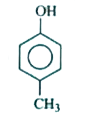
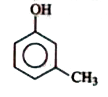
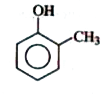
Compound 'P', `C_(7)H_(8)O` is insoluble in water, dilute HCl and `NaHCO_(3)` . It dissolves in dilute NaOH . When P is treated with `Br_(2)-H_(2)O` , it converts rapidly into a compound of formula `C_(7)H_(5)OBr_(3)` . Identify structure of :

A

B

C

D

Text Solution

AI Generated Solution

The correct Answer is:

To identify the structure of compound 'P' with the formula C₇H₈O, we can follow these steps: ### Step 1: Analyze the Solubility - Compound 'P' is insoluble in water, dilute HCl, and NaHCO₃ but dissolves in dilute NaOH. - This indicates that 'P' likely contains an acidic hydrogen, as it reacts with the base (NaOH). **Hint:** Look for functional groups that can donate a proton (H⁺) to a base. ### Step 2: Consider the Bromination Reaction - When 'P' is treated with Br₂-H₂O, it converts to a compound with the formula C₇H₅OBr₃. - The addition of three bromine atoms suggests that 'P' likely has a phenolic structure, which can undergo electrophilic aromatic substitution. **Hint:** Think about how bromine reacts with aromatic compounds and the positions where it can add. ### Step 3: Identify Possible Structures - Given that 'P' has an acidic hydrogen and can react with bromine, it is likely a substituted phenol. - The presence of a methyl group (CH₃) suggests that 'P' could be a methyl-substituted phenol. **Hint:** Consider the positions of the methyl group relative to the hydroxyl group (–OH) on the benzene ring. ### Step 4: Determine the Position of the Methyl Group - The methyl group is an electron-donating group, which affects the reactivity of the aromatic ring. - For bromination to occur at the ortho or para positions, the methyl group should be positioned in a way that does not hinder the electrophilic attack by bromine. **Hint:** The meta position for the methyl group would allow bromination to occur at the ortho and para positions without interference. ### Step 5: Conclude the Structure of Compound 'P' - Based on the analysis, the structure of compound 'P' is likely 2-methylphenol (also known as ortho-cresol). - The bromination of 2-methylphenol would lead to the formation of 2-bromo-4-methylphenol, which fits the formula C₇H₅OBr₃. **Hint:** Verify the final structure by checking if it matches the molecular formula and the reactivity described. ### Final Structure The structure of compound 'P' is: ``` CH3 | C6H4 - OH ``` (2-methylphenol or ortho-cresol)

To identify the structure of compound 'P' with the formula C₇H₈O, we can follow these steps: ### Step 1: Analyze the Solubility - Compound 'P' is insoluble in water, dilute HCl, and NaHCO₃ but dissolves in dilute NaOH. - This indicates that 'P' likely contains an acidic hydrogen, as it reacts with the base (NaOH). **Hint:** Look for functional groups that can donate a proton (H⁺) to a base. ...
Promotional Banner

Similar Questions

Explore conceptually related problems

Compound A (C_(7) H_(8) O) is insoluble in water, dilute HCl & aqueous NaHCO_(3) , but it dissolves in dilute NaOH. When A is treated with Br_(2) water it is converted into a compound C_(7) H_(5)Obr_(3) rapidly. The structure of A is:

Find compound with formula C_(4)H_(8)Br_(2) How many structure of (X) are possible?

Compound (A) C_(7)H_(8)O is insoluble in aqueous NaHCO_(3) and dissolves in aqueous NaOH and gives a characteristic colour with neutral FeCl_(3) . When treated with Br_(2) (A) forms compound (B) C_(7)H_(5)O Br_(3) . The most probable structure of compound A is :

An organic compound (A) (C_(8)H_(8)O_(3)) was insoluble in water, dilute HCI, and NaHCO_(3) . It was soluble in NaOH. A solution of (A) in dilute NaOH was boiled and steam distilled and distillate was reacted with NaOH to give a yellow precipitate. The alkaline residue is acidifield to give a solid (B) (C_(7)H_(6)O_(3)) . (B) dissolves in aqueous NaHCO_(3) with the evolution of gas. Identify (A) and (B).
