Home
Class 12
CHEMISTRY
A monocarboxylic acid decolourise Br(2)-...

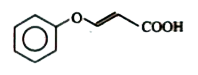
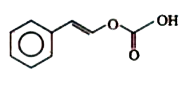
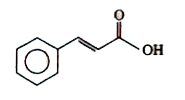
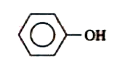
A monocarboxylic acid decolourise `Br_(2)-H_(2)O`, on heating with soda lime derivative of styrene is formed, with neutral `FeCl_(3)`, a buff coloured precipitate is formed . Acid could be :

A

B

C

D

Text Solution

Verified by Experts

The correct Answer is:

D

Reaction with `Br_(2)-H_(2)O` indicates presence of alkene and reaction with `FeCl_(3)` indicates presence of phenol.
Promotional Banner

Similar Questions

Explore conceptually related problems

P and Q are isomers of dicarboxylic acid C_(4)H_(4)O_(4) . Both decolorize Br_(2)//H_(2)O . On heating, P forms the cyclic anydride. Upon treatment with dilute alkaline KMnO_(4) , p as well as Q could produce one or more than one from the S,T and U Compounds formed from P and Q are, respectively:

Treatment of benzoic acid with Cl_(2)//FeCl_(3) will give

A and B are functional isomers of compound C_(3)H_(6)O . On heating with NaOH and I_(2) isomer A froms yellow percipitate of iodoform whereas isomer B does not form any precipitate. Write the formulae of A and B.

An organic compound (A) (C_5 H_8 O_3) on heating with soda lime gives (B) which reacts with HCN to give ( C) . The compound ( C) reacts with thionyl chloride to produce (D) which on reaction with KCN gives a compound ( E) . Alkaline hydrolysis of ( E) gives a salt (F) which on heating with soda lime produces n-butane . Careful oxidation of (A) with dichromate give acetic acid and malonic acid. Give the structures to (A) to (F) with proper reasoning.

FeCl_(3).6H_(2)O is actually:

When MgCl_(2).6H_(2)O is strongly heated, then if forms :

An aqueous solution of a substance, on treatment with dilute HCl, gives a white precipitate soluble in hot water. When H_(2)S is passed through the hot acidic solution, a black precipitate is formed. The substance is:

Compound (A) C_(7)H_(8)O is insoluble in aqueous NaHCO_(3) and dissolves in aqueous NaOH and gives a characteristic colour with neutral FeCl_(3) . When treated with Br_(2) (A) forms compound (B) C_(7)H_(5)O Br_(3) . The most probable structure of compound A is :
