Home
Class 12
PHYSICS
Show mathematically that the potential a...

Show mathematically that the potential at a point on the equitorial line of an electic dipole is zero.

Text Solution

Verified by Experts
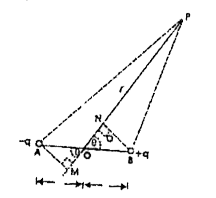
Electric Potential at any point due to an Electric Dipole : Consider an electric dipole AB having charge - 9 at point A and charge + q at point B and 2a is its dipole length. Let O be the centre of the dipole and P be any point at a distance from its centre, where electric potential due to the dipole is to be determined. Let `anglePOB=theta`.
The potential at point P due to charge -q,
and the potential at point P due to charge +q,
`V_(2)=(1)/(4piin_(0)).(q)/(PB)`
Therefore, net potential at point P due to the dipole,
`V_(2)=V_(1)+V_(2)=-(1)/(4piin_(0)).(q)/(PA)+(1)/(4piin_(0)).(q)/(PB)`
or `V=(1)/(4piin_(0)).q[(1)/(PB)-(1)/(PA)]" "......(i)`

To find PB and PA, draw BN perpendicular to OP and AM perpendicular to PQ after producing it. From right angled AAMO, we have
`costheta=(OM)/(OA)=(OM)/(a)orOM=acostheta`
In case the length of the dipole is very small as compared to distance r, then `PA~~PM=PO+OM=r-:a cos`
Similarly, it can be obtained that
`PB=r-acostheta`
In the equation (1), substituting for PA and PB, we have
`V=(1)/(4piin_(0)).q[(1)/(r-acostheta)-(1)/(r+acostheta)]`
`=(1)/(4piin_(0)).q[(r+acostheta-r+acostheta)/(r^(2)-a^(2)cos^(2)theta)]`
`=(1)/(4piin_(0)).q[(2acostheta)/(r^(2)-a^(2)cos^(2)theta)]`
Since q (20) = P, the electric dipole moment of the dipole, the above equation becomes
`V=(1)/(4piin_(0)).(Pcostheta)/((r^(2)-a^(2)cos^(2)theta))" "......(2)`
The equation (2) gives electric potential due to the dipole at a distance r from its centre in a direction making an angle with the dipole.
Special cases : Let us find the electric potential due to the dipole in the following two cases :
When point P lies on the axial line of the dipole :
In such a case, `theta=0^(@)` and `cos0^(@)=1`
Therefore, the equation (2) gives
`V=(1)/(4piin_(0)).(Pcos0^(@))/((r^(2)-a^(2)cos^(2)0^(@)))`
`V=(1)/(4piin_(0)).(P(1))/((r^(2)-a^(2)))`
`V=(1)/(4piin_(0)).(P)/((r^(2)-a^(2)))`
When point P lies on the equitorial line of the dipole :
In such a case, theta=90^(@)`. and `cos90^(@)=0`
From equation (2)
y=0
Promotional Banner

Topper's Solved these Questions

  • ELECTROSTATIC POTENTIAL

    BETTER CHOICE PUBLICATION|Exercise NUMERICAL PROBLEMS|16 Videos
  • ELECTROSTATIC POTENTIAL

    BETTER CHOICE PUBLICATION|Exercise MOST EXPECTED QUESTIONS |7 Videos
  • ELECTROSTATIC POTENTIAL

    BETTER CHOICE PUBLICATION|Exercise SHORT ANSWERTYPE QUESTIONS (2 Marks Questions)|9 Videos
  • ELECTRONIC DEVICES SOLIDS

    BETTER CHOICE PUBLICATION|Exercise Most Expected Questions|9 Videos
  • FORCE ON A CHARGE

    BETTER CHOICE PUBLICATION|Exercise NUMERICAL PROBLEMS |14 Videos

Similar Questions

Explore conceptually related problems

Derive an expression for electric potential at any point due to electric dipole. Show that the potential at a point on the equatorial line of an electric dipole is zero.

What is the direction of electric field at a point on the equitorial line of an electric dipole?

What is electric field intensity? Give its SI units. Derive an expression for it at a point on the equitorial line of an electric dipole. What is field, when dipole is short?

Derive an expression for the electric potential at a point along the axial line of an electric dipole.

