Home
Class 12
PHYSICS
Define drift velocity of electricity and...

Define drift velocity of electricity and establish its relation with velocity of the electrons and the intensity of applied electric field.

Text Solution

Verified by Experts
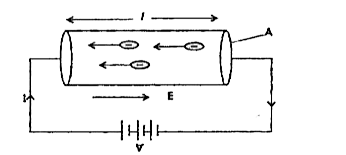
Drift velocity may be defined as that velocity with which a free electron in addition to its random motion gets drifted under the influence of an external field through the body of the conductor.
Relation between drift velocity and electric field : When an electric field is applied across the two ends of a conductor, the electrons possessing negative charge get accelerated in a direction opposite to the electric field. Due to this acceleration, the velocity of an electron increases, but it happens so only for a short time. It is because of the fact that the electron experiences random forces due to vibrating ions in the metal. Therefore, the electron may get deflected or scattered in a wide range of directions due to the action of random forces, Suppose that such a deflection takes place once in a time ton the average, called average relaration time. The velocity acquired by the electron due to external electric field in time equal to t is called drift velocity and it is imposed on the random velocity of electrons. If E is strength of the electric field applied, then
Force on the electron due to electric field = e E
Here, e is charge on electron. If m is mass of the electron, then acceleration produced is given by
`a=(eE)/m " "...(1)`
As the net velocity of an electron due to random motion is zero and the electron is accelerated for an average time `tau` , the additional velocity i.e., drift velocity acquired by the electron,
`v_d = 0 + a tau = atau`
From eqn. (1), substituting the value of a, we have
`upsilon_(d) =(eE)/mtau`
where `tau` = average relaxation time.
Relaxation time. : The short time for which free electron accelerates before it undergoes a collision with the positive ion in conductor, is called a relaxation time.
Relation between drift velocity and current : Consider a conductor of length I and area of cross-section A.

Let V = Potential difference applied across the ends of the conductor
Let n = Number of free electrons per unit volume of the conductor
Al = Volume of the conductor
n Al = Total number of electrons in the conductor
Total charge on the conductor = q = (n Al) e ...(1)
Time taken by the free electrons to cross the length of the conductor,
`t = (l)/(upsilon_d)" "...(2)`
But `I = q/t`
`I=("nAle")/(llupsilon_d)` [Using (1) and (2)]
`I = nAeupsilon_d`
Promotional Banner

Topper's Solved these Questions

  • ELECTRIC CURRENT, RESISTANCE AND E.M.F.

    BETTER CHOICE PUBLICATION|Exercise LONG ANSWERTYPE QUESTIONS |8 Videos
  • ELECTRIC CURRENT, RESISTANCE AND E.M.F.

    BETTER CHOICE PUBLICATION|Exercise NUMERICAL PROBLEMS|54 Videos
  • ELECTRIC CURRENT, RESISTANCE AND E.M.F.

    BETTER CHOICE PUBLICATION|Exercise MOST EXPECTED QUESTIONS |14 Videos
  • ELECTRIC CHARGES AND ELECTROSTATIC FORCE

    BETTER CHOICE PUBLICATION|Exercise NUMERICAL PROBLEMS (MOST EXPECTED NUMERICALS )|6 Videos
  • ELECTRIC FIELD

    BETTER CHOICE PUBLICATION|Exercise NUMERICAL PROBLEMS (MOST EXPECTED QUESTIONS)|4 Videos

Similar Questions

Explore conceptually related problems

Establish the relation between drift velocity of electrons and electric field applied to the conductor.

How much is the drift velocity of electrons?

BETTER CHOICE PUBLICATION-ELECTRIC CURRENT, RESISTANCE AND E.M.F.-SHORT ANSWER TYPE QUESTIONS
  1. Is a wire carrying current charged?

    Text Solution

    |

  2. What is non-ohmic device? Give one example.

    Text Solution

    |

  3. If the electron drift speed is so small and the electron's charge is s...

    Text Solution

    |

  4. A large number of free electrons are present in metals. Why is there n...

    Text Solution

    |

  5. Standard resistance coils are made of which materials and why ?

    Text Solution

    |

  6. Discuss the effect of temperature on resistivity of metals.

    Text Solution

    |

  7. Why conducting wires are made of copper?

    Text Solution

    |

  8. What is the resistance of a conductor? State the factors on which resi...

    Text Solution

    |

  9. What is the difference between e.m.f. and potential diffrence?

    Text Solution

    |

  10. What are ohmic and non-ohmic resistors? Give one example of each.

    Text Solution

    |

  11. What is e.m.f. of a cell ? On what factors does its value depend ?

    Text Solution

    |

  12. Establish the relation between current and drift velocity?

    Text Solution

    |

  13. Define drift velocity of electricity and establish its relation with v...

    Text Solution

    |

  14. Obtain the condition fo rmaximum current through a resisitor, when a n...

    Text Solution

    |

  15. Define internal resistance of cell and find an expression for it.

    Text Solution

    |

  16. What is internal resistance of a cell? Derive an expression for it.

    Text Solution

    |

  17. What is internal resistance of a cell? Derive an expression for it.

    Text Solution

    |

  18. The internal resistance of a cell is the resistance of

    Text Solution

    |

  19. Derive expression for the total resistance of a circuit in which a few...

    Text Solution

    |

  20. Explain colour code for carbon resistors giving examples.

    Text Solution

    |

