Home
Class 12
PHYSICS
The magnetic field at a point due to a c...

The magnetic field at a point due to a current carrying conductor is directly proportional to

Text Solution

Verified by Experts
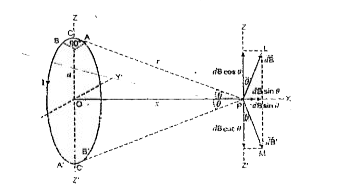
Consider a current carrying coil carrying current I.
O is the centre of the circular coil and a be its radius.
Consider a point P on the axis of this current carrying circular coil at a distance r from the centre of the coil.

Suppose AB is a small elementary portion of length`dl` at a distance r from the observation point. Every current element is perpendicular to the direction of `vecr`.
According to Biot-Savart.s Law,
Magnetic field at P due to small element AB = dB
and `dB = (mu_0)/(4pi) (I dl sin theta)/(r^2)`
`dB = (mu_0)/(4pi) (I dl)/(r^2) " " [sin theta = sin 90^@ = 1 and theta = 90^@]`
`vec(dB)` is perpendicular to the plane in which `vec(dl)` and `vec(r)` lie and is along PL which is perpendicular to PC.
Resolve dB into two rectangular components
1. `dB cos theta`, which is perpendicular to the axis of the coil.
2. `dB sin theta`, which is along the axis of coil but away from the centre of the coil.
As the coil is symmetrical about its axis, so every element of length `vec(dl)` has an equal and opposite element, for example, AB has an equal and opposite element A.B. at diametrically opposite point D. The magnetic field `vec(dB)` due to the current element A.B. has the magnitude same as that due to the current element AB but its direction is along the PM. Thus,
`|vec(dB)| = |vec(dB)|`
Both `vec(dB)` and `vec(dB.)` can be resolved in two mutually perpendicular components along PX and YY.. The y -components of the magnetic field due to these elements along YY. being equal and opposite cancel each other. Hence, the resultant of these components `(vec(dB) cos)` for the complete loop, from symmetry, is zero. Thus, only the x-component of `vec(dB) = vec(dB) sin phi` survives and this component of magnetic field due to each component of the loop points in the same direction.
Therefore, magnetic field at point P due to whole coil is equal to the sum of `vec(dB) sin phi` components of magnetic field due to each element, i.e.,
`vecB = sum vec(dB) sin phi`
or `vecB = int vec(dB) sin phi " " ...(1)`
Now, `|vec(dB)|` for the current element at P is given by :
`dB = (mu_0I)/(4pi) (dl sin pi/2)/(r^2) " " (as theta = 90^@)`
or `dB = (mu_0 I dl)/(4pir^2)`
Substituting this value of dB is eqn. (1), we have
`B = int (mu_0 I dl)/(4pi r^2) sin phi`
`= (mu_0 I sin phi)/(4pi r^2) xx 2 pi a`
as `I , phi` and r are fixed and
`int dl` = Circumference of the coil `= 2 pi a `
or `B = (mu_0)/(4pi) (2 pi Ia )/(r^2) sin phi" " (2) `
Now from right angld `Delta COP`
`sin phi = a/r = a/(sqrt(a^2 + x^2)) as r = sqrt(a^2 + x^2)`
`therefore B = (mu_0)/(4pi) (2 pi I a)/(r^2) xx a/(sqrt(a^2 + x^2))`
or `B = (mu_0 2 pi I)/(4pi) xx (a^2)/((a^2 + x^2)^(3//2))`
If there are n turns in the coil, then the strength of magnetic field at point P due to the coil will be n times the magnetic field due to a coil of single turn, i.e.,
`B = (mu_0)/(4pi) 2 pi n I xx (a^2)/((a^2 + x^2)^(3//2))" " ....(3) `
If the observation lies at the centre of the coil then `x = 0 `
From eqn. (3),
`B = (mu_0)/(4pi) (2pi n I a^2)/((a^2)^(3//2))`
`B = (mu_0)/(4pi) (2 pi n I)/(a)`
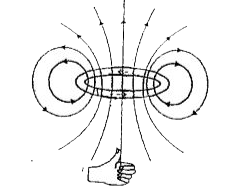
which is required expression for magnetic field at the centre of current carrying circular coil. Magnetic field due to current carrying circular coil can be shown as given aside.
Promotional Banner

Topper's Solved these Questions

  • MAGNETIC EFFECTS OF CURRENT

    BETTER CHOICE PUBLICATION|Exercise NUMERICALS PROBLEMS |3 Videos
  • MAGNETIC EFFECTS OF CURRENT

    BETTER CHOICE PUBLICATION|Exercise SHORT ANSWER TYPE QUESTIONS|4 Videos
  • MAGNETIC DIPOLES AND EARTH'S MAGNETISM

    BETTER CHOICE PUBLICATION|Exercise Most Expected Questions|8 Videos
  • NUCLEAR REACTIONS

    BETTER CHOICE PUBLICATION|Exercise Numerical Problems|9 Videos

Similar Questions

Explore conceptually related problems

With the help of a necessary diagram, derive an expression for magnetic field due to straight current carrying conductor at any point.

The magnetic field around a current carrying straight conductor is in concentric circles with the center of circle at a point where the conductor is not located. Is this statement true.

Write expression for the magnetic flux density at a point due to a current carrying wire of: a finite length?

State Ampere's circuital law. By using it derive an expression for magnetic field intensity at a point due to a straight current carrying conductor.

BETTER CHOICE PUBLICATION-MAGNETIC EFFECTS OF CURRENT-LONG ANSWER TYPE QUESTIONS
  1. Using Ampere's circuital law, derive an expression for the magnetic fi...

    Text Solution

    |

  2. Using Ampere's circuital law, derive an expression for the magnetic fi...

    Text Solution

    |

  3. Derive an expression for magnetic field at the centre of circular curr...

    Text Solution

    |

  4. The magnetic field at a point due to a current carrying conductor is d...

    Text Solution

    |

  5. State the Biot-Savart's law for the magnetic field due to a current ca...

    Text Solution

    |

  6. Derive an expression for magnetic field at the centre of circular curr...

    Text Solution

    |

  7. Derive an expression for magnetic field at the centre of circular curr...

    Text Solution

    |

  8. Write expression for the magnetic flux density at a point due to a cur...

    Text Solution

    |

  9. Write expression for the magnetic flux density at a point due to a cur...

    Text Solution

    |

  10. State Ampere's circuital law. By using it derive an expression for mag...

    Text Solution

    |

  11. State Ampere's circuital law. By using it derive an expression for mag...

    Text Solution

    |

  12. State Ampere's circuital law. By using it derive an expression for mag...

    Text Solution

    |

  13. State the rule that is used to find the direction of field acting at a...

    Text Solution

    |

  14. Using Ampere's circuital theorem, calculate the magnetic field due to ...

    Text Solution

    |

  15. What is Maxwell's right hand thumb rule?

    Text Solution

    |

  16. State Biot-Savart law. Using Biot-Savart law find the magnitude and di...

    Text Solution

    |