Home
Class 12
PHYSICS
What is magnetic dipole? Derive an expre...

What is magnetic dipole? Derive an expression for magnetic field intensity at a point on the equitorial line of a bar magnet.

Text Solution

Verified by Experts
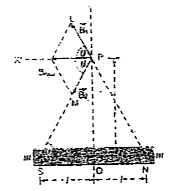
Magnetic field intensity: Magnetic field intensity at a point on equitorial line of magnetic dipole: Let we have a bar magnet NS of length 2l. O is the mid-point of the bar magnet and m is the pole strength of, its each pole. Let P is any point on the equitorial line of this bar magnet passing through O. Let r= OP= Distance of observation point from centre of the magnets. Also SN = 2l= Magnetic length of magnet and OS= ON=l
Magnetic field at P due to North Pole `= B_(1)= (mu_(0))/(4pi) (m)/(NP^(2))` along PA
In right angle `Delta OSP`,
`NP^(2)= OP^(2) + ON^(2) = r^(2) +l^(2)`
`rArr B_(1)= (mu_(0) m)/(4pi (r^(2) + l^(2)))` along PA ...(i)
Magnetic field at P due to South Pole `=B_(2)= (mu_(0))/(4pi) (m)/(SP^(2))` along PB
In right angled `Delta OSP`
`SP^(2)= OP^(2) + OS^(2) = r^(2) + l^(2)`
`rArr B_(2)= (mu_(0))/(4pi) (m)/((r^(2) + l^(2)))` along PB...(ii)

From (i) and (ii), it is clear that `B_(1) and B_(2)` are equal in magnitude
Let `anglePSN= anglePNS= theta`
Also `angleAPX = anglePNS= theta` (Corresponding angles) and `angleXPS= anglePSN =theta`-(alternate angles)
Now, components of `vec(B)_(1) and vec(B)_(2)` along Y-axis are `B_(1) sin theta and B_(2) sin theta` respectively. These two components are equal and opposite and hence, they cancel each other. While components of `vec(B)_(1) and vec(B)_(2)` along X-axis are `B_(1) cos theta and B_(2) cos theta` respectively. They act along the same direction and hence, are added up.
`therefore` The magnitude of resultant magnetic field at P due to bar magnet will be
`B= B_(1) cos theta + B_(2) cos theta`
`B= B_(1) cos theta + B_(1) cos theta (because B_(1)= B_(2)]`
`B= 2B_(1) cos theta`
In right angled `Delta OPS`
`cos theta= (OS)/(SP)`
But `SP^(2)= OS^(2) + OP^(2)` [Using Pythagorous Theorem]
`SP= sqrt(OS^(2) + OP^(2))`
`rArr cos theta= (OS)/(sqrt(OS^(2) + OP^(2)))`
`rArr cos theta= (l)/(sqrt(l^(2) + r^(2)))` ...(iv)
Use eqns (i) and (iv) in eq (iii), `B= 2(mu_(0))/(4pi) (m)/((r^(2) + l^(2))) .(l)/(sqrt(r^(2) + l^(2)))`
`rArr B= 2(mu_(0))/(4pi) (m(2l))/((r^(2) + l^(2))^(3//2))`
But m (2l)= M =Magnetic moment
`therefore B= (mu_(0))/(4pi) (M)/((r^(2) + l^(2))^(3//2))`
If observation point P is far away from the magnet ie., `r gt gt l` or we can say than when magnet is of very short length. Thus `l^(2)` can be neglected.
`B= (mu_(0))/(4pi )(M)/((r^(2))^(3//2))`
`B= (mu_(0))/(4pi) (M)/((r^(3)))`
which is the required expression for magnetic field at any point on the equitorial line of bar magnet. Direction of magnetic field at a point on the equitorial line of magnetic dipole is opposite to direction of magnetic dipole moment.
Promotional Banner

Topper's Solved these Questions

  • MAGNETIC DIPOLES AND EARTH'S MAGNETISM

    BETTER CHOICE PUBLICATION|Exercise Long answer type questions|18 Videos
  • MAGNETIC DIPOLES AND EARTH'S MAGNETISM

    BETTER CHOICE PUBLICATION|Exercise Most Expected Questions|8 Videos
  • MAGNETIC DIPOLES AND EARTH'S MAGNETISM

    BETTER CHOICE PUBLICATION|Exercise Most Expected Questions|8 Videos
  • INTERFERENCE OF LIGHT

    BETTER CHOICE PUBLICATION|Exercise MOST EXPECTED QUESTIONS (1 Mark)|3 Videos
  • MAGNETIC EFFECTS OF CURRENT

    BETTER CHOICE PUBLICATION|Exercise NUMERICALS PROBLEMS |3 Videos

Similar Questions

Explore conceptually related problems

Derive an expression for the magnetic field intensity at a point on the equatorial line of the magnetic dipole.

What is magnetic field intensity?

Define magneticfield intensity at a point. Derive an expression for magnetic field intensity at a point on the axial line of magnetic dipole with the help of diagram.

