Home
Class 12
PHYSICS
A charged particle having a mass of 1.6x...

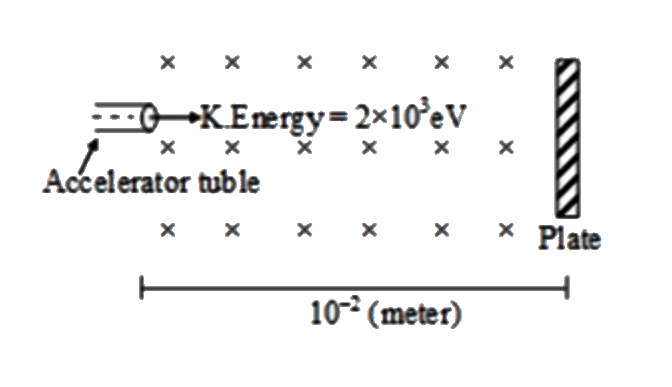
A charged particle having a mass of `1.6xx10^(-26) kg` comes out of accelerator tube with kinetic energy `2xx10^3 eV` . Calculate the smallest magnitude of the magnetic field that should be applied in vertically downwards direction to just prevent the charged particle from colliding the plate (Assume charge on particle = charge of the proton)

A

2 Tesla

B

4 Tesla

C

0.02 Tesla

D

0.04 Tesla

Text Solution

Verified by Experts

The correct Answer is:

A

`r=d " or " (sqrt(2mk))/(qB)= d rArr B = sqrt((2mk)/(q^(2)d^(2)))`
or `B= sqrt((2xx1.6 xx 10^(-26) xx2xx10^(3)xx e)/(e^(2)xx10^(-4)))`
`B= sqrt((2xx1.6 xx 10^(-26) xx 2xx10^(3))/(1.6 xx 10^(-19) xx 10^(-4)))= 2` Tesla
Promotional Banner

Similar Questions

Explore conceptually related problems

The de Broglie wavelength of positively charged particle of mass 3.35xx10^(-27) kg is 19 nm . Calculate the kinetic energy of the particle .

Calculate the charge on an alpha particle. Given on a proton =1.6xx10^(19) C .

A cyclotron is used to accelerate charged particles. Then the time period under the influence of 1T magnetic field of a proton :-

A beam of charged particle, having kinetic energy 10^3 eV , contains masses 8xx10^(-27) kg and 1.6xx10^(-26) kg emerge from the end of an accelerator tube. There is a plate at distance 10^2 m from the end of the tube and placed perpendicular to the beam. Calculate the magnitude of the smallest magnetic field which can prevent the beam from striking the plate.

The magnetic field is confirmed in a square region. A positive charged particle of charge q and mass m the limiting velocities of the particles so that it may come out of face (1), (2), (3), and (4).

Two charges particles each having equal charges 2 xx 10^(-5) C are brought from infinity to within a separation of 10 cm. Calculate the increase in potential energy during the process and the work required for this purpose.

A charged particle of mass 0.003 g is held stationary in space by placing it in a downward direction of electric field of 6xx10^(4)NC^(-1) . Then, the magnitude of charge is

A charged particle of mass m and charge q is released from rest in an electric field of constant magnitude E . The kinetic energy of the particle after time t is
