Home
Class 12
CHEMISTRY
Which one of the following compounds mos...

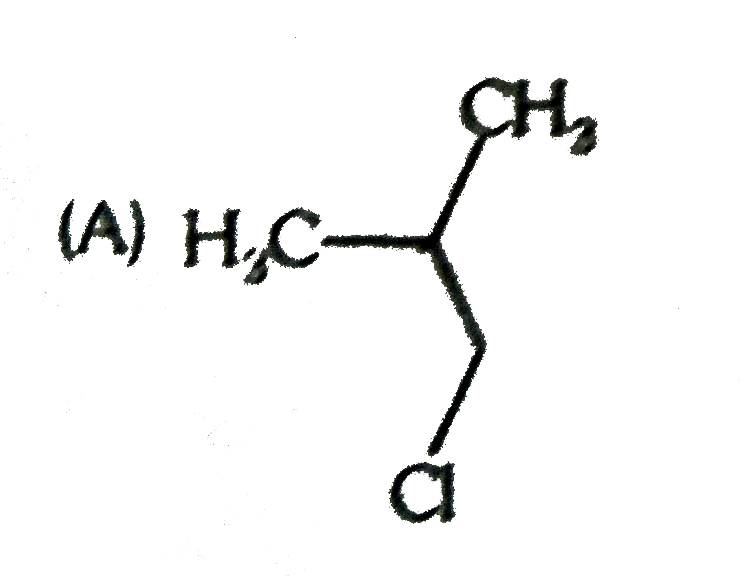
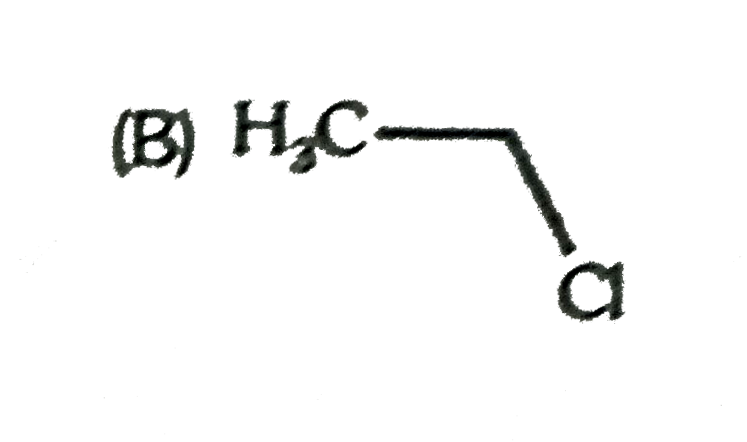
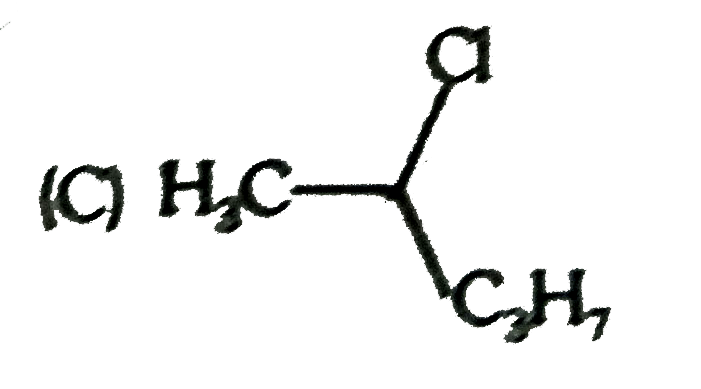
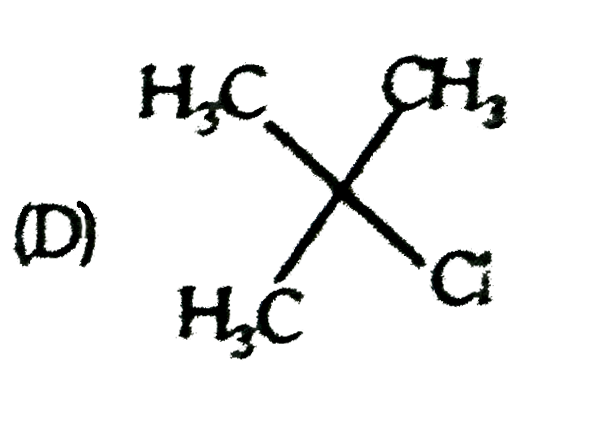
Which one of the following compounds most readily undergoes substitution by `S_(N^(2))` mechanism?

A

B

C

D

Text Solution

AI Generated Solution

The correct Answer is:

To determine which compound most readily undergoes substitution by the \( S_N2 \) mechanism, we need to analyze the stability of the carbocations formed during the reaction and the steric hindrance around them. Here’s a step-by-step solution: ### Step 1: Understand the \( S_N2 \) Mechanism The \( S_N2 \) mechanism involves a nucleophile attacking the electrophilic carbon atom from the opposite side of the leaving group, leading to a simultaneous bond formation and bond breaking. The rate of this reaction is influenced by the steric hindrance around the carbon atom that is attached to the leaving group. ### Step 2: Identify the Stability of Carbocations The stability of carbocations is crucial in determining the reactivity in \( S_N2 \) reactions. The order of stability for carbocations is: - Tertiary (3°) > Secondary (2°) > Primary (1°) > Methyl Since \( S_N2 \) reactions are inversely proportional to the stability of the carbocation, we want to favor the least stable carbocation. ### Step 3: Analyze the Given Compounds Let’s assume we have four options (A, B, C, D) with different alkyl halides. We need to analyze each compound to determine the type of carbocation formed upon the departure of the leaving group (halide). 1. **Option A**: Forms a tertiary carbocation. 2. **Option B**: Forms a primary carbocation. 3. **Option C**: Forms a secondary carbocation. 4. **Option D**: Forms a methyl carbocation. ### Step 4: Evaluate Steric Hindrance In addition to carbocation stability, steric hindrance plays a significant role in \( S_N2 \) reactions. More bulky groups around the electrophilic carbon will hinder the nucleophile's approach. - **Option A**: Tertiary carbocation with significant steric hindrance due to bulky groups. - **Option B**: Primary carbocation with minimal steric hindrance. - **Option C**: Secondary carbocation with moderate steric hindrance. - **Option D**: Methyl carbocation with no steric hindrance. ### Step 5: Conclusion Since \( S_N2 \) reactions are favored by less stable carbocations and minimal steric hindrance, the compound that most readily undergoes substitution by the \( S_N2 \) mechanism will be the one that forms a primary carbocation with the least steric hindrance. Thus, **Option B** is the correct answer as it forms a primary carbocation and has the least steric hindrance.
Promotional Banner

Topper's Solved these Questions

  • ALKYL AND ARYL HALIDE

    ALLEN|Exercise EXERCISE-02|1 Videos
  • ALKYL AND ARYL HALIDE

    ALLEN|Exercise EXERCISE-04 [A]|1 Videos
  • ALKYL AND ARYL HALIDE

    ALLEN|Exercise EXERCISE-01|1 Videos
  • ALKENE, ALKANE & ALKYNE

    ALLEN|Exercise EXCERSISE-3|28 Videos
  • Atomic Structure

    ALLEN|Exercise All Questions|62 Videos

Similar Questions

Explore conceptually related problems

Which one of the following compounds will be most readily dehydrated?

Which one of the following compounds will be most readily dehydrated?

Which one of the following compounds readily reacts will NaOH ?

Which of the following compounds are readily soluble in water?

Which one of the following chlorohydrocarbons readily undergoes solvolysis?

To which of the following compounds H_(2) adds most readily?

Which of the following compounds undergoes nucleophilic substitution most readly?

Which of the following undergoes nucleophilic substitution exclusively by S_(N^(1)) mechanism?

ALLEN-ALKYL AND ARYL HALIDE-EXERCISE
  1. In S(N^(1)) the first step involves the formation of

    Text Solution

    |

  2. To form alkane isonitrile, alkyl halide is reacted with:

    Text Solution

    |

  3. Which one of the following compounds most readily undergoes substituti...

    Text Solution

    |

  4. (sec-Butyl bromide) undergoes alkaline hydrolysis by :

    Text Solution

    |

  5. Grignard reagent can be prepared by

    Text Solution

    |

  6. Most stable carbocation formed from (CH(3))(3)C-Br,(C(6)H(5))(3)CBr,(C...

    Text Solution

    |

  7. For the reaction

    Text Solution

    |

  8. The products of reaction of alcoholic silver nitrite with enthyl bromi...

    Text Solution

    |

  9. The reaction , CH(3)Br +OH^(-)rarrCH(3)OH+Br^(-) obeys the mechanism

    Text Solution

    |

  10. Ethylidene chloride can be prepared by the reaction of HCl and

    Text Solution

    |

  11. 1-phenyl-2-chloropropane on treating with alc. KOH gives mainly

    Text Solution

    |

  12. Grignard reagent is obtained when magnesium is treated with

    Text Solution

    |

  13. Ethylene reacts bromine to form-

    Text Solution

    |

  14. C(2)H(4) overset(Br(2))rarr X overset(KCN)rarr Y, Y is

    Text Solution

    |

  15. Reactivity order of halides for dehydrohalogenation is : -

    Text Solution

    |

  16. Which of the following is least reactive in a nucleophilic substiution...

    Text Solution

    |

  17. The correct reactivity order of alcohols towards H-X will be (I) CH(...

    Text Solution

    |

  18. Identify 'Z' in the following reaction series, CH(3)CH(2)CH(2)Brover...

    Text Solution

    |

  19. For the reaction C(2)H(5) OH + HX to C2 H(5) X + H(2)O , the order of ...

    Text Solution

    |

  20. Ethyl alcohol reacts at a faster rate with HI than with HCl in forming...

    Text Solution

    |
