Home
Class 12
CHEMISTRY
An organic compound A has molecular form...

An organic compound A has molecular formula `C_(10)H_(17)Br` and it is non-resolvable. A does not decolourize brown colour of bromine water solution. A on treatement with `(CH_(3))_(2 COK//(CH_(3))_(3)COH` yields `B` as majot product. B on treatment with `H_(2)//Pt` yields `(C_(10)H_(16))` which on treatment with `CI_(2)//hv` yields three monochloro derivative. Also B on boiling with acidic permanganate solution yields `C(C_(10)H_(16)O_(3))C`. on heating with sodalime yields `D(C_(9)H_(16)O).D` on reducing with `LiAIH_(4)` followed yields `C(C_(10)H_(16)O_(3)).C` on heating with sodalime yields `D(C_(9)H_(16)O).D` on reducing with `LiAIH_(4)` followed by heating product with concentrated `H_(2)SO_(4)` yields `E(C_(9)H_(16))` as major product. E on treatment with ozone followed by work-up with `Zn-H_(2)O` yields 6-Ketononanal.
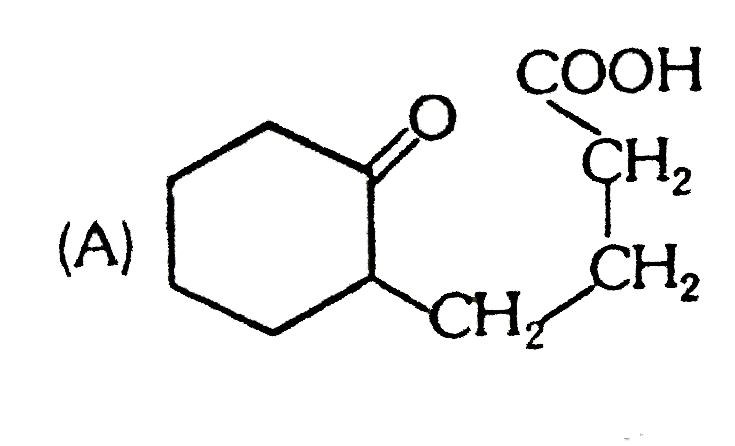
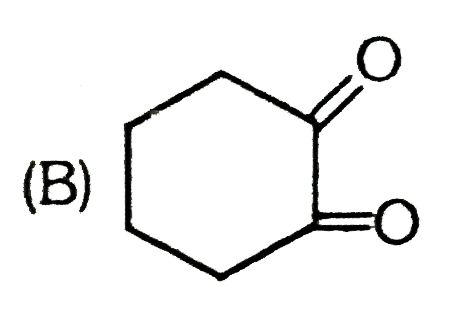
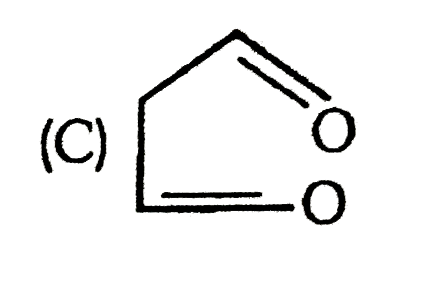
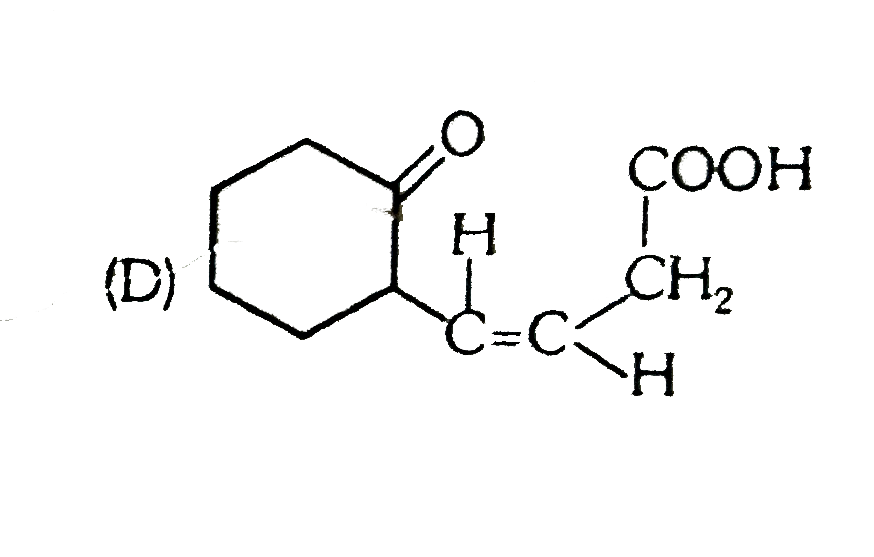
Compound C is:

A

B

C

D

Text Solution

AI Generated Solution

The correct Answer is:

To solve the problem step by step, we will analyze the information provided in the question and derive the structure of the compounds involved. ### Step 1: Determine the structure of compound A Given the molecular formula of compound A is \( C_{10}H_{17}Br \), we can calculate the degree of unsaturation using the formula: \[ \text{Degree of Unsaturation} = \frac{2n + 2 - (h + x)}{2} \] Where: - \( n \) = number of carbon atoms = 10 - \( h \) = number of hydrogen atoms = 17 - \( x \) = number of halogens = 1 (Br) Substituting the values: \[ \text{Degree of Unsaturation} = \frac{2(10) + 2 - (17 + 1)}{2} = \frac{20 + 2 - 18}{2} = \frac{4}{2} = 2 \] This indicates that compound A has 2 degrees of unsaturation, which could be due to two rings or one ring and one double bond. Since A does not decolorize bromine water, it indicates that there are no double bonds present, confirming that A must contain two rings. ### Step 2: Structure of compound A Since A is non-resolvable (optically inactive), it cannot have a chiral center. Therefore, the bromine atom must be attached in such a way that it does not create chirality. A suitable structure for A would be a bicyclic compound with the bromine attached to a position that does not create a chiral center. ### Step 3: Reaction of A with \( (CH_3)_2COK \) When compound A reacts with the bulky base \( (CH_3)_2COK \) in the presence of \( (CH_3)_3COH \), an elimination reaction occurs, leading to the formation of compound B. The bulky base promotes an E1 elimination, resulting in the formation of an alkene. ### Step 4: Structure of compound B The alkene formed (compound B) will have the formula \( C_{10}H_{16} \). The structure will be a double bond between two carbon atoms in the bicyclic framework of A. ### Step 5: Reduction of B with \( H_2/Pt \) When compound B is treated with hydrogen in the presence of platinum, it undergoes hydrogenation to yield a saturated compound, which retains the formula \( C_{10}H_{16} \). ### Step 6: Chlorination of B Upon treatment with \( Cl_2 \) in the presence of light, three monochloro derivatives are formed. This indicates that there are three distinct positions available for chlorination on the alkene. ### Step 7: Oxidation of B with acidic permanganate When B is boiled with acidic permanganate, it yields compound C with the formula \( C_{10}H_{16}O_3 \). This suggests that the oxidation introduces hydroxyl groups and possibly a carboxylic acid. ### Step 8: Heating with sodalime to yield D Heating compound C with sodalime results in the formation of compound D with the formula \( C_{9}H_{16}O \). This indicates a decarboxylation reaction. ### Step 9: Reduction of D with \( LiAlH_4 \) The reduction of D with lithium aluminum hydride (LiAlH4) will yield a compound that retains the carbon count but may change the functional groups. ### Step 10: Final reactions and identification of compound C After further treatment with concentrated \( H_2SO_4 \) and ozonolysis, compound E is formed, which leads to the identification of compound C as a ketone. ### Summary The compound C is determined to be a ketone with the molecular formula \( C_{10}H_{16}O_3 \).
Promotional Banner

Topper's Solved these Questions

  • ALKYL AND ARYL HALIDE

    ALLEN|Exercise EXERCISE-02|1 Videos
  • ALKYL AND ARYL HALIDE

    ALLEN|Exercise EXERCISE-04 [A]|1 Videos
  • ALKYL AND ARYL HALIDE

    ALLEN|Exercise EXERCISE-01|1 Videos
  • ALKENE, ALKANE & ALKYNE

    ALLEN|Exercise EXCERSISE-3|28 Videos
  • Atomic Structure

    ALLEN|Exercise All Questions|62 Videos
ALLEN-ALKYL AND ARYL HALIDE-EXERCISE
  1. An organic compound A has molecular formula C(10)H(17)Br and it is non...

    Text Solution

    |

  2. An organic compound A has molecular formula C(10)H(17)Br and it is non...

    Text Solution

    |

  3. An organic compound A has molecular formula C(10)H(17)Br and it is non...

    Text Solution

    |

  4. An organic compound A has molecular formula C(10)H(17)Br and it is non...

    Text Solution

    |

  5. Nucleophilic substitution reactions generally expressed as Nu^(-) +R...

    Text Solution

    |

  6. Nucleophilic substitution reactions generally expressed as Nu^(-) +R...

    Text Solution

    |

  7. Nucleophilic substitution reactions generally expressed as Nu^(-) +R...

    Text Solution

    |

  8. Nucleophilic substitution reactions generally expressed as Nu^(-) +R...

    Text Solution

    |

  9. Nucleophilic aliphatic substitution reaction is mainly of two types: S...

    Text Solution

    |

  10. Nucleophilic aliphatic substitution reaction is mainly of two types: S...

    Text Solution

    |

  11. Nucleophilic aliphatic substitution reaction is mainly of two types: S...

    Text Solution

    |

  12. An optically active compound A (assume dextrorotatory) has the molecul...

    Text Solution

    |

  13. An optically active compound A (assume dextrorotatory) has the molecul...

    Text Solution

    |

  14. Select the member of each pair that shows rate of S(N)2 reaction with ...

    Text Solution

    |

  15. Of the following statements which are true for S(N)1 reaction. (a) T...

    Text Solution

    |

  16. Of the following statements , which are true for S(N)2 reaction. (a)...

    Text Solution

    |

  17. Arrange the isomers of molecular formula C(4)H(9)CI in order of decrea...

    Text Solution

    |

  18. There is an overall 29-fold difference in reactivity of 1-chlorohexane...

    Text Solution

    |

  19. Identify the product when A reacts with

    Text Solution

    |

  20. Which is faster in the following pairs of halogen compounds undergoing...

    Text Solution

    |
