A
B
C
D
Text Solution
Verified by Experts
The correct Answer is:



Topper's Solved these Questions
Similar Questions
Explore conceptually related problems
ALLEN-ALKYL AND ARYL HALIDE-EXERCISE-05 (B)
- An S(N)2 reaction at an asymmetric carbon of a compound always g...
Text Solution
|
- The number of isomers possible for the molecular formula C(2) FCIBrl i...
Text Solution
|
- In the presence of peroxide, hydrogen chloride and hydrogen iodide do ...
Text Solution
|
- Identify the set of reagents // reaction conditions 'X' and 'Y' in the...
Text Solution
|
Text Solution
|
- The reagent(s) for the following conversion is/are:
Text Solution
|
- In the following groups: (I) -OAc, (II) -OMe, (III) -OSO(2)Me, (IV) ...
Text Solution
|
- CH(3)CH(2)CHCl(2) overset(Aq.KOH)rarr?
Text Solution
|
- Draw the stereochemical structure of the product in the following reac...
Text Solution
|
- Given reasons:
Text Solution
|
- An alkyl halide (A) of formula C(6)H(11)Cl on treatement with potassiu...
Text Solution
|
- With would be the major product in each of the following reactions?
Text Solution
|
- The following compound on hydrolysis in aqueous acetone will give .
Text Solution
|
- The major product of the following reaction is
Text Solution
|
- In the reaction OCH(3)overset(HBr)rarr the product are:
Text Solution
|
- The total number of alkenes possible by dehydrobromination of 3-bromo-...
Text Solution
|
- KI in acetone, undergoes S(N)2 reaction with each of P,Q ,R and S The ...
Text Solution
|
- Match the chemical conversion in List-I with the approprotae reagents ...
Text Solution
|
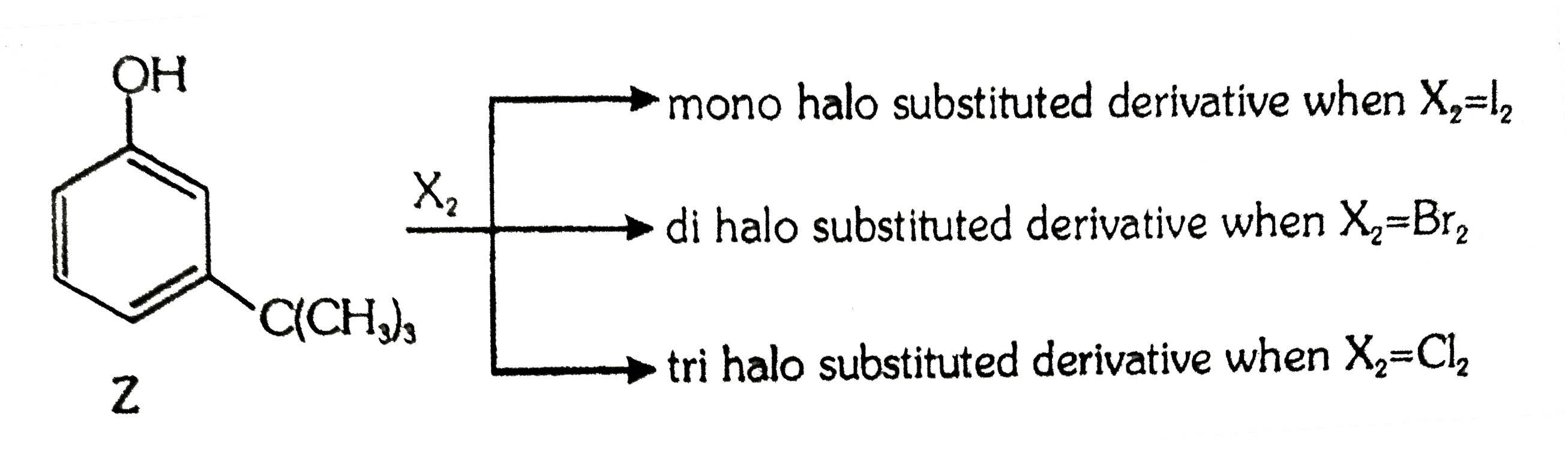
- The reactivity of compound Z with different halogens under appropriat...
Text Solution
|
- In the following monobromination reaction the number of possible chira...
Text Solution
|