Home
Class 12
CHEMISTRY
Calculate A(HOAC)^(oo) using appropriate...


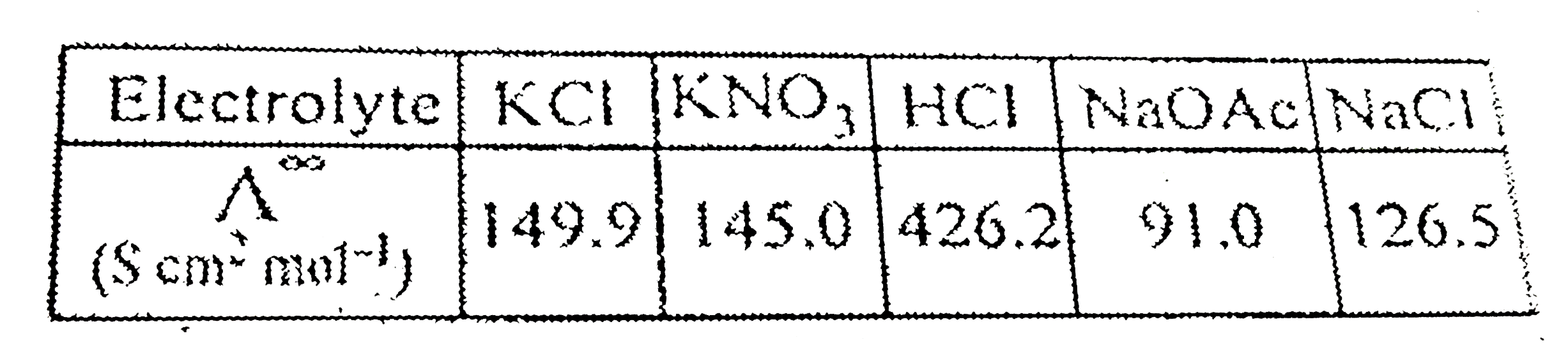
Calculate `A_(HOAC)^(oo)` using appropriate molar conductances of the électrolytes listed above at infinite dilution in `H_(2)O` at `25^(2)C.`

A

`390.7`

B

`217.5`

C

`517.2`

D

`552.7`

Text Solution

Verified by Experts

The correct Answer is:

A
Promotional Banner

Topper's Solved these Questions

  • ELECTROCHEMISTRY

    ALLEN|Exercise EXERCISE -05 [B]|38 Videos
  • ELECTROCHEMISTRY

    ALLEN|Exercise EXERCISE-04 [B]|23 Videos
  • CHEMISTRY AT A GLANCE

    ALLEN|Exercise ORGANIC CHEMISTRY|472 Videos
  • HYDROCARBON

    ALLEN|Exercise MCQ|15 Videos

Similar Questions

Explore conceptually related problems

{:("Electrolyte",^^.^(oo)(Scm^(2)mol^(-1))),(KCl,149.9),(KNO_(3),145.0),(HCl,426.2),(NaOAc,91.0),(NaCl,126.5):} Calculate ^^_(HOAc)^(oo) using appropriate molar conductance of the electrolytes listed above at infinite dilution in H_(2)O at 25^(@)C

Calculate (A_(HOAC)^(@)) using appropriate molar conductances of the electrolytes listed above at infinite dilution in H_(2)O at 25^(@)C .

Calculate, molar conductance of acetic acid using appropriate molar conductances of the electrolytes listed above at infinite dilution in H_(2)O at 25^(@)C :

The specific conductance of a0.5 N solution of an electrolyte at 25^@C is 0.00045 Scm^(-1) . The equivalent conductance of this electrolyte at infinite dilution is 300 S cm^2eq^(-1) . The degree of dissociation of the electrolyte is

The equivalent conductances of two strong electrolytes at infinite dilution in H2O (where ions move freely through a solution) at 25^(@)C are given below: wedge_(CH_(3)COONa^(@) = 91.0Scm^(2)//equ iv , wedge_HCl^(@)= 426.25cm^(2)//equiv What additional information/quantity one needs to calculate overset(o)(wedge) of an aqueous solution of acetic acid?

The molar ionic conductance at infinite dilution of K^(+) and SO_(4)^(2-) are 73.5 and 160 Scm^(2)mol^(-1) respectively.The molar conductance of solution of K_(2)SO_(4) at infinite dilution will be

The conductivity of 0.001 M acetic is 4 xx 10^(-5)S//cm. Calculate the dissociation constant of acetic acid, if molar conductivity at infinite dilution for acetic is 390 S cm^(2)//mol.

The molar conductance of NaCl varies with the concentration as shown in the following table and all values follows the equation. lambda_(m)^(c)=lambda_(m)^(oo)-bsqrt(C) where lambda_(m)^(c) = molar specific conductance lambda_(m)^(oo)= molar specific conductance at infinite dilution C=molar concentration When a certain conductivity cell (C) was filled with 25 xx10^(-4)(M) NaCl solution, the resistance of the cell was found to be 1000 ohm. At infinite dilution, conductance of Cl^(-) and SO_(4)^(2-) are 80ohm^(-1) cm^(2) "mole"^(-1) and 160ohm^(-1) cm^(2) "mole"^(-1) respectively. What is the molar conductance of NaCl at infinite dilution?

The molar conductance of NaCl varies with the concentration as shown in the following table and all values follows the equation. lambda_(m)^(c)=lambda_(m)^(oo)-bsqrt(C) where lambda_(m)^(c) = molar specific conductance lambda_(m)^(oo)= molar specific conductance at infinite dilution C=molar concentration When a certain conductivity cell (C) was filled with 25 xx10^(-4)(M) NaCl solution, the resistance of the cell was found to be 1000 ohm. At infinite dilution, conductance of Cl^(-) and SO_(4)^(2-) are 80ohm^(-1) cm^(2) "mole"^(-1) and 160ohm^(-1) cm^(2) "mole"^(-1) respectively. What is the cell constant of the conductivity cell (C)?

Molar conductance of 2 M H_(2)A acid is 10 S cm^(2) mol^(-1) Molar conductance of H_(2)A at infinite dilution is 400 S cm^(2) mol^(-1) which statement is/are correct?

ALLEN-ELECTROCHEMISTRY-EXERCISE-05 [A]
  1. The standard e.m.f of a cell, involving one electron change is found t...

    Text Solution

    |

  2. Consider the following E^(@) values E^(@) values E(Fe^(3+)//Fe^(2+))^...

    Text Solution

    |

  3. Calculate A(HOAC)^(oo) using appropriate molar conductances of the éle...

    Text Solution

    |

  4. The highest electrical conductivity of the following aqueous solutions...

    Text Solution

    |

  5. Aluminium oxide may be electrolysed at 1000^(@)C to furnish aluminium ...

    Text Solution

    |

  6. For a spontaneous reaction, DeltaG, equilibrium constant K and E("cell...

    Text Solution

    |

  7. The molar conductivities Lambda(NaOAc)^@ and Lambda(HCI)^@ at infinite...

    Text Solution

    |

  8. Resistance of a conductivity cell filled with 0.1 mol L^(-1) KCl solut...

    Text Solution

    |

  9. At 25^(@)C, {:(Ag+I^(-)rarr,AgI+e,,E^(@) =0.152V),(Agrarr,Ag.^(+)+e,,E...

    Text Solution

    |

  10. The cell, Zn | Zn^(2+) (1M) || (1M) | Cu (E(cell)^(@) = 1.10V), was wa...

    Text Solution

    |

  11. Given E(Cr^(3+)//cr)^@ =- 0.72 V, E(Fe^(2+)//Fe)^@ =- 0.42 V. The pote...

    Text Solution

    |

  12. Given : E(Fe^(3+)//Fe)^(@) = -0.036V, E(FE^(2+)//Fe)^(@)= -0.439V. The...

    Text Solution

    |

  13. The Gibbs energy for the decomposition of Al2O3 at 500^@C is as follow...

    Text Solution

    |

  14. Resistance of 0.2 M solution of an electrolyte is 50Omega. The specifi...

    Text Solution

    |

  15. The reduction potential of hydrogen half cell will be negative if :

    Text Solution

    |

  16. The standard reduction potentials for Zn^(2+)//Zn, Ni^(2+)//Ni, and Fe...

    Text Solution

    |

  17. Use the data given in Q.8 and find out which of the following is the ...

    Text Solution

    |

  18. The equivalent conductance of NaCl at concentration C and at infinite...

    Text Solution

    |

  19. In which of the following reactions H(2)O(2) acts as a reducing agent?...

    Text Solution

    |

  20. Resistance of 0.2 M of solution of an electrolysis is 50 Omega. The sp...

    Text Solution

    |
