Home
Class 12
PHYSICS
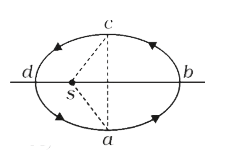
Figure shows elliptical path ‘abcd’ of a...

Figure shows elliptical path ‘abcd’ of a planet around the sun S such that the area of triangle ‘csa’ is 1/4 the area of the ellipse. (See figure) With ‘db’ as the major axis, and ‘ca’ as the minor axis. If `t_1` is the time taken for planet to go over path ‘abc’ and `t_2` for path taken over ‘cda’ then:

A

`t_(1)=4t_(2)`

B

`t_(1)=3t_(2)`

C

`t_(1)=t_(2)`

D

`t_(1)=2t_(2)`

Text Solution

Verified by Experts

The correct Answer is:

B
Promotional Banner

Topper's Solved these Questions

  • GRAVITATION

    ALLEN|Exercise Exercise 5 B (Previous Year Questions)|9 Videos
  • GRAVITATION

    ALLEN|Exercise Illustration|34 Videos
  • GRAVITATION

    ALLEN|Exercise Exercise 4 B (Brain Storming Subjective Exercise)|20 Videos
  • GEOMETRICAL OPTICS

    ALLEN|Exercise subjective|14 Videos
  • KINEMATICS-2D

    ALLEN|Exercise Exercise (O-2)|46 Videos

Similar Questions

Explore conceptually related problems

Figure elliptical path abcd of a planet around the sun S such that the area of Delta csa is (1)/(4) the area of the ellipse, (see figure) with db as the semimajor axis, and ca as the semiminor axis if t_(1) is the time taken for planet to go over path abc and t_(2) for path taken over cda then:

Figure shows the elipticla path of a planet about the sun. The two shaded parts have equal area. If t_1 and t_2 be the tim taken by the planet to go from a to b and from c to d respectively

The figure shows elliptical orbit of a planet m about the sun S. the shaded area SCD is twice the shaded area SAB. If t_(1) be the time for the planet to move from C to D and t_(2) is the time to move from A to B, then:

The figure shows elliptical orbit of a planet m about the sun S. the shaded area SCD is twice the shaded area SAB. If t_(1) be the time for the planet to move from C to D and t_(2) is the time to move from A to B, then:

Figure shows the motion of a planet around the Sun S in an elliptical orbit with the Sun at the focus. The shaded areas A and B are also shown in the figure which can be assumed to be equal. If t_(1) and t_(2) represent the time taken for the planet to move from a to b and c to d , respectively then

Figure shows the motion of a planet around the Sun S in an elliptical orbit with the Sun at the focus. The shaded areas A and B are also shown in the figure which can be assumed to be equal. If t_(1) and t_(2) represent the time taken for the planet to move from a to b and c to d , respectively then

The figure shows elliptical orbit of a plant P about the sun S. The shaded area CSD is twice tha shaded area ASB. If t_(1) is the time taken by the planet to move from C to D and t_(2) is the time to move from A to B, determine the ratio t_(1)//t_(2)

The figure represents an elliptical orbit a planet around sun. The planet takes time T_(1) to travel from A to B and it takes time T_(2) to travel from C to D . If the area CSD is double that of area ASB , them

A planet revolves around the sun in elliptical orbit of eccentricity 'e'. If 'T' is the time period of the planet then the time spent by the planet between the ends of the minor axis and major axis close to the sun is

Figure 1.31 shows the trace of the path of a charged particle in a bubble chamber. Assume that the magnetic field is into the plane of the paper with magnitude 0.4 T. The smooth spiral path occurs because the particle loses energy in ionizing molecules along the path. a. Which part of the path corresponds to higher kinetic energy for the particle? Inner or outer part of spiral. b. Is the charge positive or negative? c. The radius of curvature ranges from 70 mm to 10 mm. What is the range of values of the magnitude of momentum if the magnitude of the charge is e?

ALLEN-GRAVITATION-Exercise 5 A (Previous Year Questions)
  1. The time period of an earth satellite in circular orbit is independent...

    Text Solution

    |

  2. Suppose the gravitational force varies inversely as the n^(th) power o...

    Text Solution

    |

  3. Suppose the gravitational force varies inversely as the n^(th) power o...

    Text Solution

    |

  4. The average density of the earth

    Text Solution

    |

  5. IF the change in the value of g at the height h above the surface of t...

    Text Solution

    |

  6. A particle of mass 10 g is kept on the surface of a uniform sphere of ...

    Text Solution

    |

  7. If g(E) and g(m) are the acceleration due to gravity on the surface of...

    Text Solution

    |

  8. A planet in a distant solar system is 10 times more massive than the e...

    Text Solution

    |

  9. This question contains Statement -1 and Stantement -2 Of the four choi...

    Text Solution

    |

  10. Find the height (in terms of R, the radius of the earth) at which the ...

    Text Solution

    |

  11. Two bodies of masses m and 4m are placed at a distance r. The gravitat...

    Text Solution

    |

  12. Two particles of equal mass go around a circle of radius R under the a...

    Text Solution

    |

  13. The mass of a spaceship is 1000 kg. It is to be launched from the eart...

    Text Solution

    |

  14. Four particles, each of mass M and equidistant from each other, move a...

    Text Solution

    |

  15. From a solid sphere of mass M and radius R, a spherical portion of rad...

    Text Solution

    |

  16. A very long (length L) cylindrical galaxy is made of uniformly distrib...

    Text Solution

    |

  17. The correct variation of gravitational potential V with radius r measu...

    Text Solution

    |

  18. A satellite is revolving in a circular orbit at a height 'h' from the ...

    Text Solution

    |

  19. Figure shows elliptical path ‘abcd’ of a planet around the sun S such ...

    Text Solution

    |

  20. An astronaut of mass m is working on a satellite orbiting the earth at...

    Text Solution

    |
