Home
Class 12
PHYSICS
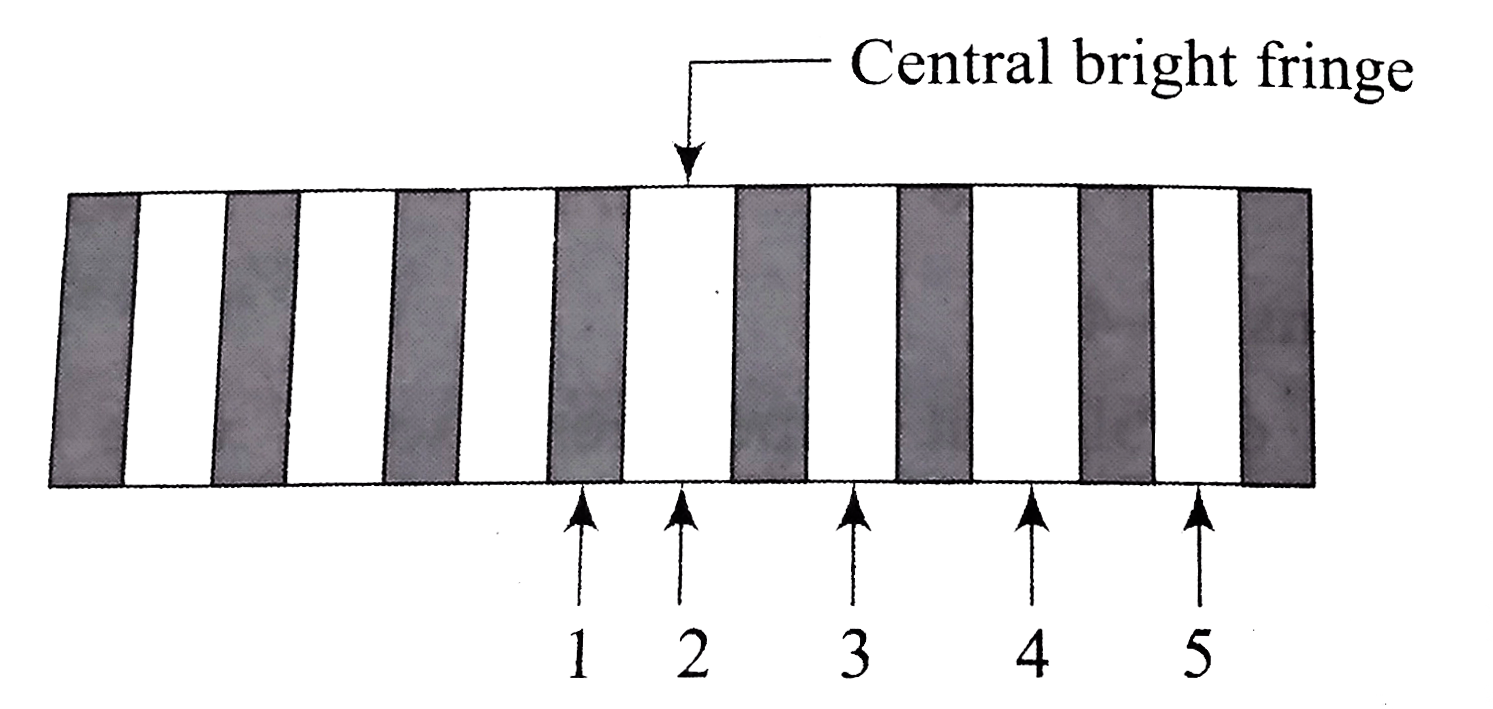
Figure shows the interference pattern ob...

Figure shows the interference pattern obtained ina double-slit experiment using light of wavelength 600 m. 1, 2, 3, 4 and 5 are maked on fiv fringes.

Let `Delta X_(A)` and `Delta X_(c)` represent path difference between waves interfering at 1 and 3, respectively. Then `(|Delta X_(c)| - |Delta X_(A)|)` is equal to

A

0

B

300 mn

C

600 nm

D

900 nm

Text Solution

Verified by Experts

The correct Answer is:

B

`CBFimplies` path difference `=0`
`DeltaX_(A)toAt" "1`
dark fringe having path difference `=(lamda)/(2)`
`DeltaX_(C)to`At 3,
bright fringes path difference `=lamda`
`therefore(|DeltaX_(C)|-|DeltaX_(A)|)=(lamda-(lamda)/(2))=(lamda)/(2)=(600)/(2)nm=300nm`
Promotional Banner

Topper's Solved these Questions

  • WAVE OPTICS

    ALLEN|Exercise Exercise 4 A (Conceptual subjective Exercise)|9 Videos
  • WAVE OPTICS

    ALLEN|Exercise Exercise 4 B (Conceptual subjective Exercise)|8 Videos
  • WAVE OPTICS

    ALLEN|Exercise Exercise 2 (Brain Teasures)|22 Videos
  • UNIT & DIMENSIONS, BASIC MATHS AND VECTOR

    ALLEN|Exercise Exercise (J-A)|7 Videos

Similar Questions

Explore conceptually related problems

The figure shows the interfernece pattern obtained in double slit experiment using light of wavelength 600 nm. Q. The third order bright fringe is

The figure shows the interfernece pattern obtained in double slit experiment using light of wavelength 600 nm. Q. Let DeltaX_(A) and DeltaX_(C) represent path differences between waves interering at 1 and 3 respectively then (|DeltaX_(C)|-(|DeltaX_(A)|) is equal to

The figure shows the interfernece pattern obtained in double slit experiment using light of wavelength 600 nm. Q. Which fringe results from a phase difference of 4pi between the light waves incidenting from two slits?

A Young's double slit experiment uses a monochromatic light of wavelength lambda . The intensity of each slit is same and is equal to I_(0) . What will be the resultant intensity at a point where waves interfere at a path difference of (lambda)/2 ?

In the adjacent figure 'P' is any interior point of the equilateral triangle ABC is side length 2 unit . If x_(a), x_(b) and x_(c) represent the distance of P from the sides BC, CA and AB respectively then x_(a)+x_(b)+x_(c) is equal to

In Young’s double slit experiment, using light of wavelength 600 nm, 10^(th) bright fringe is obtained on a screen, 3mm from the centre of the pattern. If the screen is 120 cm away from the slits, calculate: (i) Distance between the two slits, (ii) Fringe width, i.e. fringe separation.

Light of wavelength 500nm is used to form interference pattern in Young's double slit experiment. A uniform glass plate of refractive index 1.5 and thickness 0.1mm is introduced in the path of one of the interfering beams. The number of fringes which will shift the cross wire due to this is

In a double slit experiment, at a certain point on the screen the path difference between the two interfering waves is 1/3 rd of a wavelength. The ratio of the intensity of light at that point to that at the centre of a bright fringe is:

In a triangle ABC, if A is (1, 2) and the equations of the medians through B and c are x+ y= 5 and x= 4 respectively then B must be:

In Young.s double slit interference experiment the wavelength of light used is 6000 A^(0) . If the path difference between waves reaching a point P on the screen is 1.5 microns, then at that point P

ALLEN-WAVE OPTICS-Exercise 3 (Miscellaneous type Questions)
  1. The lens governing the behavior of the rays namely rectilinear propaga...

    Text Solution

    |

  2. The lens governing the behavior of the rays namely rectilinear propaga...

    Text Solution

    |

  3. The lens governing the behavior of the rays namely rectilinear propaga...

    Text Solution

    |

  4. Huygen was the first scientist who proposed the idea of wave theory of...

    Text Solution

    |

  5. Huygen was the first scientist who proposed the idea of wave theory of...

    Text Solution

    |

  6. Huygen was the first scientist who proposed the idea of wave theory of...

    Text Solution

    |

  7. Huygen was the figure scientist who proposed the idea of wave theory o...

    Text Solution

    |

  8. Huygen was the figure scientist who proposed the idea of wave theory o...

    Text Solution

    |

  9. Huygen was the figure scientist who proposed the idea of wave theory o...

    Text Solution

    |

  10. Figure shows the interference pattern obtained in a double-slit experi...

    Text Solution

    |

  11. Figure shows the interference pattern obtained ina double-slit experim...

    Text Solution

    |

  12. Figure shows the interference pattern obtained ina double-slit experim...

    Text Solution

    |

  13. Discuss properties and uses of X-ray?

    Text Solution

    |

  14. A p type semiconductor has acceptor level 114 meV above the valance ba...

    Text Solution

    |

  15. The figure shown a schematic diagram showing the arrangement of young'...

    Text Solution

    |

  16. What will be conductivity of pure silicon crystal at 300 K temperatur...

    Text Solution

    |

  17. Thin films, including soap bubbles and oil show patterns of alternativ...

    Text Solution

    |

  18. Thin films, including soap bubbles and oil show patterns of alternativ...

    Text Solution

    |

  19. Thin films, including soap bubbles and oil show patterns of alternativ...

    Text Solution

    |

  20. Thin films, including soap bubbles and oil show patterns of alternativ...

    Text Solution

    |
