Home
Class 12
PHYSICS
A vessel ABCD of 10 cm width has two sma...

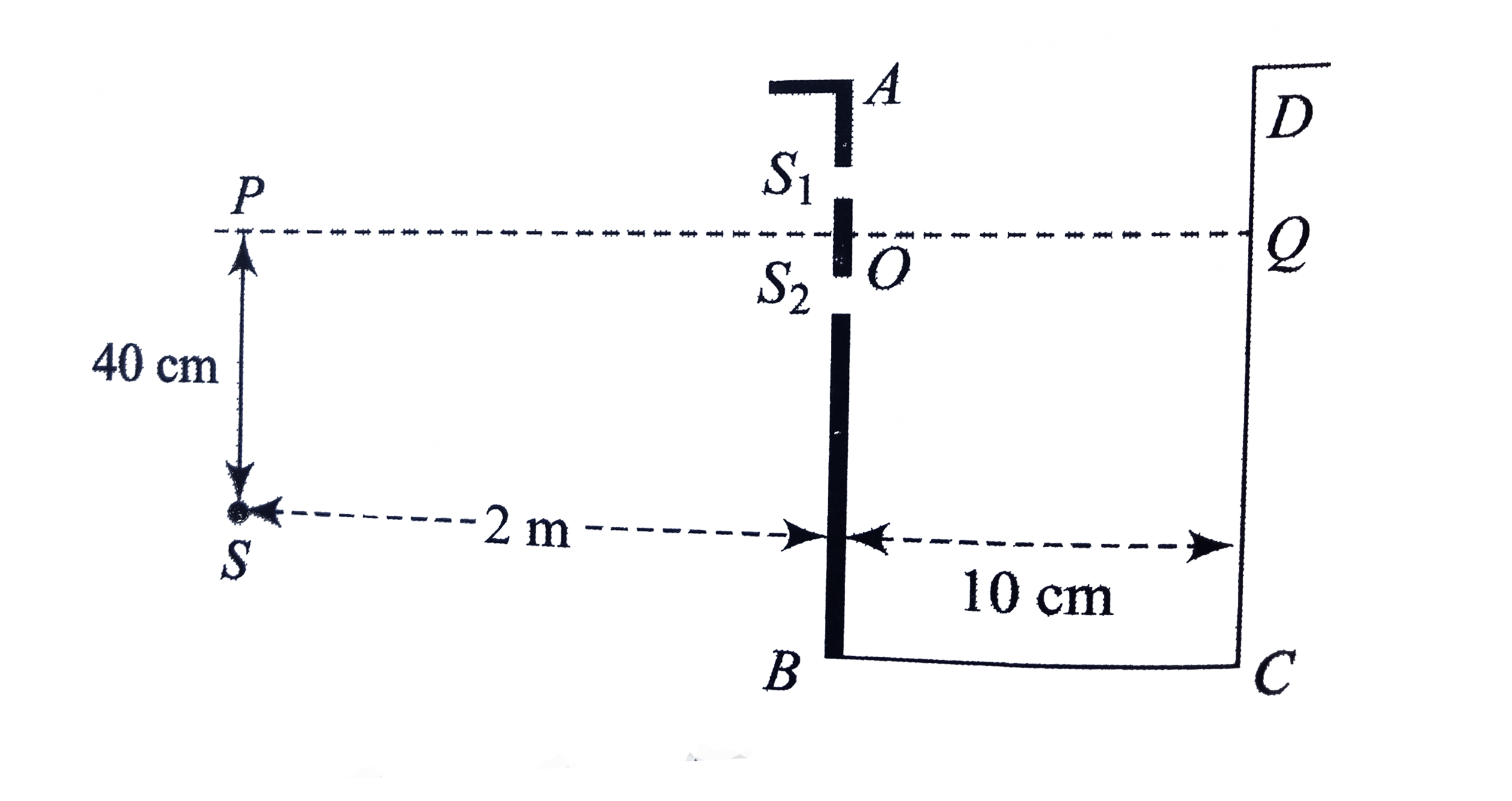
A vessel ABCD of 10 cm width has two small slits `S_(1)` and `S_(2)` sealed with identical glass plates of equal thickness. The distance between the slits is 0.8 mm. POQ is the line peropendicular to the plane AB and passing through O, the middle point of `S_(1)` and `S_(2)`. A monochromatic light source is kept at S, 40 cm below P and 2 m form the vessel to illuminate the slits as shown in figure .Calculate the position of the central bright fringe on the other wall CD with respect to line OQ. Now , a liquid is poured into the vessel and filled up to OQ. The central bright fringe is found to be at Q. Calculate the refractive index of the liquid to the liquid.

Text Solution

Verified by Experts

The correct Answer is:
2 cm above point Q on side `CD,mu=1.0016`


(i) O is the middle point of slits `S_(1)&S_(2)` also `S_(1)S_(2)=d=0.8mm` in figure `tanalpha=(y_(1))/(D_(1))`
`tanalpha=(40)/(200)=(1)/(5)thereforesinalpha=(1)/(sqrt(26))=(1)/(5.1)approx(1)/(5)approxtanalpha`
path difference `Deltax_(1)=SS_(1)-SS_(2)`
`Deltax_(1)=dsinalpha=0.8xx(1)/(5)` or `Deltax_(1)=0.16mm` ...(i)
let R represents the position of CBF. i.e.,
net path difference should be 0
Now `Deltax_(2)=S_(2)R-S_(1)R`
or `Deltax_(2)=dsinthetaimpliesDeltax_(1)=Deltax_(2)` ..(ii)
For central bright fringe
`Deltax_(2)-Deltax_(1)=0impliesdsintheta-Deltax_(1)=0`
`impliesdsintheta=Deltax_(1)=0.16mm`
`implies(0.8)sintheta=0.16impliessintheta=(0.16)/(0.8)=(1)/(5)`
`thereforetantheta=(1)/(sqrt(24))=(1)/(4.9)=(1)/(5)=sintheta`
So, `tantheta=(y_(2))/(D_(2))=(1)/(5)impliesy_(2)=2cm`
(ii).
When liquid of refractive index `mu` is poured
Then for CBF at Q, net path difference =0
`(mu-1)t=Deltax_(1)implies(mu-1)100=0.16impliesmu-1=0.0016`
Promotional Banner

Topper's Solved these Questions

  • WAVE OPTICS

    ALLEN|Exercise Exercise 2 (Previous Year Questions)|7 Videos
  • WAVE OPTICS

    ALLEN|Exercise Exercise 5 A (Previous Years Questions)|17 Videos
  • UNIT & DIMENSIONS, BASIC MATHS AND VECTOR

    ALLEN|Exercise Exercise (J-A)|7 Videos
ALLEN-WAVE OPTICS-Exercise 5 B (Previous Years Questions)
  1. Two beams of light having intensities I and 4I intefere to produce a f...

    Text Solution

    |

  2. In the ideal double-slit experiment, when a glass-plate (refractive in...

    Text Solution

    |

  3. In the below diagram, CP represents a wavefront and AO and BP, the cor...

    Text Solution

    |

  4. In YDSE, bichromatic light of wavelengths 400 nm and 560 nm are used...

    Text Solution

    |

  5. In Young's double slit experiment intensity at a point is ((1)/(4)) of...

    Text Solution

    |

  6. In the Young's double slit experiment using a monochromatic light of w...

    Text Solution

    |

  7. In a Young's double slit experiment, the separaton between the two sli...

    Text Solution

    |

  8. A light source, which emits two wavelengths lambda(1)=400 nm and lambd...

    Text Solution

    |

  9. While conduction the Young's double slit experiment, a student replace...

    Text Solution

    |

  10. Fig. shows a surface XY separating two transparent media, medium 1 and...

    Text Solution

    |

  11. Fig. shows a surface XY separating two transparent media, medium 1 and...

    Text Solution

    |

  12. Fig. shows a surface XY separating two transparent media, medium 1 and...

    Text Solution

    |

  13. A coherent parallel beam of microwaves of wavelength lambda = 0.5 mm f...

    Text Solution

    |

  14. The Young's double-slit experiment is done in a medium of refractive i...

    Text Solution

    |

  15. A glass of refractive index 1.5 is coated with a thin layer of thickne...

    Text Solution

    |

  16. A vessel ABCD of 10 cm width has two small slits S(1) and S(2) sealed ...

    Text Solution

    |

  17. A point source S emitting light of wavelength 600 nm is placed at a ve...

    Text Solution

    |

  18. In a young's double slit experiment, two wavelength of 500 nm and 700 ...

    Text Solution

    |

  19. A Young's double slit interference arrangement with slits S(1) and S(2...

    Text Solution

    |

