Home
Class 11
PHYSICS
A moving 2 kg ball with a speed of 2 ms^...

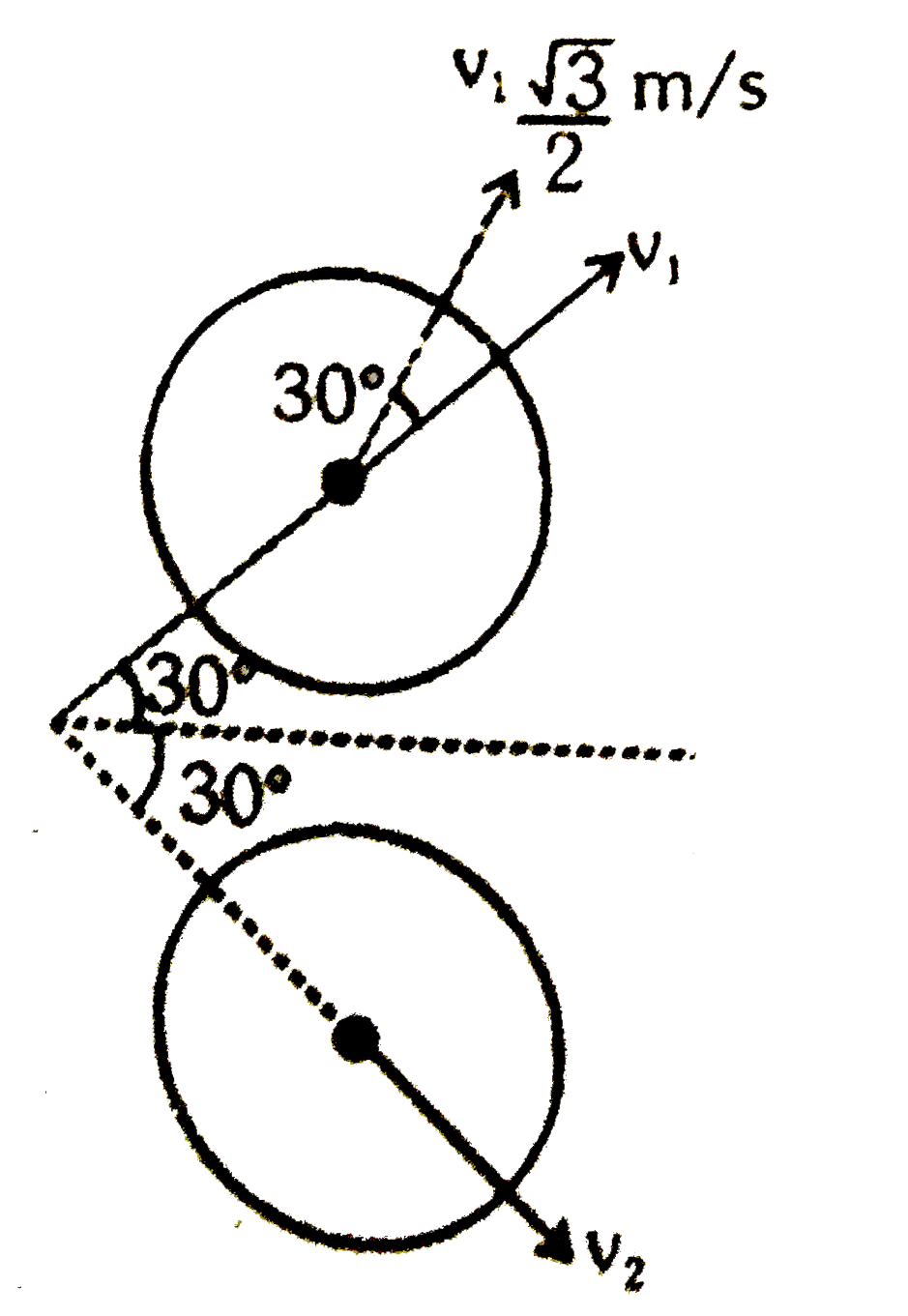
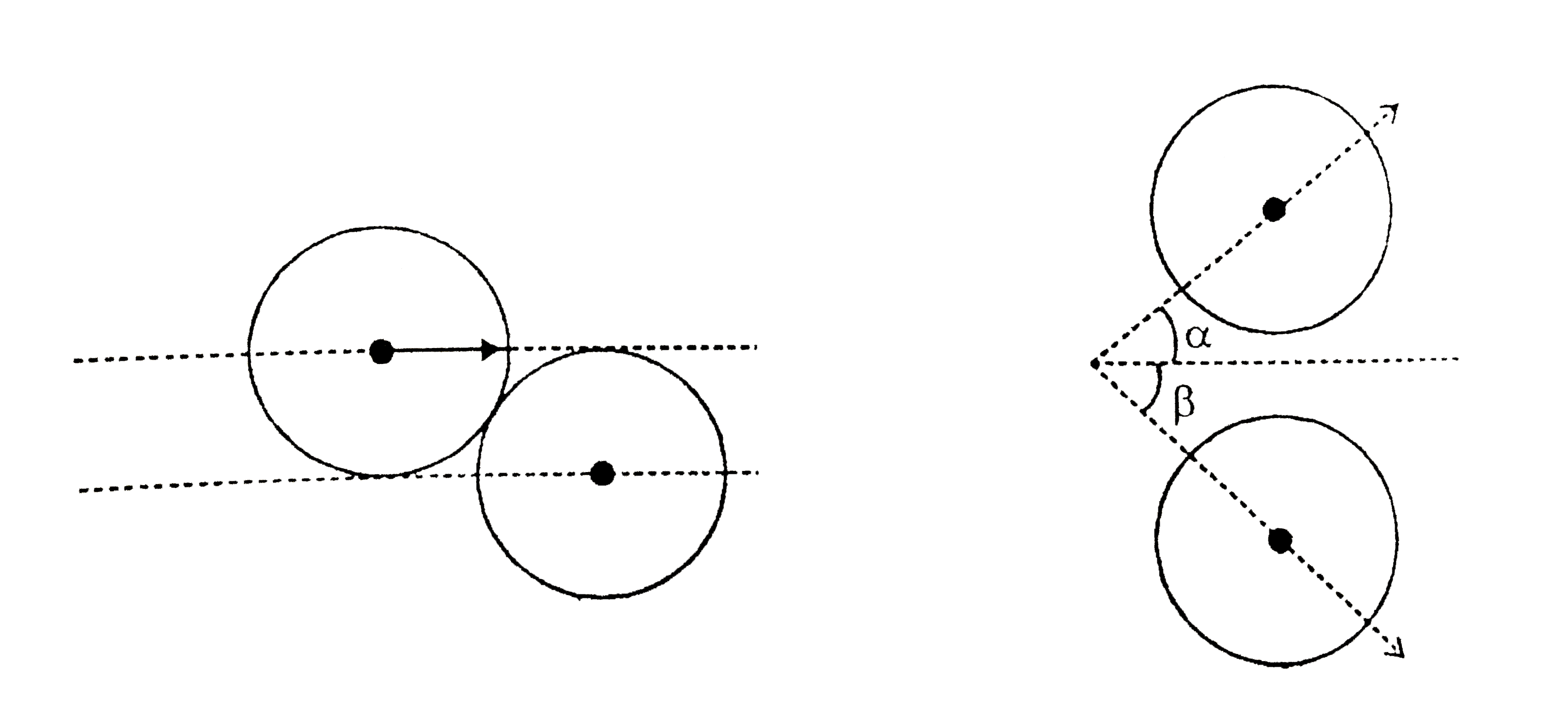
A moving `2 kg` ball with a speed of `2 ms^(-1)` hits obliquely a stationary identical ball inelastically as shown. If the first ball move away with angle `alpha = 30^(@)` to the original path, find the total kinetic energy lost after the collision

A

`4//3 J`

B

`5//4 J`

C

`6//5 J`

D

`7//6 J`

Text Solution

Verified by Experts

The correct Answer is:
A


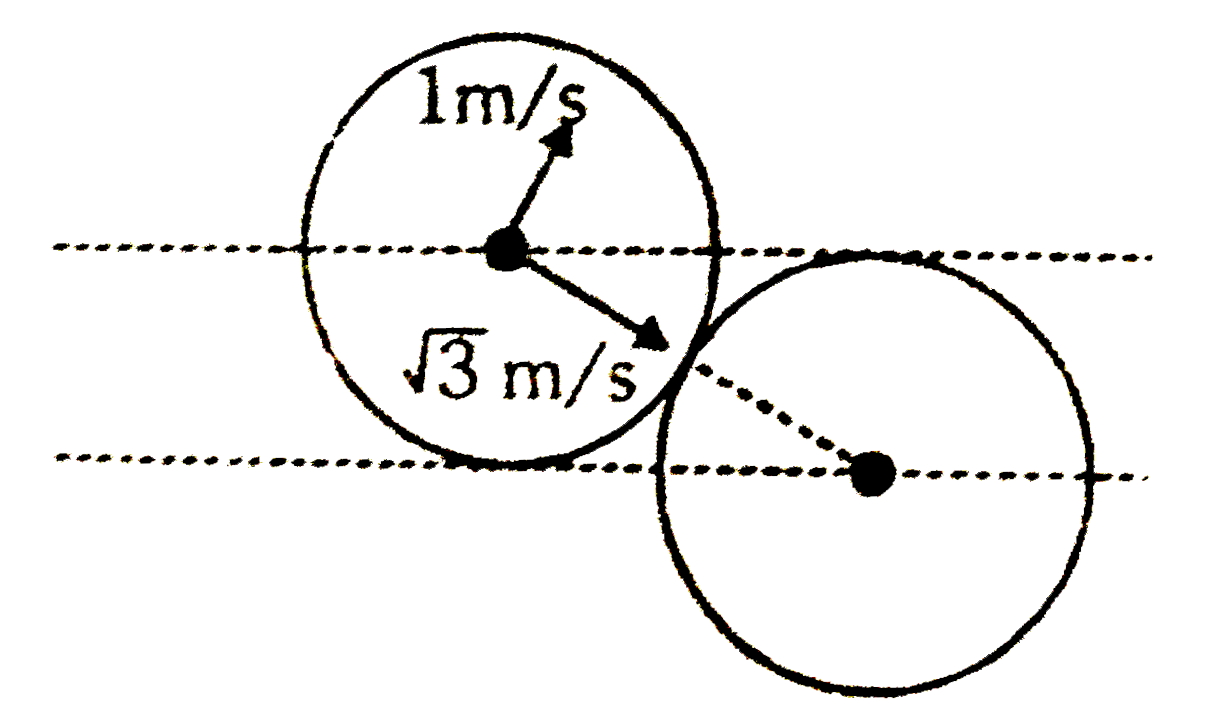
Tangential component remain same

`1 = (sqrt3v_(1))/(2) rArr v_(1) = (2)/(sqrt3)`
Momentum is conserved along normal
`2sqrt3 = (2 xx v_(1))/(2) + 2 xx v_(2) rArr sqrt3 = (1)/(sqrt3) + v_(2)`
`v_(2) = (2)/(sqrt3)`
`DeltaKE = (1)/(2) xx 2 xx 4 - ((1)/(2) xx 2 xx ((2)/(sqrt3))^(2) + (1)/(2) xx 2 xx ((2)/(sqrt3))^(2))`
`= (4)/(3)J`
Promotional Banner

Topper's Solved these Questions

  • CENTRE OF MASS

    ALLEN|Exercise EXERCISE-II|43 Videos
  • CENTRE OF MASS

    ALLEN|Exercise EXERCISE-III|42 Videos
  • CENTRE OF MASS

    ALLEN|Exercise EXERCISE-V B|19 Videos
  • BASIC MATHEMATICS USED IN PHYSICS &VECTORS

    ALLEN|Exercise EXERCISE-IV ASSERTION & REASON|11 Videos
  • ELASTICITY, SURFACE TENSION AND FLUID MECHANICS

    ALLEN|Exercise Exercise 5 B (Integer Type Questions)|3 Videos

Similar Questions

Explore conceptually related problems

A ball moving with a speed of 9m//s strikes an identical ball at rest, such that after the collision, the direction of each ball makes an angle of 30^(@) with the original line of motion. Find the speeds of the two balls after collision.

A ball , moving with a speed of 10 sqrt(3) m//s , strikes an identical stationary ball such that after the collision , the direction of each ball makes an angle of 30^(@) with the original line of motion. The speeds of two balla after the collision are , respectively.

A ball of mass m collides with a stationary identical ball a speed v_(0) . Find the impulse of the colliding balls (e=1//2) .

A ball of mass 1 kg moving with a velocity of "0.4 ms"^(-1) collides with another stationary ball. After the collision, the first ball moves with a velocity of 0.3ms^(1) in a direction making an angle of 90^(@) with its initial direction. The momentum of the second ball after the collision will be (in kg ms^(-1) )

A smooth ball 'A' moving with velocity 'V' collides with another smooth identical ball at rest. After collision both the balls move with same speed with angle between their velocities 60^(@) . No external force acts on the system of balls. If the kinetic energy lost is fully converted to heat then heat produced is

A smooth ball 'A' moving with velocity 'V' collides with another smooth identical ball at rest. After collision both the balls move with same speed with angle between their velocities 60^(@) . No external force acts on the system of balls. The speed of each ball after the collision is

A spherical ball of mass 1 kg moving with a uniform speed of 1 m//s collides symmetrically with two identical spherical balls of mass 1 kg each at rest touching each other. If the two balls move with 0.5 m//s in two directions at the same angle of 60^(@) with the direction of the first ball, the loss of kinetic energy on account of the collision is :-

An iron ball A collides with another stationary iron ball B If the ratio of radii of the balls is n = 2, find the ratio of their speeds just after the collision (e = 0.5)

A ball of mass m moving at a speed v makes a head on inelastic collision with an identical ball at rest. The kinetic energy of the balls after the collision is 3/4th of the original. Find the coefficient of restitution.

A ball A moving with a velocity 5 m/s collides elastically with another identical ball at rest such that the velocity of A makes an angle of 30^(@) with the line joining the centres of the balls. Then consider following statements : (A) Balls A an B move at right angles after collision (B) kinetic energy is conserved (C) speed of A after collision is (5/2) m/s (D) speed of B after collision is ( 5sqrt(3)//2 ) m/s Select correct alternative :-

ALLEN-CENTRE OF MASS-EXERCISE-I
  1. Two blocks A(3 kg) and B(2 kg) resting on a smooth horizontal surface ...

    Text Solution

    |

  2. A shell is fired vertically upwards with a velocity v(1) from the deck...

    Text Solution

    |

  3. A shell is fired from a cannon with a velocity V at an angle theta wit...

    Text Solution

    |

  4. A ball hits a floor and rebounds after an inelastic collision. In this...

    Text Solution

    |

  5. Three balls A, B and C are placed on a smooth horizontal surface. Give...

    Text Solution

    |

  6. A body of mass 1 kg strikes elastically with another body at rest and ...

    Text Solution

    |

  7. A small bucket of mass M is attached to a long inextensible cord of le...

    Text Solution

    |

  8. In the figure shown, a particle P strikes the inclined smooth plane ho...

    Text Solution

    |

  9. A ball of mass 2m impinges directly on a ball of mass m, which is at r...

    Text Solution

    |

  10. A body of mass 2 kg is projected upward from the surface of the ground...

    Text Solution

    |

  11. A ball of mass 1 kg strikes a heavy plarform elastically, moving upwar...

    Text Solution

    |

  12. Two particles of mass m, constrained to move along the circumference o...

    Text Solution

    |

  13. Two particles start moving from the same point along the same straight...

    Text Solution

    |

  14. A uniform rope of linear mass density lambda and length l is coiled on...

    Text Solution

    |

  15. A 10 g rubber ball and a 10g clay ball are each thrown at a wall with ...

    Text Solution

    |

  16. Two friends are sitting in a stationary boat. At t = 30s the person at...

    Text Solution

    |

  17. Two blocks of masses m(1) and m(2)(m(1) gt m(2)) connected by a massle...

    Text Solution

    |

  18. A small puck is sliding to the right with momentum vec(P)(1) on a hori...

    Text Solution

    |

  19. A smooth sphere is moving on a horizontal surface with velocity vector...

    Text Solution

    |

  20. A moving 2 kg ball with a speed of 2 ms^(-1) hits obliquely a stationa...

    Text Solution

    |