Home
Class 11
PHYSICS
Two particles of mass m each are attache...

Two particles of mass m each are attached to a light rod of length d, one at its centre and the other at a free end, The rod is fixed at the other end and is rotated in a plane at an angular speed `omega`. Calculate the angular momentum of the particle at the end with respect to the particle at the centre

Text Solution

Verified by Experts

The correct Answer is:
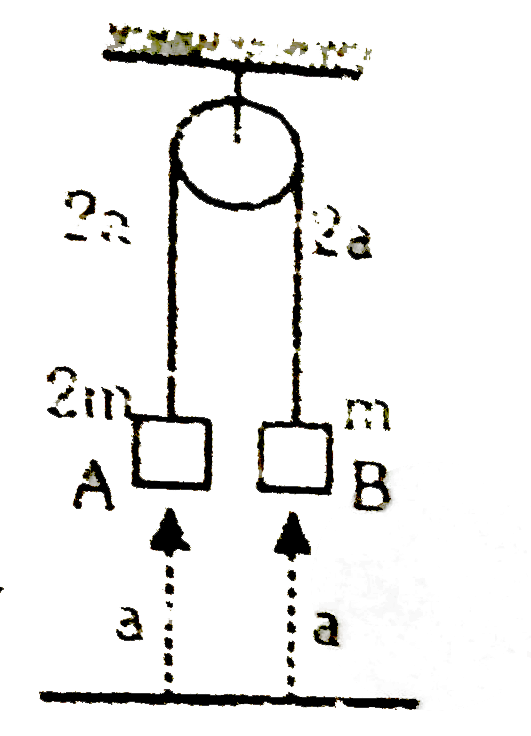
(i) `sqrt(2ag)/(3)` (ii) `(3v)/(g)` (iii) `(2v)/(g)`

`2mg - T = 2m.a` ….(i)
`T - mg = m.a` ….(ii)
On solving eq. (i) & (ii) `a = (g)/(3)`
(a) `v_(B) = sqrt(u^(2) + 2as) = sqrt(0 + 2((g)/(3))a) = sqrt((2ag)/(3))`
(b) `s = ut + (1)/(2) t^(2), a = 0 + (1)/(2)((g)/(3)) t^(2), t = sqrt((6a)/(g)) = (3v)/(g)`
(c ) `t = (2v)/(g)`
Promotional Banner

Topper's Solved these Questions

  • CENTRE OF MASS

    ALLEN|Exercise EXERCISE-V A|20 Videos
  • CENTRE OF MASS

    ALLEN|Exercise EXERCISE-V B|19 Videos
  • CENTRE OF MASS

    ALLEN|Exercise EXERCISE-IV A|32 Videos
  • BASIC MATHEMATICS USED IN PHYSICS &VECTORS

    ALLEN|Exercise EXERCISE-IV ASSERTION & REASON|11 Videos
  • ELASTICITY, SURFACE TENSION AND FLUID MECHANICS

    ALLEN|Exercise Exercise 5 B (Integer Type Questions)|3 Videos

Similar Questions

Explore conceptually related problems

Two small balls A and B each of mass m, are attached tightly to the ends of a light rod of length d. The structure rotates about the perpendicular bisector of the rod at an angular speed omega . Calculate the angular momentum of the individual balls and of the system about the axis of rotation.

Two balls of masses m and 2m are attached to the ends of a light rod of length L . The rod rotates with an angular speed omega about an axis passing through the center of mass of system and perpendicular to the plane. Find the angular momentum of the system about the axis of rotation.

A rod of mass 2 kg ad length 2 m is rotating about its one end O with an angular velocity omega=4rad//s . Find angular momentum of the rod about the axis rotation.

A particle is attached to an end of a rigid rod. The other end of the rod is hunged and the rod rotates always remaining horizontal. Its angular speed is increasing at contant rate. The mass of the particle is m . The force exerted by the rod on the particle is vecF , then:

A particle of mass m is attached to a vertical rod with two inextensible strings AO and BO of equal lengths l. Distance between A and B is also l. The setup is rotated with angular speed omega with rod as the axis.

A particle, held by a string whose other end is attached to a fixed point C, moves in a circle on a horizontal frictionless surface. If the string is cut, the angular momentum of the particle about the point C

Two particles of masses m_1 and m_2 are joined by a light rigid rod of length r. The system rotates at an angular speed omega about an axis through the centre of mass of the system and perpendicular to the rod. Show that the angular momentum of the system is L=mur^2omega where mu is the reduced mass of the system defined as mu=(m_1m_2)/(m_1+m_2)

A particle of mass m is fixed to one end of a light rigid rod of length l and rotated in a vertical ciorcular path about its other end. The minimum speed of the particle at its highest point must be

A small mass m is attached to a massless string whose other end is fixed at P as shown in the figure. The mass is undergoing circular motion in the x-y plane with centre at O and constant angular speed omega . If the angular momentum of the system. calculated about O and P are denoted. by vecL_O and vecL_P respectively, then.

A particles of mass m is fixed to one end of a light spring of force constant k and unstreatched length l. the system is rotated about the other end of the spring with an angular velocity omega in gravity free space. The increase in length of the spring is

