Home
Class 11
PHYSICS
Two spherical bodies of masses M and 5M ...

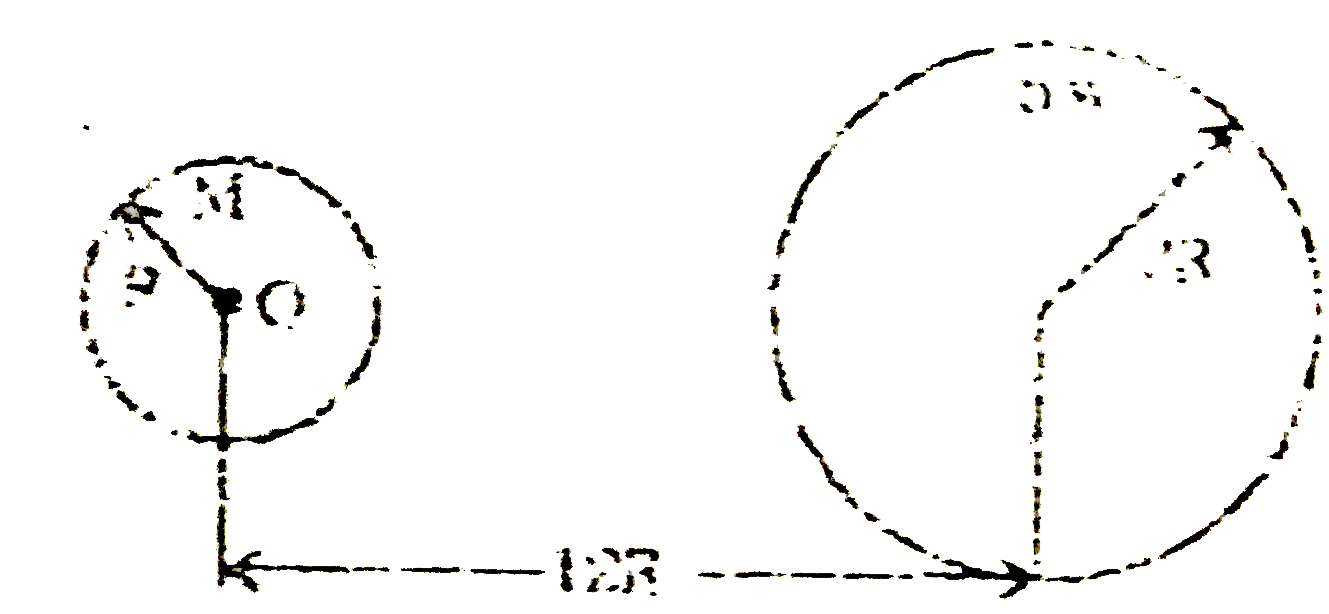
Two spherical bodies of masses M and 5M and radii R and 2R are released in free space with initial separation between their centres equal to 12 R. if they attract each other due to gravitational force only, then the distance convered by the smaller body before collision is

A

`2.5 R`

B

`4.5R`

C

`7.5R`

D

`1.5R`

Text Solution

Verified by Experts

The correct Answer is:
C


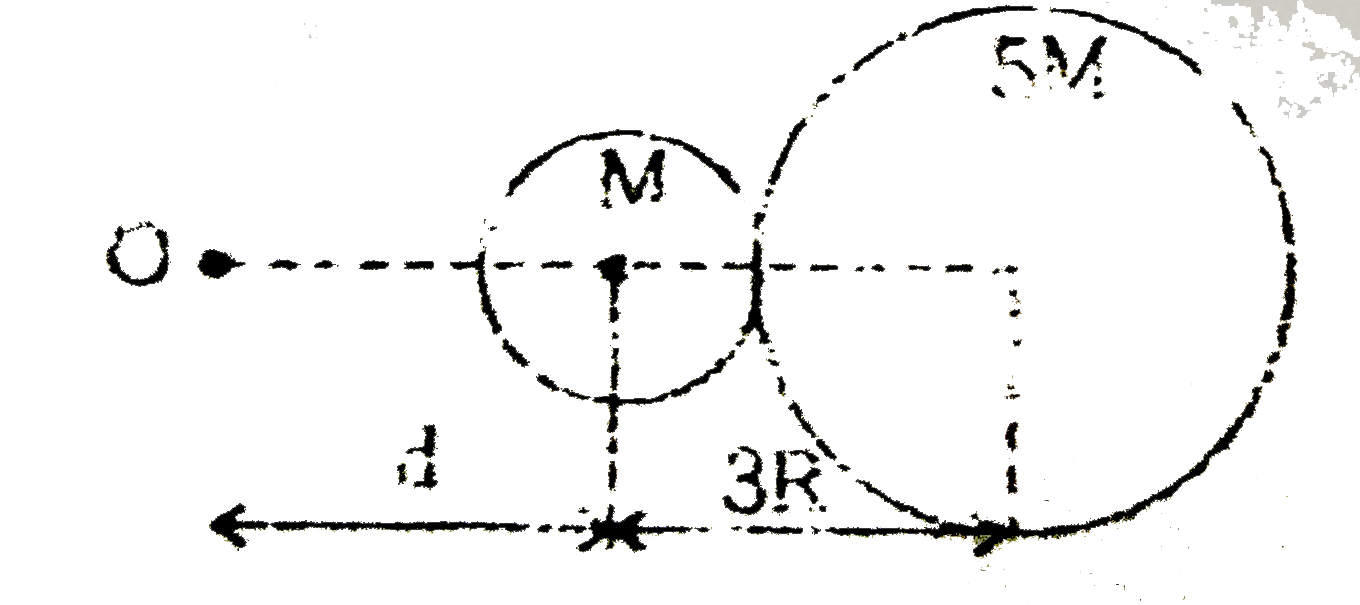
Initial position

Just before collision
For this system, position fo centre of mass remains same
`[:. Vec(F)_("system") = 0]`
`(M(0) + 5M(12R))/(M + 5M) = (M(d) + 5M (d + 3R))/(M + 5M) rArr d = 7.5 R`
Promotional Banner

Topper's Solved these Questions

  • CENTRE OF MASS

    ALLEN|Exercise EXERCISE-V B|19 Videos
  • CENTRE OF MASS

    ALLEN|Exercise EXERCISE-IV B|14 Videos
  • BASIC MATHEMATICS USED IN PHYSICS &VECTORS

    ALLEN|Exercise EXERCISE-IV ASSERTION & REASON|11 Videos
  • ELASTICITY, SURFACE TENSION AND FLUID MECHANICS

    ALLEN|Exercise Exercise 5 B (Integer Type Questions)|3 Videos

Similar Questions

Explore conceptually related problems

Two spherical bodies of mass M and 5M & radii R & 2R respectively are released in free space with initial separation between their centres equal to 12R. If they attract each other due to gravitational force only, then the distance covered by the smallar body just before collision is

Two spherical bodies of masses m and 5m and radii R and 2R respectively, are released in free space with initial separation between their centres equal to 12 R. If they attract each other due to gravitational force only, the distance covered by smaller sphere just before collision is

Two spherical bodies of masses m and 6m and radii R and 2R respectively are released in free space with initial separation between their centres equal to 10 R . If they attract each other due to gravitational force only , then the distance covered by smaller sphere just before collisions will be

Two spherical bodies of masses 2M and M and radii 3R and R respectively are held at a distance 16R from each other in free space. When they are released they start approaching each other due to the gravitational force of attraction , then find (a) the ratio of their accelerations during their motion (b) their velocitites at the time of impact.

Two spherical balls of mass 10 kg each are placed 100 m apart. Find the gravitational force of attraction between them.

Two spheres each of mass M and radius R are separated by a distance of r . The gravitational potential at the midpoint of the line joining the centres of the spheres is

Two spheres each of mass M and radius R are separated by a distance of r . The gravitational potential at the midpoint of the line joining the centres of the spheres is

Two objects of masses m and 4m are at rest at an infinite separation. They move towards each other under mutual gravitational attraction. If G is the universal gravitaitonal constant, then at separation r

Two bodies with masses M_(1) and M_(2) are initially at rest and a distance R apart. Then they move directly towards one another under the influence of their mutual gravitational attraction. What is the ratio of the distances travelled by M_(1) to the distance travelled by M_(2) ?

Two bodies with masses M_(1) and M_(2) are initially at rest and a distance R apart. Then they move directly towards one another under the influence of their mutual gravitational attraction. What is the ratio of the distances travelled by M_(1) to the distance travelled by M_(2) ?

ALLEN-CENTRE OF MASS-EXERCISE-V A
  1. Two identical particles move towards each other with velocity 2v and v...

    Text Solution

    |

  2. Consider the following two statements. (a) Linear momentum of a syst...

    Text Solution

    |

  3. Two spherical bodies of masses M and 5M and radii R and 2R are release...

    Text Solution

    |

  4. A body A of mass M while falling vertically downwards under gravity br...

    Text Solution

    |

  5. The block of mass M moving on the frictionless horizontal surface col...

    Text Solution

    |

  6. A mass m moves with a velocity v and collides with another identical m...

    Text Solution

    |

  7. A 'T' shaped object with dimension shown in the figure, is lying on a ...

    Text Solution

    |

  8. A bomb of mass 16kg at rest explodes into two pieces of masses 4 kg an...

    Text Solution

    |

  9. Consider a two particle system with the particles having masses m1 and...

    Text Solution

    |

  10. A circular disc of radius R is removed from a bigger circular disc of ...

    Text Solution

    |

  11. A block of mass 0.50 kg is moving with a speed of 2.00 m/s on a smooth...

    Text Solution

    |

  12. A thin rod of length 6 m is lying along the x-axis with its ends at x=...

    Text Solution

    |

  13. Consider a rubber ball freely falling from a height h = 4.9 m onto a h...

    Text Solution

    |

  14. Assertion Two particles moving in the same direction do not lose all t...

    Text Solution

    |

  15. This question has Statement I and Statement II. Of the four choices g...

    Text Solution

    |

  16. Distance of the centre of mass of a solid uniform cone from its vertex...

    Text Solution

    |

  17. A particle of mass m moving in the x direction with speed 2v is hit by...

    Text Solution

    |

  18. A uniform thin rod AB of length L has linear mass density mu (x) = a +...

    Text Solution

    |

  19. In transistor, the change in base current from 450 microampere to 500 ...

    Text Solution

    |

  20. In the figure shown ABC is a uniform wire. If centre of mass of wire l...

    Text Solution

    |