Home
Class 11
PHYSICS
A mass m moves with a velocity v and col...

A mass m moves with a velocity v and collides with another identical mass. After collision, the first mass moves with velocity `v//sqrt(3)` in a direction perpendicular to the initial direction of motion. Find the speed of the second mass after collision.

A

v

B

`sqrt3 v`

C

`(2)/(sqrt3) v`

D

`(v)/(sqer3)`

Text Solution

Verified by Experts

The correct Answer is:
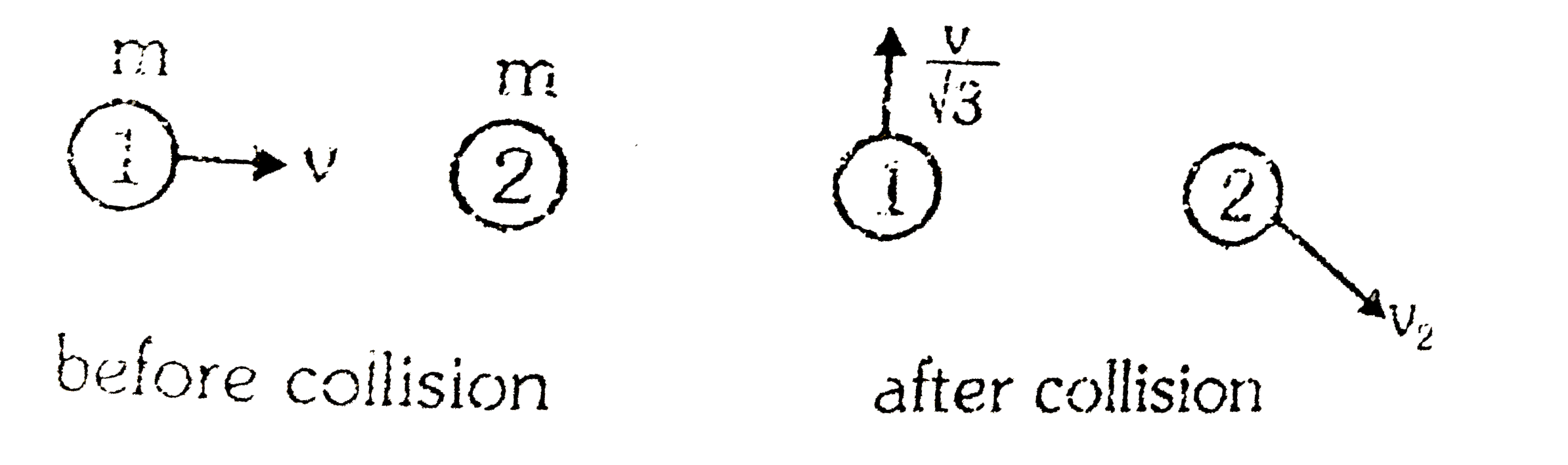
C


From COLM
`mv_(2) = sqrt((mv^(2)) + (m (v)/(sqrt3))^(2)) rArr v_(2) = (2v)/(sqrt3)`
Promotional Banner

Topper's Solved these Questions

  • CENTRE OF MASS

    ALLEN|Exercise EXERCISE-V B|19 Videos
  • CENTRE OF MASS

    ALLEN|Exercise EXERCISE-IV B|14 Videos
  • BASIC MATHEMATICS USED IN PHYSICS &VECTORS

    ALLEN|Exercise EXERCISE-IV ASSERTION & REASON|11 Videos
  • ELASTICITY, SURFACE TENSION AND FLUID MECHANICS

    ALLEN|Exercise Exercise 5 B (Integer Type Questions)|3 Videos

Similar Questions

Explore conceptually related problems

A mass m moves with a velocity v and collides inelastically with another identical mass. After collision the 1st mass moves with velocity v/(sqrt3) in a direction perpendicular to the initial direction of motion. Find the speed of the second mass after collision

A sphere of mass m moves with a velocity 2v and collides inelastically with another identical sphere of mass m. After collision the first mass moves with velocity v in a direction perpendicular to the initial direction of motion . Find the speed of the second sphere after collision .

A ball of mass 1 kg moving with a velocity of "0.4 ms"^(-1) collides with another stationary ball. After the collision, the first ball moves with a velocity of 0.3ms^(1) in a direction making an angle of 90^(@) with its initial direction. The momentum of the second ball after the collision will be (in kg ms^(-1) )

Two spherical balls of masses m1 and m2 collide as shown in figure. After collision mass m1 moves with velocity u/3 in a direction perpendicular to original direction. The angle theta at which mass m2 will move after collision is

Two spherical balls of masses m_1 and m_2 collide as shown in figure. After collision mass m_1 moves with velocity u/3 in a direction perpendicular to original direction. The angle theta at which mass m_2 will move after collision is

A ball of mass m moving with velocity v collides head on elastically with another identical ball moving with velocity - V. After collision

On a friction surface a block a mass M moving at speed v collides elastic with another block of same mass M which is initially at rest . After collision the first block moves at an angle theta to its initial direction and has a speed (v)/(3) . The second block's speed after the collision is

Two sphere A and B of masses m_(1) and m_(2) respectivelly colides. A is at rest initally and B is moving with velocity v along x-axis. After collision B has a velocity (v)/(2) in a direction perpendicular to the original direction. The mass A moves after collision in the direction.

Two sphere A and B of masses m_(1) and m_(2) respectivelly colides. A is at rest initally and B is moving with velocity v along x-axis. After collision B has a velocity (v)/(2) in a direction perpendicular to the original direction. The mass A moves after collision in the direction.

A body of mass 'm' moving with certain velocity collides with another identical body at rest. If the collision is perfectly elastic and after the collision both the bodies moves

ALLEN-CENTRE OF MASS-EXERCISE-V A
  1. Two identical particles move towards each other with velocity 2v and v...

    Text Solution

    |

  2. Consider the following two statements. (a) Linear momentum of a syst...

    Text Solution

    |

  3. Two spherical bodies of masses M and 5M and radii R and 2R are release...

    Text Solution

    |

  4. A body A of mass M while falling vertically downwards under gravity br...

    Text Solution

    |

  5. The block of mass M moving on the frictionless horizontal surface col...

    Text Solution

    |

  6. A mass m moves with a velocity v and collides with another identical m...

    Text Solution

    |

  7. A 'T' shaped object with dimension shown in the figure, is lying on a ...

    Text Solution

    |

  8. A bomb of mass 16kg at rest explodes into two pieces of masses 4 kg an...

    Text Solution

    |

  9. Consider a two particle system with the particles having masses m1 and...

    Text Solution

    |

  10. A circular disc of radius R is removed from a bigger circular disc of ...

    Text Solution

    |

  11. A block of mass 0.50 kg is moving with a speed of 2.00 m/s on a smooth...

    Text Solution

    |

  12. A thin rod of length 6 m is lying along the x-axis with its ends at x=...

    Text Solution

    |

  13. Consider a rubber ball freely falling from a height h = 4.9 m onto a h...

    Text Solution

    |

  14. Assertion Two particles moving in the same direction do not lose all t...

    Text Solution

    |

  15. This question has Statement I and Statement II. Of the four choices g...

    Text Solution

    |

  16. Distance of the centre of mass of a solid uniform cone from its vertex...

    Text Solution

    |

  17. A particle of mass m moving in the x direction with speed 2v is hit by...

    Text Solution

    |

  18. A uniform thin rod AB of length L has linear mass density mu (x) = a +...

    Text Solution

    |

  19. In transistor, the change in base current from 450 microampere to 500 ...

    Text Solution

    |

  20. In the figure shown ABC is a uniform wire. If centre of mass of wire l...

    Text Solution

    |

