Home
Class 12
PHYSICS
A block is released on the slant face of...

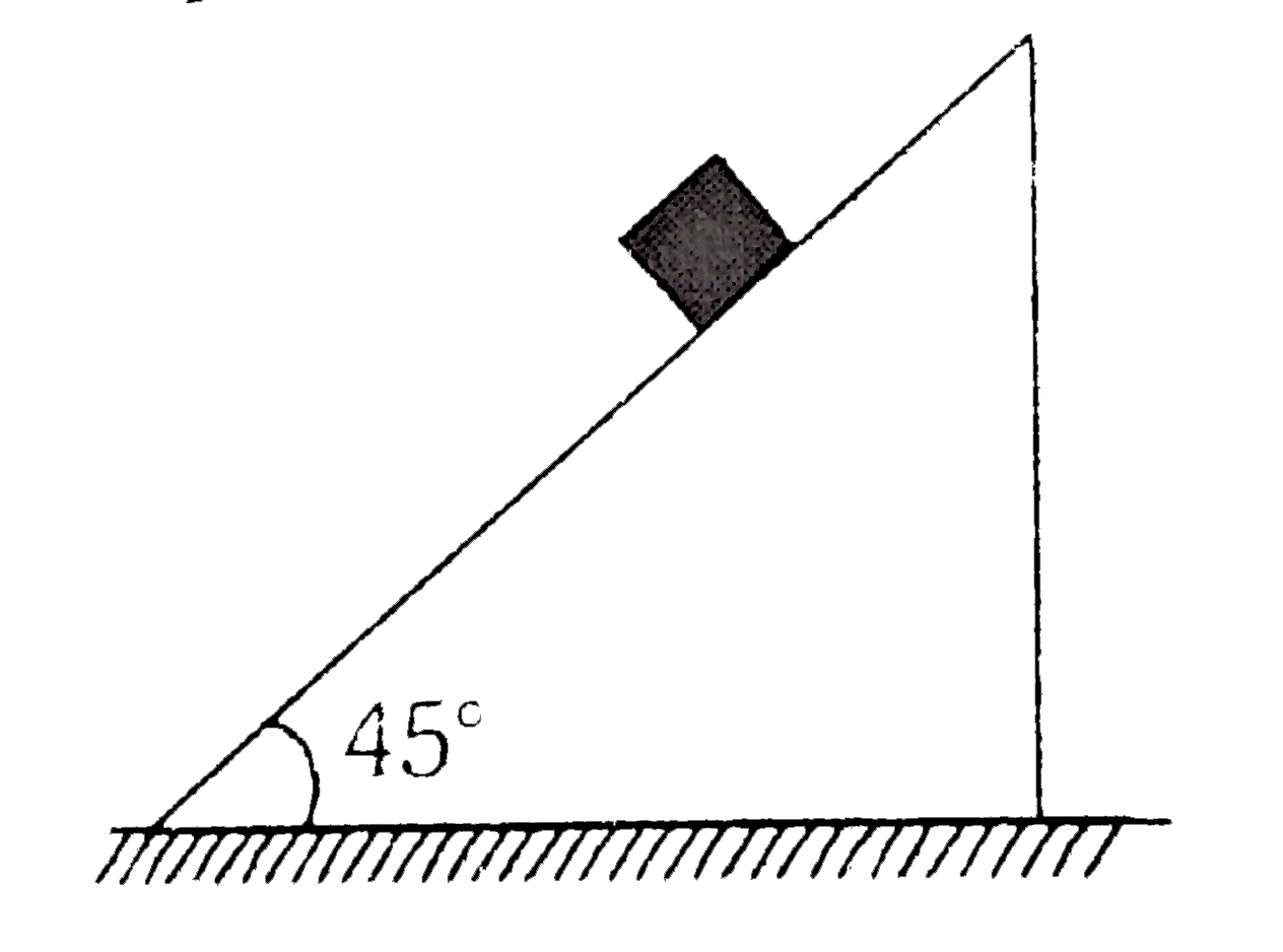
A block is released on the slant face of a wedge of equal mass placed on a horizontal floor. The slant face of the wedge makes an angle of `45^(@)` with the floor. Coefficient of friction between all surfaces in contact is the same. Different value/ range of coefficient of friction is given in column I and corresponding consequences in column II and III (wedge is fress to move)

`{:(,"Column-I",,"Column-II",,"Column-III",),((I),mu=0,(i),"Work done by friction on block and wedge is negative (on each)",(P),"Centre of mass of system (block+wedge) moves rightward and downward",),((II),mu gt 1,(ii),"Work done by friction on block is negative but on wedge it is zero",(Q),"Centre of mass of system (block+wedge) moves leftward and downward",),((III),sqrt(5)-2 lt mu lt 1,(iii),"Work done by friction on block and wedge is zero (on each)",(R ),"Centre of mass of system (block+wedge) remains at rest",),((IV),mu lt sqrt(5) - 2,(iv),"Friction between the block and wedge is static and between the wedge and ground it is kinetic in nature.",(S),"Centre of mass of system (block+wedge) moves vertically downward",):}`
Which of the following options is the correct representaion of the case that the block slides down the wedge and wedge slide on the floor

A

`(I) (iv)S`

B

`(III)(ii)Q`

C

`(IV)(i)Q`

D

`(II)(iii)R`

Text Solution

Verified by Experts

The correct Answer is:
B

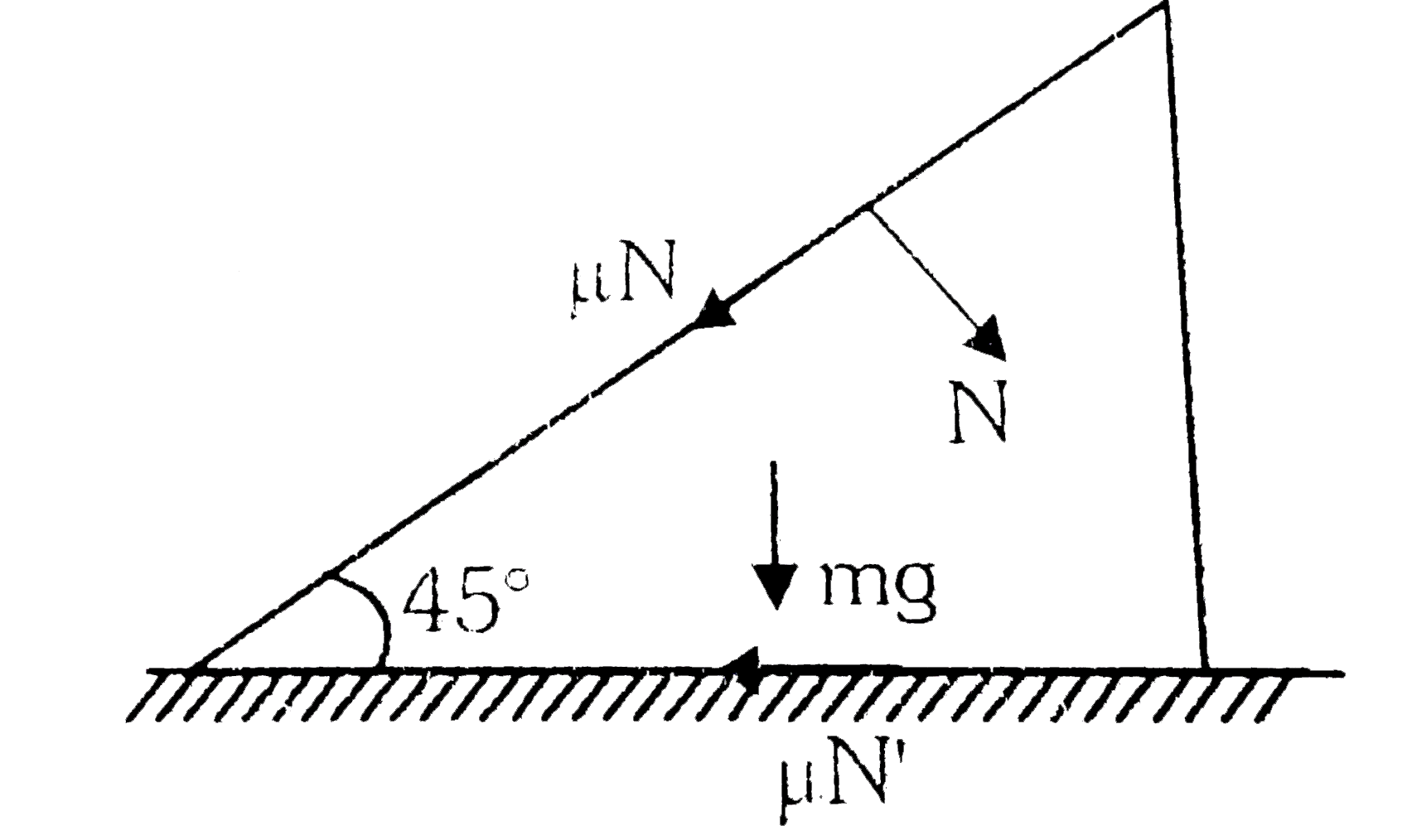
Block moves if `multtantheta`
`implies mult1 " ".....(i)`

For the wedge not to move
`(N)/sqrt(2)-(muN)/sqrt(2)lemuN'`
Here `N=(mg)/sqrt(2)" " N'=(muN)/sqrt(2)+(N)/sqrt(2)+mg`
`"therefore" " "mu ge(sqrt(5-2))" ".....(ii)`
So`(sqrt(5-2))lemu lt1`
Work done by friction on wedge is zero and on block it is negative.
Promotional Banner

Topper's Solved these Questions

  • TEST PAPERS

    ALLEN|Exercise part-2 physic|48 Videos
  • TEST PAPERS

    ALLEN|Exercise PHYSICS|17 Videos
  • TEST PAPERS

    ALLEN|Exercise Part-1 Physics|15 Videos
  • TEST PAPER 4

    ALLEN|Exercise PHYSICS|44 Videos
  • UNIT & DIMENSIONS, BASIC MATHS AND VECTOR

    ALLEN|Exercise Exercise (J-A)|7 Videos

Similar Questions

Explore conceptually related problems

Calculate angle of friction between wedge and block system is at rest M coefficient of friction between wedge and block.

A block of mass m slides over a smooth wedge of mass M which is placed over a rough horizontal surface . The centre of mass of the system will move towards left Here mu = coefficient of friction between the wedge and the ground .

A block of mass m is placed at rest on a smooth wedge of mass M placed at rest on a smooth horizontal surface. As the system is released

a Block of mass m is placed on a wedge of mass M there is no friction between the block and the wedge .The minmum coefficient of friction between the wedge and the gound so that wedge does not move is,

A block of mass "5kg" is placed on a wedge having inclination of 37^(@) with the horizontal. Coefficient of friction between block and wedge is 0.8. Then select the correct statement.

A cube of mass m is placed on top of a wedge of mass 2m, as shown in figure. There is no friction between the cube and the wedge. The minimum co - efficient of friction between the wedge and the horizontal surface, so that the wedge does not move is

A block of mass m is placed on the inclined sufrace of a wedge as shown in fig. Calculate the acceleration of the wedge and the block when the block is released. Assume all surfaces are frictionless.

A horizontal force F pushes wedge of mass M on a smooth horizontal surface. A block of mass m is stationary to the wedge, then:

Find the accelerations of rod A and wedge B in the arrangement shown in figure if the ratio of the mass of the wedge to that of the rod equals eta , and the friction between all contact surfaces is negligible.

A block of mass m is released from the top of a wedge of mass M as shown in figure. Find the displacement of wedges on the horizontal ground when the block reaches the bottom of the wedges. Neglect friction everywhere.

ALLEN-TEST PAPERS-part-2 physics
  1. Two Earth's satellites move in a common plane along circular obrits. T...

    Text Solution

    |

  2. A block is released on the slant face of a wedge of equal mass placed ...

    Text Solution

    |

  3. A block is released on the slant face of a wedge of equal mass placed ...

    Text Solution

    |

  4. A block is released on the slant face of a wedge of equal mass placed ...

    Text Solution

    |

  5. Consider a non conduting ring of radius r and mass m and a particle of...

    Text Solution

    |

  6. Consider a non conduting ring of radius r and mass m and a particle of...

    Text Solution

    |

  7. Consider a non conduting ring of radius r and mass m and a particle of...

    Text Solution

    |

  8. A commander fires a shell at certain angle of projection from A which...

    Text Solution

    |

  9. A trinary star system which is a system of three orbiting around centr...

    Text Solution

    |

  10. A planet is made of two materials of density rho(1) and rho(2) as show...

    Text Solution

    |

  11. A double slit is illuminated by light of wavelength 12000 A .the slits...

    Text Solution

    |

  12. A long thin pliable carpet is laid on the floor. One end of the carpet...

    Text Solution

    |

  13. A regular tetrahedron frame is made up of homogeneous resitance wire o...

    Text Solution

    |

  14. A long straight wire of negligible resistance is bent into V shape, it...

    Text Solution

    |

  15. A solid cube is floating (completely submerged) in a container filled ...

    Text Solution

    |

  16. The arms of a U shaped tube are vertical. The arm on right side is clo...

    Text Solution

    |

  17. A cup contains some mercury in it. Now a narrow glass tube is lowered ...

    Text Solution

    |

  18. From a water tap, liquid comes out in from of cylinder. As water moves...

    Text Solution

    |

  19. A small ball of mass m and charge q is attached to the bottom end of a...

    Text Solution

    |

  20. In youngs double slit experiment the fringes are formed at a distance ...

    Text Solution

    |

