Home
Class 12
PHYSICS
A non-viscous liquid of constant density...

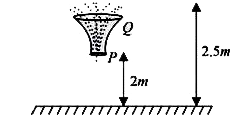
A non-viscous liquid of constant density `10^(3) kg // m^(3)` flows in streamline motion along a vertical tube PQ of variable cross-section. Height of P and Q are 2m and 2.5 m respectively. Area of tube at Q is three time area of tube at P. Find the work done per unit volume by pressure as liquid flows from P to Q. Speed of liquid at P is `3m//s ( g = 10 m//s^(2))`.

A

`2000 J//m^(3)`

B

`1000 J//m^(3)`

C

`1500J//m^(3)`

D

`9000J//m^(3)`

Text Solution

Verified by Experts

The correct Answer is:

B

Mass of `1m^(2)` volume `=1000kg`
from equation of continuity
`A_(Q)=3A_(P)`
`V_(Q)A_(Q)=A_(P)V_(P)`
`V_(Q)3.A_(P)(3)=Ap(3)`
`V_(Q)=1m//s`
A change is in P.E `=1000xx10xx(1)/(2)=5000J`
change in `K.E =(1)/(2)xx1000(3^(2)-1^(2))=4000J`
Net workdone by pressure `=1000J//m^(3)`
Promotional Banner

Topper's Solved these Questions

Similar Questions

Explore conceptually related problems

A non viscous liquid of constant density 10^(3) kg//m^(3) flows in stream line motion along a vertical tube PQ of variable cross-section. Height of P and Q are 2m and 2.5m respectively. Area of tube at Q is equal to 3 times the area of tube at 'P'. Then work done per unit volume by pressure as liquid flows from P and Q. Speed of liquid at 'P' is 3 m//s .

A non viscous liquid of constant density 10^(3) kg//m^(3) flows in stream line motion along a vertical tube PQ of variable cross-section. Height of P and Q are 2m and 2.5m respectively. Area of tube at Q is equal to 3 times the area of tube at 'P'. Then work done per unit volume by pressure as liquid flows from P and Q. Speed of liquid at 'P' is 3 m//s .

A non-viscous liquid of constant density 500 kg//m^(3) flows in a variable cross-sectional tube. The area of cross section of the tube at two points P and Q at heights of 3 m and 6 m are 2 xx 10^(-3) m^(3) and 4 xx 10^(-3) m^(3) , respectively. Find the work done per unit volume by the forces of gravity as the fluid flows from point P to Q .

A non-viscous liquid of constant density 1000kg//m^3 flows in a streamline motion along a tube of variable cross section. The tube is kept inclined in the vertical plane as shown in Figure. The area of cross section of the tube two point P and Q at heights of 2 metres and 5 metres are respectively 4xx10^-3m^2 and 8xx10^-3m^2 . The velocity of the liquid at point P is 1m//s . Find the work done per unit volume by the pressure and the gravity forces as the fluid flows from point P to Q.

Water flows through a horizontal tube of variable cross section.The area of cross section at A and B are 4 mm^2 and 2mm^2 respectively. If 1 cc of water enters per second through A find a) The speed of water at A b) the speed of river at B c) the pressure difference P_A-P_B .

Water flows through a horizontal tube of variable cross-section. The area of cross section at A and B are 4 mm^2 and 2mm^2 respectively. If 1 cc of water enters per seconds through. A find a. The speed of water at A, b. the speed of river at B and c. the pressure difference P_A-P_B .

An ideal liquid (water) flowing through a tube of non-uniform cross section area at A and B are 40 cm^2 and 20 cm^2 respectively. If pressure difference between A & B is 700 N/(m^2) then volume flow rate is

Water flows in a stream line manner through a capillary tube of radius a. The pressure difference being P and the rate of flow is Q. If the radius is reduced to a/4 and the pressure is increased to 4P. then the rate of flow becomes

Water flows in a streamline manner through a capillary tube of radius a. The pressure difference being P and the rate of flow is Q . If the radius is reduced to a//2 and the pressure difference is increased to 2P, then find the rate of flow.

Water flows through a tube shown in figure. The areas of cross section at A and B are 1cm^2 and 0.5 cm^2 respectively. The height difference between A and B is 5m. If the speed of water at A is 10 cms^-1 find a) the speed at B. b) the difference in pressures at A and B.

ALLEN-TEST PAPERS-part-2 physic
  1. A horizontal cylinderical tank (6)/(pi)m in diameter is half full of w...

    Text Solution

    |

  2. A container having two immiscible liquids of densities 'p' and '2p' mo...

    Text Solution

    |

  3. A non-viscous liquid of constant density 10^(3) kg // m^(3) flows in ...

    Text Solution

    |

  4. A uniform thin rod is bent in the form of closed loop ABCDEFA as shown...

    Text Solution

    |

  5. Find force F required to keep the system in equilibrium. The dimension...

    Text Solution

    |

  6. A solid homogeneous sphere is moving on a rough horizontal surface, pa...

    Text Solution

    |

  7. Two current carrying coil having radius 'r' are seperated by distance ...

    Text Solution

    |

  8. The magnetic field in a region is given by vec(B)=B(0)(1+(x)/(a))hat(k...

    Text Solution

    |

  9. In the circuit shown in Fig. Sliding contact is moving with uniform ve...

    Text Solution

    |

  10. A bulb of 100 W is connected in parallel to an ideal inductance of 1H....

    Text Solution

    |

  11. A ray of light is incident on the surface of a sphere of refractive in...

    Text Solution

    |

  12. A cylinder tank of base area A has a small hole of areal a at the bott...

    Text Solution

    |

  13. A ring of mass 'm' and radius 'r' carrying current i(0) is lying in t...

    Text Solution

    |

  14. In the circuit shown in figure power factor of box is 0.5 and power fa...

    Text Solution

    |

  15. A parabolic mirror is silvered at inner surface. The equation of the c...

    Text Solution

    |

  16. Consider two heavy right circular rollers of the radii R and r respect...

    Text Solution

    |

  17. Figure shows graph of deviation delta versus angle of incidence for a ...

    Text Solution

    |

  18. A plank P is placed on a solid cylinder S, which rolls on a horizontal...

    Text Solution

    |

  19. An object to the left of a lens is imaged by the lens on a screen 30cm...

    Text Solution

    |

  20. A direct current if 2A and an alternating current having a maximum val...

    Text Solution

    |
