Home
Class 12
MATHS
If P N is the perpendicular from a point...

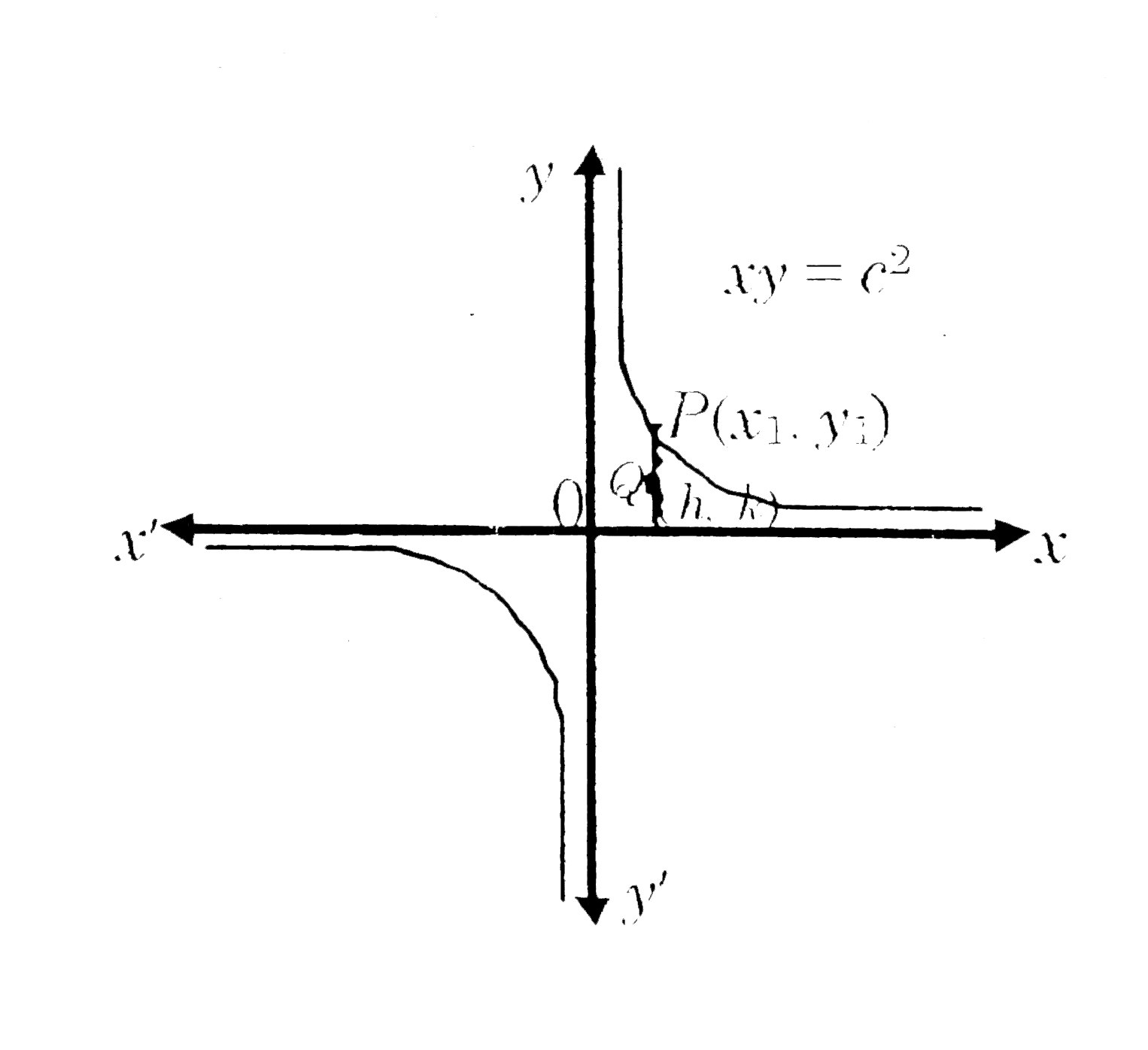
If `P N` is the perpendicular from a point on a rectangular hyperbola `x y=c^2` to its asymptotes, then find the locus of the midpoint of `P N`

A

Circle

B

Parabola

C

Ellipse

D

Hyperbola

Text Solution

Verified by Experts

The correct Answer is:
D


Let `xy=c^(2)` be the rectangular hyperbola, and let `P(x_(1),y_(1))` be a point on it. . Let Q (h,k) be the mid-point of PN.
Then the coordinates of Q are `(x_(1),(y_(1))/(2))`
`therefore x_(1) = h` and `(y_(1))/(2)=k`
`implies x_(1)=h` and `y_(1) =2k`
But `(x_(1),y_(1))` lies on `xy = c^(2)`
`h.(2k) = c^(2) implies hk = c^(2)//2.`
Promotional Banner

Topper's Solved these Questions

Similar Questions

Explore conceptually related problems

the product of the perpendicular distance from any points on a hyperbola to its asymptotes is

The product of lengths of perpendicular from any point on the hyperbola x^(2)-y^(2)=8 to its asymptotes, is

The product of lengths of perpendicular from any point on the hyperola x^(2)-y^(2)=16 to its asymptotes is

The product of perpendicular drawn from any points on a hyperbola (x^2)/(a^2)-(y^2)/(b^2)=1 to its asymptotes is

.Find the product of lengths of the perpendiculars from any point on the hyperbola x^2/16-y^2/9=1 to its asymptotes.

Find the product of the length of perpendiculars drawn from any point on the hyperbola x^2-2y^2-2=0 to its asymptotes.

P Q and R S are two perpendicular chords of the rectangular hyperbola x y=c^2dot If C is the center of the rectangular hyperbola, then find the value of product of the slopes of C P ,C Q ,C R , and C Sdot

The tangent at any point P on the circle x^2+y^2=4 meets the coordinate axes at A and B . Then find the locus of the midpoint of A Bdot

If the sum of the slopes of the normal from a point P to the hyperbola x y=c^2 is equal to lambda(lambda in R^+) , then the locus of point P is (a) x^2=lambdac^2 (b) y^2=lambdac^2 (c) x y=lambdac^2 (d) none of these

If the sum of the slopes of the normal from a point P to the hyperbola x y=c^2 is equal to lambda(lambda in R^+) , then the locus of point P is (a) x^2=lambdac^2 (b) y^2=lambdac^2 (c) x y=lambdac^2 (d) none of these

ALLEN-TEST PAPERS-part-2 Mathematics
  1. If f' ((x)/(y)). f((y)/(x))=(x^(2)+y^(2))/(xy) AA x,y in R^(+) and f(1...

    Text Solution

    |

  2. Range of the function f defined by (x) =[(1)/(sin{x})] (where [.] an...

    Text Solution

    |

  3. The vlaue of sqrt3cot20^(@)-4cos20^(@), is

    Text Solution

    |

  4. Which of the following function is surjective but not injective. (a) ...

    Text Solution

    |

  5. f:RrarrR is a function satisfying f(x+5)gef(x)+5 and f(x+1)lef(x)+1. ...

    Text Solution

    |

  6. If f(x)=((1-tanx)/(1+sinx))^(cosec x) is to be made continuous at x=0,...

    Text Solution

    |

  7. If a(1) is the greatest value of f(x) , where f(x) =((1)/(2+[sinx])) (...

    Text Solution

    |

  8. The value of f(0), so that the function f(x)=((27-2x)^2-3)/(9-3(243+5x...

    Text Solution

    |

  9. Let f:N rarr N be a function that (i) x-f(x)=19[x/19]-90[f(x)/90], f...

    Text Solution

    |

  10. The range of f(x)=sin^(-1)((x^2+1)/(x^2+2)) is (a)[0,pi/2] (b) (0,pi/...

    Text Solution

    |

  11. Let f:[-pi/3,(2pi)/3] rarr [0,4] be a function defined as f(x)=sqrt(3)...

    Text Solution

    |

  12. If vec(alpha), vec(beta),vec(gamma) are three non-collinear unit vecto...

    Text Solution

    |

  13. If the angle between the vectors a=hat(i)+cosxhat(j)+hat(k) and b=(sin...

    Text Solution

    |

  14. Find the slope of a common tangent to the ellipse (x^2)/(a^2)+(y^2)/(b...

    Text Solution

    |

  15. If a tangent to the ellipse (x^(2))/(a^(2))+(y^(2))/(b^(2))=1 makes eq...

    Text Solution

    |

  16. Find the vertices of the hyperbola 9x^2=16 y^2-36 x+96 y-252=0

    Text Solution

    |

  17. If P N is the perpendicular from a point on a rectangular hyperbola x ...

    Text Solution

    |

  18. Find the range of f(x)=sin^(-1)x+tan^(-1)x+cos^(-1)xdot

    Text Solution

    |

  19. If cos^(-1)x+cos^(-1)y+cos^(-1)z=pi,t h e n x^2+y^2+z^2+2x y z=1 2...

    Text Solution

    |

  20. The complete solution set of the inequality (cos^(-1)x)^(2)-(sin^(-1)...

    Text Solution

    |

