


Home
Class 11
PHYSICS
Three coplanar vectrors vec(A), vec(B) a...

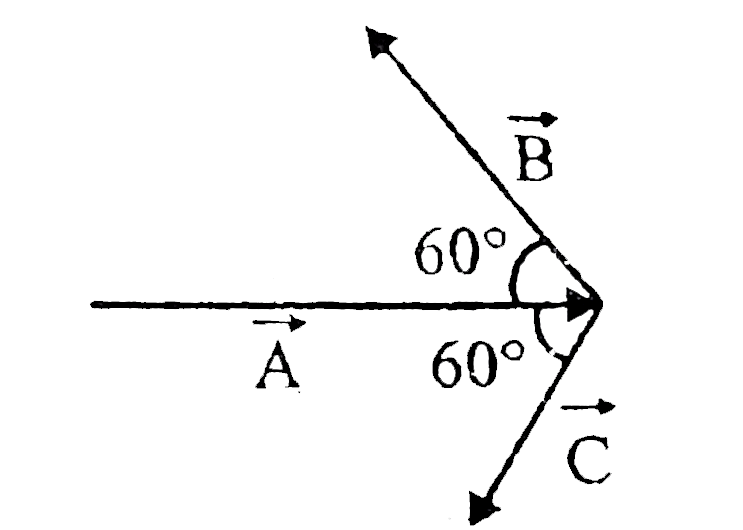
Three coplanar vectrors `vec(A), vec(B)` and `vec(C)` have magnitudes `4, 3` and `2` respectively. If the angle any two vector is `120^(@)` then which of the following vector may be equal to `(3vec(A))/4+vec(B)/3+vec(C)/2`

A

B

C

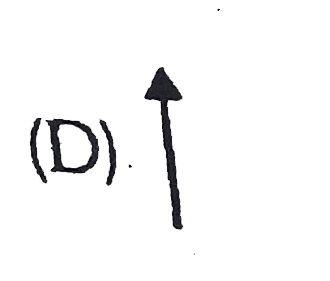
D

Text Solution

Verified by Experts

The correct Answer is:

B

As `|vec(B)/3|=|vec(C)/2|` so `vec(B)/3+vec(C)/2=-vec(A)/4` therefore `(3vec(A))/4+vec(B)/3+vec(C)/2=vec(A)/2`
Promotional Banner

Topper's Solved these Questions

  • MISCELLANEOUS

    ALLEN|Exercise Part -II Example|61 Videos
  • MISCELLANEOUS

    ALLEN|Exercise Part -II Example Some worked out Examples|1 Videos
  • KINEMATICS (MOTION ALONG A STRAIGHT LINE AND MOTION IN A PLANE)

    ALLEN|Exercise BEGINNER S BOX-7|8 Videos
  • PHYSICAL WORLD, UNITS AND DIMENSIONS & ERRORS IN MEASUREMENT

    ALLEN|Exercise EXERCISE-IV|8 Videos

Similar Questions

Explore conceptually related problems

The magnitudes of vectors vec(A),vec(B) and vec(C) are 3,4 and 5 unit respectively. If vec(A)+vec(B)=vec(C), the angle between vec(A) and vec(B) is

Find the angle between two vectors vec a and vec b with magnitudes sqrt(3) and 2 respectively having vec a. vec b=sqrt(6)

What is the angle between vectors vec a\ a n d\ vec b with magnitudes 2 and 3 respectively ? Given vec adot vec b=sqrt(3) .

Let vec a ,\ vec b ,\ vec c be three vectors of magnitudes 3, 4 and 5 respectively. If each one is perpendicular to the sum of the other two vectors, prove that | vec a+ vec b+ vec c|=5sqrt(2) .

The magnitude of vector vec(A),vec(B) and vec(C ) are respectively 12,5 and 13 unit and vec(A)+vec(B)= vec(C ) then the angle between vec(A) and vec(B) is

If vec a\ a n d\ vec b are two vectors of magnitudes 3 and (sqrt(2))/3 respectively such that vec axx vec b is a unit vector. Write the angle between vec a\ a n d\ vec bdot

Two vectors vec(A) and vec(B) have equal magnitudes . If magnitude of vec(A) + vec(B) is equal to n times the magnitude of vec(A) - vec(B) , then the angle between vec(A) and vec(B) is

Three vector vec(A) , vec(B) , vec(C ) satisfy the relation vec(A)*vec(B)=0 and vec(A).vec(C )=0 . The vector vec(A) is parallel to

Three vector vec(A) , vec(B) , vec(C ) satisfy the relation vec(A)*vec(B)=0 and vec(A).vec(C )=0 . The vector vec(A) is parallel to

vec a , vec b , vec c are three coplanar unit vectors such that vec a+ vec b+ vec c=0. If three vectors vec p , vec q ,a n d vec r are parallel to vec a , vec b ,a n d vec c , respectively, and have integral but different magnitudes, then among the following options, | vec p+ vec q+ vec r| can take a value equal to a. 1 b. 0 c. sqrt(3) d. 2
