Home
Class 11
PHYSICS
Two positrons (e+) and two protons (p) a...

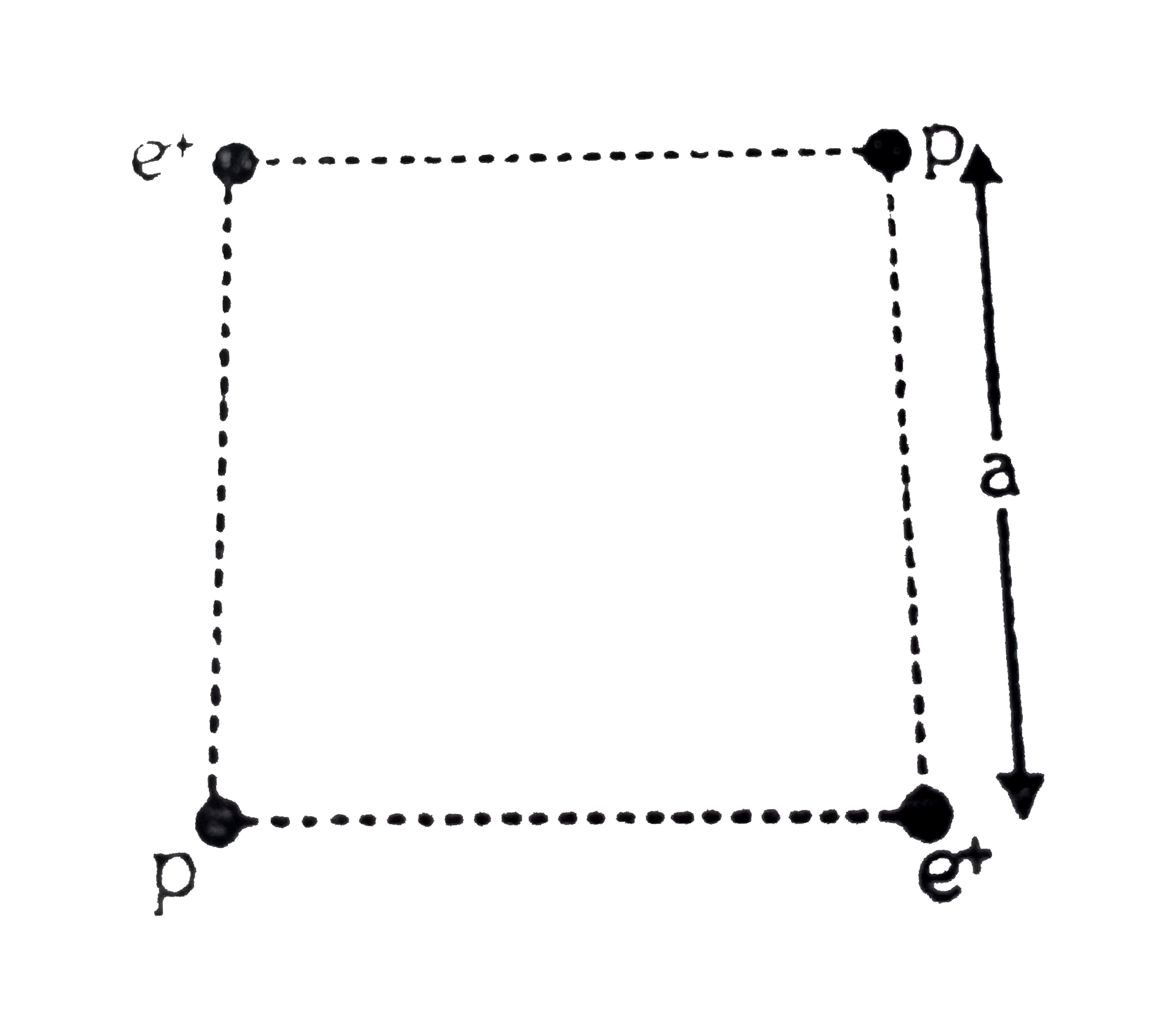
Two positrons (e+) and two protons (p) are kept on four corners of a square of side a as shown in figure. The mass of proton is much larger than the mass of positron. Let q denotes the charge on the proton as well as the position then the kinetic energies of one of the positrons and one of the protons respectively after a very long time will be-

Text Solution

Verified by Experts

The correct Answer is:
D

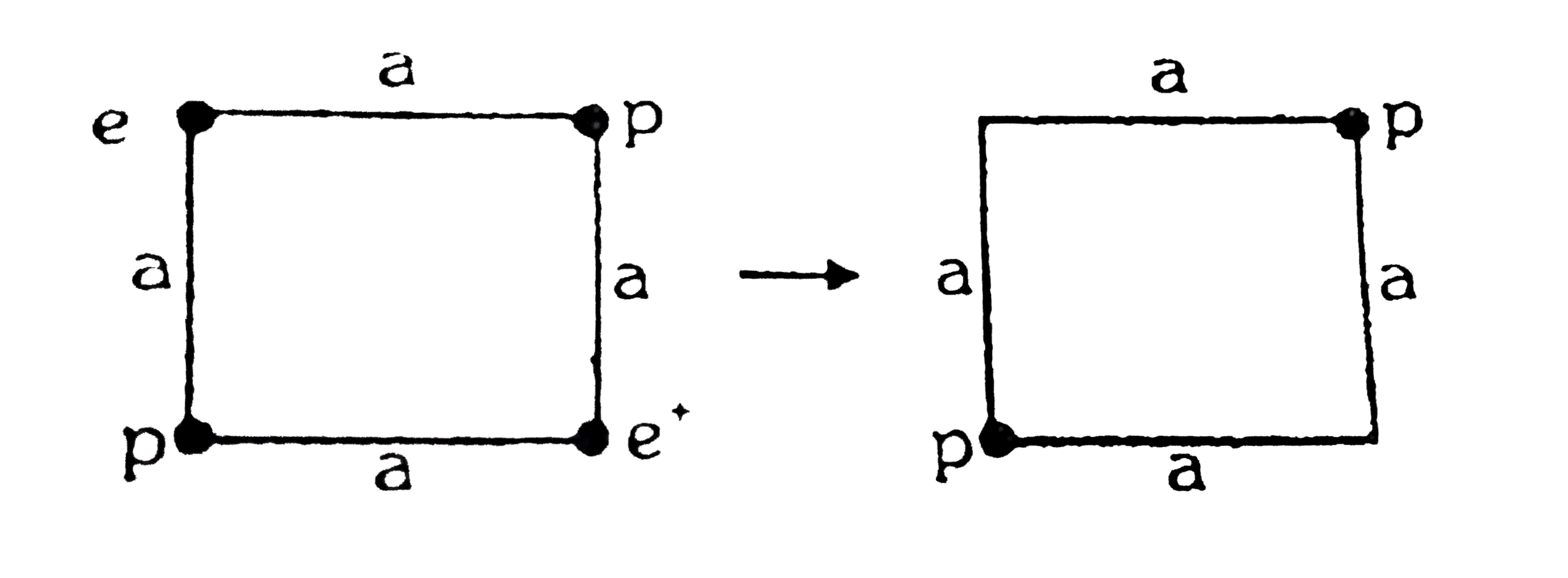
As mass of proton `gt gt gt` mass of position so initial accelaration of position is much larger than proton. Therefore position reach far away in very short time as compare to proton.

`2K_(e^(+))=((4kq^(2))/a+(2kq^(2))/(asqrt(2)))-(kq^(2))/(asqrt(2))rArrK_(e^(+))=q^(2)/(2pi in_(0)a)(1+1/(4sqrt(2)))` and `2K_(p)=(kq^(2))/(asqrt(2))-0rArr K_(p)=q^(2)/(8sqrt(2)pi in_(0)a)`
Promotional Banner

Topper's Solved these Questions

  • MISCELLANEOUS

    ALLEN|Exercise Part -II Example Some worked out Examples|1 Videos
  • MISCELLANEOUS

    ALLEN|Exercise Exercise-01|87 Videos
  • MISCELLANEOUS

    ALLEN|Exercise Question|1 Videos
  • KINEMATICS (MOTION ALONG A STRAIGHT LINE AND MOTION IN A PLANE)

    ALLEN|Exercise BEGINNER S BOX-7|8 Videos
  • PHYSICAL WORLD, UNITS AND DIMENSIONS & ERRORS IN MEASUREMENT

    ALLEN|Exercise EXERCISE-IV|8 Videos

Similar Questions

Explore conceptually related problems

Four equal electric charges are arranged at the four corners of a square of side 'a'. Out of these four charges, two charges are positive and placed at the ends of one diagonal. The other two charges are positive and placed at the ends of the other diagonal. The energy of the system in

A particle which is four times in mass and two times in charge that of proton is called

Four charges are placed at four corners of a square as shown in figure. The side of the square is a. Two charges are positive and two are negative, but their magnitudes are the same. Now, an external agent starts decreasing all the sides of the square slowly and at the same rate. What happens to the electrical potential energy of the system and what will be the nature of work done by the agent?

A proton (mass m and charge +e ) and an alpha -particle (mass 4 m and charge +2e ) are projected with the same kinetic energy at right angles to the uniform magnetic field. Which one of the following statements will be true?

A proton is kept at rest. A positively charged particle is released from rest at a distance d in its field. Consider two experiments, one ini which the charged particle is also a proton and in another, a position. In the same time t , the work done on the two moving charged particles is

A proton is kept at rest. A positively charged particle is released from rest at a distance d in its field. Consider two experiments, one ini which the charged particle is also a proton and in another, a position. In the same time t , the work done on the two moving charged particles is

Two positive charges of magnitude q are placed at the ends of a side ( side 1) of a square of side 2a . Two negative charges of the same magnitude are kept at the other corners . Staring from rest , a charge Q moves from the middle of side 1 to the centre of square , its kinetic energy at the centre of square is -.

An accelration produces a narrow beam of protons, each having an initial speed of v_(0) . The beam is directed towards an initially uncharges distant metal sphere of radius R and centered at point O. The initial path of the beam is parallel to the axis of the sphere at a distance of (R//2) from the axis, as indicated in the diagram. The protons in the beam that collide with the sphere will cause it to becomes charged. The subsequentpotential field at the accelerator due to the sphere can be neglected. The angular momentum of a particle is defined in a similar way to the moment of a force. It is defined as the moment of its linear momentum, linear replacing the force. We may assume the angular momentum of a proton about point O to be conserved. Assume the mass of the proton as m_(P) and the charge on it as e. Given that the potential of the sphere increases with time and eventually reaches a constant velue. After a long time, when the potential of the sphere reaches a constant value, the trajectory of proton is correctly sketched as

A proton is kept at rest. A positively charged particle is released from rest at a distance d in its field. Consider two experiments, one in which the charged particle is also a proton and in another, a positron. In the same time t , the work done on the two moving charged particles is

An electron and a proton are detected in a cosmic ray experiment, the first with kinetic energy 10 keV, and the second with 100 keV. The ratio of their speeds is (where m_e and m_p are masses of electron and proton respectively)

ALLEN-MISCELLANEOUS-Part -II Example
  1. Two conducting hollow spherical shells of radii R and 2R cerry charges...

    Text Solution

    |

  2. An isolated conducting sphere of charge Q and radius R is connected to...

    Text Solution

    |

  3. Two positrons (e+) and two protons (p) are kept on four corners of a s...

    Text Solution

    |

  4. Four charges are placed at the circumference of a dial clock as shown ...

    Text Solution

    |

  5. A small electric dipole is placed at origin with its dipole moment dir...

    Text Solution

    |

  6. Uniform electric field of magnitude 100 Vm^-1 in space is directed alo...

    Text Solution

    |

  7. Figure shows a uniformly charged hemisphere of radius R. It has a volu...

    Text Solution

    |

  8. A metallic rod of length I rotates at angular velocity omega about an...

    Text Solution

    |

  9. Consider a finite charged rod. Electric field at point P (shown) makes...

    Text Solution

    |

  10. The electric potential in a region is given by the relation V(x) = 4+5...

    Text Solution

    |

  11. A thin homogeneous rod of mass m and length l is free to rotate in ver...

    Text Solution

    |

  12. A thin homogeneous rod of mass m and length l is free to rotate in ver...

    Text Solution

    |

  13. A thin homogeneous rod of mass m and length l is free to rotate in ver...

    Text Solution

    |

  14. A simple pendulum is suspended in a lift which is going up with an acc...

    Text Solution

    |

  15. The variation of potential with distance x from a fixed point is shown...

    Text Solution

    |

  16. The energy density u is plotted against the distance r from the centre...

    Text Solution

    |

  17. The figure shown four situations in which charges as indicated (q gt 0...

    Text Solution

    |

  18. An electric field is given by E=(y hat(i)+ xhat(k))N//C. Work done in ...

    Text Solution

    |

  19. The arrangement shown consists of three elements. (i) A thin rod of ...

    Text Solution

    |

  20. Six charges are kept at the vertices of a regular hexagon as shown in ...

    Text Solution

    |

