Home
Class 11
PHYSICS
A metallic rod of length I rotates at a...

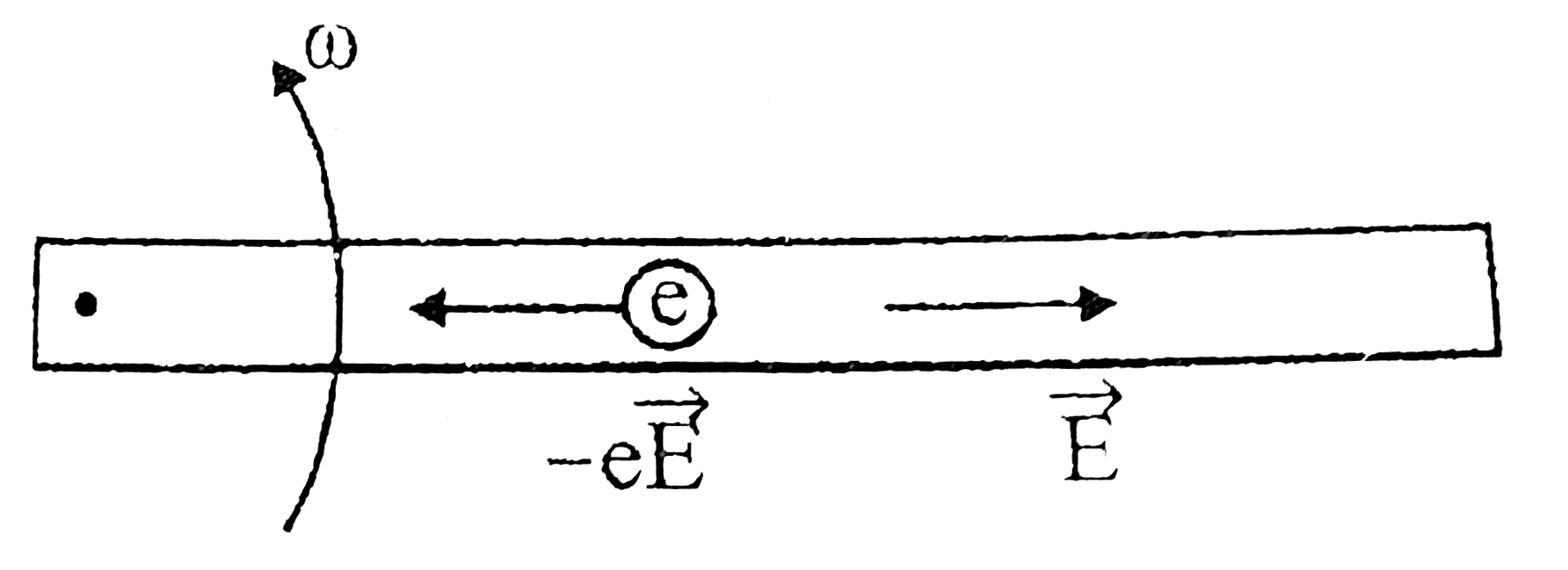
A metallic rod of length I rotates at angular velocity `omega` about an axis passing through one end and perpendicular to the rod. If mass of electron is m and its charge is -e then the magnitude of potential difference between its two ends is

A

`(m omega^(2)l^(2))/((2e))`

B

`(m omega^(2)l^(2))/(e)`

C

`(m omega^(2)l)/(e)`

D

None of these

Text Solution

Verified by Experts

The correct Answer is:
A

When rod the centripetal acceleration of electron comes electric from electric field `E=(mromega^(2))/(e)`
Thus, `DeltaV=-int vec(E).dr=-underset(0)overset(l)(int)(mromega^(2))/(e)dr=(momega^(2)l^(2))/(2e)`
Promotional Banner

Topper's Solved these Questions

  • MISCELLANEOUS

    ALLEN|Exercise Part -II Example Some worked out Examples|1 Videos
  • MISCELLANEOUS

    ALLEN|Exercise Exercise-01|87 Videos
  • MISCELLANEOUS

    ALLEN|Exercise Question|1 Videos
  • KINEMATICS (MOTION ALONG A STRAIGHT LINE AND MOTION IN A PLANE)

    ALLEN|Exercise BEGINNER S BOX-7|8 Videos
  • PHYSICAL WORLD, UNITS AND DIMENSIONS & ERRORS IN MEASUREMENT

    ALLEN|Exercise EXERCISE-IV|8 Videos

Similar Questions

Explore conceptually related problems

Moment of inertia of a thin rod of mass m and length l about an axis passing through a point l/4 from one end and perpendicular to the rod is

A rod is rotating with angular velocity omega about axis AB. Find costheta .

The radius of gyration of an uniform rod of length l about an axis passing through one of its ends and perpendicular to its length is.

A rod of length l rotates with a uniform angular velocity omega about its perpendicular bisector. A uniform magnetic field B exists parallel to the axis of rotation. The potential difference between the two ends of the lrod is

A rod of length l rotates with a uniform angular velocity omega about its perpendicular bisector. A uniform magnetic field B exists parallel to the axis of rotation. The potential difference between the two ends of the lrod is

find the radius of gyration of a rod of mass m and length 2l about an axis passing through one of its ends and perpendicular to its length.

Moment of inertia of a uniform rod of length L and mass M , about an axis passing through L//4 from one end and perpendicular to its length is

Moment of inertia of a uniform rod of length L and mass M , about an axis passing through L//4 from one end and perpendicular to its length is

A uniform rod of mass m and length l rotates in a horizontal plane with an angular velocity omega about a vertical axis passing through one end. The tension in the rod at a distance x from the axis is

Derive an expression per the M.I. of a rectangular rod about an axis passing through its centre of mass and perpendicular to its length.

ALLEN-MISCELLANEOUS-Part -II Example
  1. Two positrons (e+) and two protons (p) are kept on four corners of a s...

    Text Solution

    |

  2. Four charges are placed at the circumference of a dial clock as shown ...

    Text Solution

    |

  3. A small electric dipole is placed at origin with its dipole moment dir...

    Text Solution

    |

  4. Uniform electric field of magnitude 100 Vm^-1 in space is directed alo...

    Text Solution

    |

  5. Figure shows a uniformly charged hemisphere of radius R. It has a volu...

    Text Solution

    |

  6. A metallic rod of length I rotates at angular velocity omega about an...

    Text Solution

    |

  7. Consider a finite charged rod. Electric field at point P (shown) makes...

    Text Solution

    |

  8. The electric potential in a region is given by the relation V(x) = 4+5...

    Text Solution

    |

  9. A thin homogeneous rod of mass m and length l is free to rotate in ver...

    Text Solution

    |

  10. A thin homogeneous rod of mass m and length l is free to rotate in ver...

    Text Solution

    |

  11. A thin homogeneous rod of mass m and length l is free to rotate in ver...

    Text Solution

    |

  12. A simple pendulum is suspended in a lift which is going up with an acc...

    Text Solution

    |

  13. The variation of potential with distance x from a fixed point is shown...

    Text Solution

    |

  14. The energy density u is plotted against the distance r from the centre...

    Text Solution

    |

  15. The figure shown four situations in which charges as indicated (q gt 0...

    Text Solution

    |

  16. An electric field is given by E=(y hat(i)+ xhat(k))N//C. Work done in ...

    Text Solution

    |

  17. The arrangement shown consists of three elements. (i) A thin rod of ...

    Text Solution

    |

  18. Six charges are kept at the vertices of a regular hexagon as shown in ...

    Text Solution

    |

  19. Electric field in a region is given by vec(E)=-4xhat(i)+6yhat(j). The ...

    Text Solution

    |

  20. An infinite plane of charge with sigma=2 in(0) C/m^(2) is tilted at a ...

    Text Solution

    |

