Home
Class 11
PHYSICS
The figure shown four situations in whic...

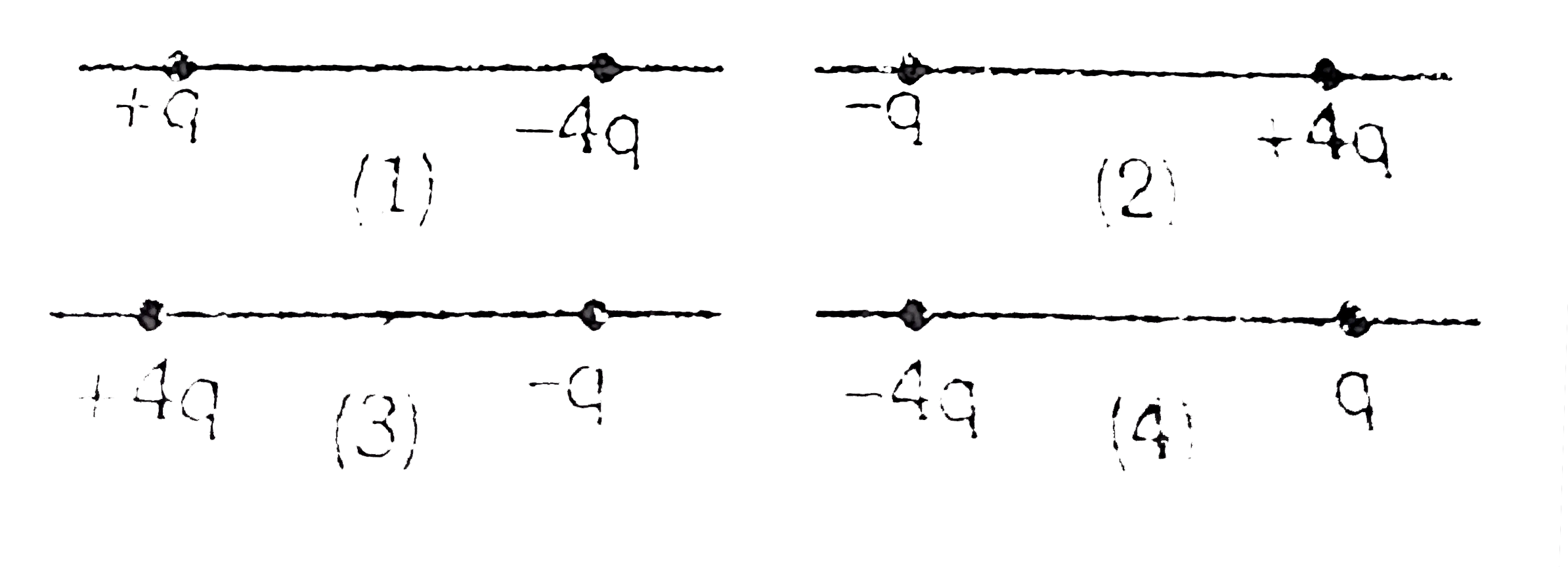
The figure shown four situations in which charges as indicated `(q gt 0)` are fixed on an axis. How many situations is there a point to the left of the charges where an electron would be ib equilibrium?

Text Solution

Verified by Experts

The correct Answer is:
2

For (1)
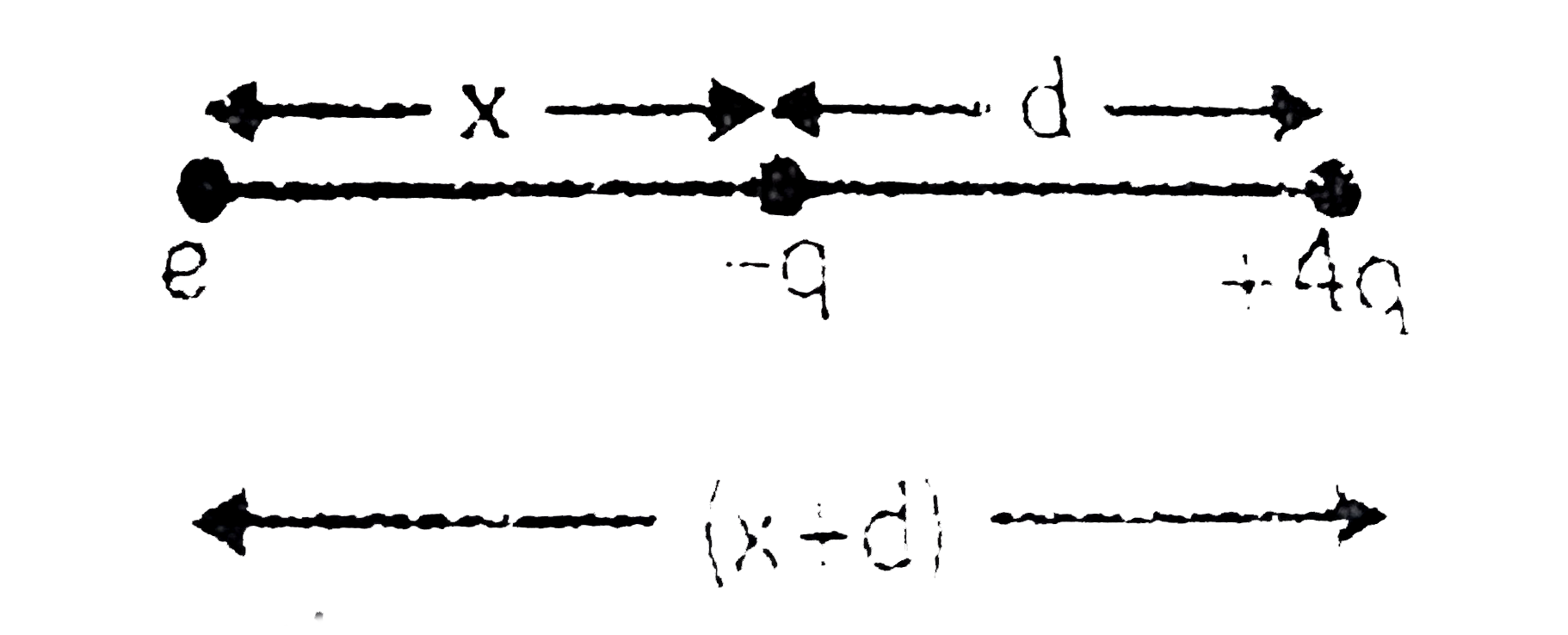
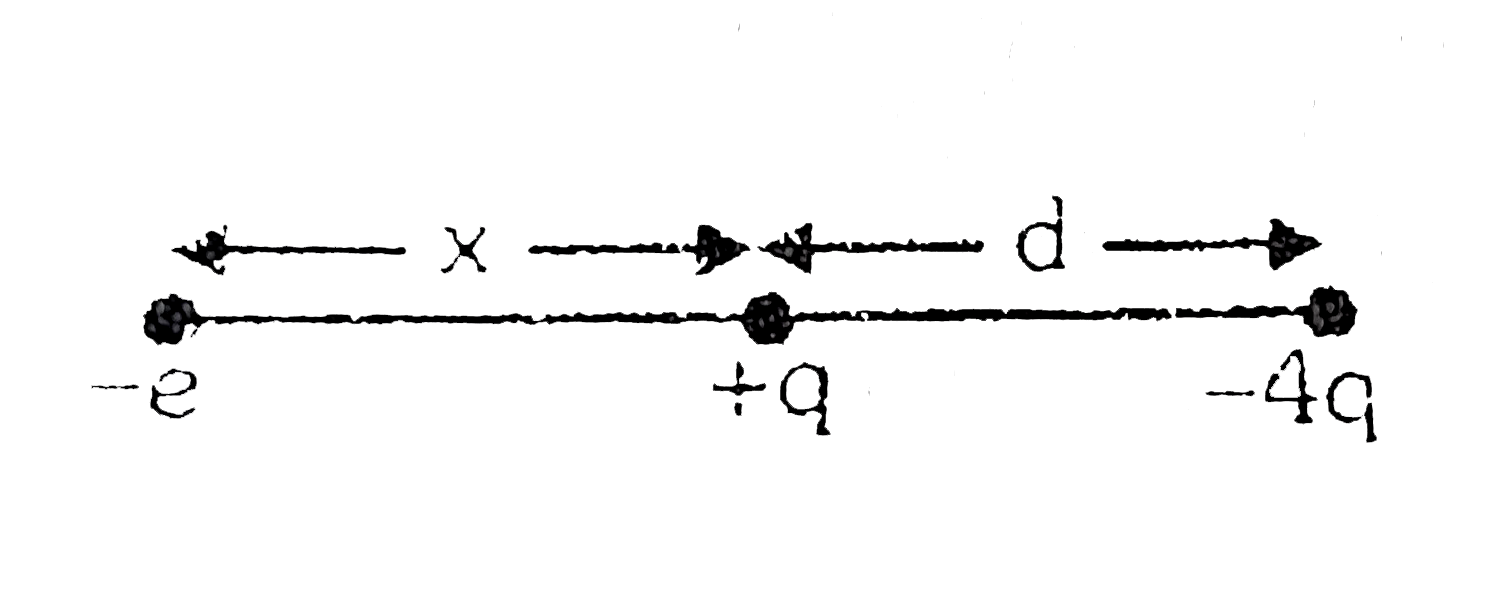
Let the electron be held at a distance x from `+q` charge.
For equilibrium `(q(-e))/(4pi in_(0) x^(2))+((-e)(-4q))/(4pi in_(0)(x+d)^(2))=0`
We can find value of x for which `F_("net")=0` which means that electron will be in equilibrium.
For (2):
For equilibrium `((-e)(-q))/(4pi in_(0)x^(2))+((-e)4q)/(4pi in_(0)(x+d)^(2))=0`
We can find value of x for which `F_("net")=0` which means that electron will be in equilibrium. In case (3) and (4) the electron will not remain at rest, since it experiences a net non-zero force.
OR
Equilibrium is always found near the smaller charge

Promotional Banner

Topper's Solved these Questions

  • MISCELLANEOUS

    ALLEN|Exercise Part -II Example Some worked out Examples|1 Videos
  • MISCELLANEOUS

    ALLEN|Exercise Exercise-01|87 Videos
  • MISCELLANEOUS

    ALLEN|Exercise Question|1 Videos
  • KINEMATICS (MOTION ALONG A STRAIGHT LINE AND MOTION IN A PLANE)

    ALLEN|Exercise BEGINNER S BOX-7|8 Videos
  • PHYSICAL WORLD, UNITS AND DIMENSIONS & ERRORS IN MEASUREMENT

    ALLEN|Exercise EXERCISE-IV|8 Videos

Similar Questions

Explore conceptually related problems

Figure shows four situations in which an electron is moving in electric / magnetic field . In which case the de Broglie wavelength of electron is increasing ?

Four equal charges are kept fixed on the vertices of a square of side 'a'. A charge q_1 is kept at the centre of the square as shown in the figure . Then

Following figures show four situations in which positive and negative charges move horizontaly through a region and give the rate at which each charge moves. Rank the situations according to the effective current through the region greatest first.

Two fixed charges +4q and +q are at a distance 3 m apart. At what point between the charge, a third charge +q must be placed to keep it in equilibrium ?

A charge Q_(1)=+1" C " and Q_(2)=-4 C are fixed at a separation of 1 m. Where should you place the third charge 'q', so that the entire system is in equilibrium ?

A figure below shows the forces that three charged particles exert on each other. Which of the four situations shown can be correct .

Figure shows two charge particles on an axis. The charges are free to move. At one point, however, a third charged particle can be placed such that all three particles are in equilibrium. (a) Is that point to the left of the first two particles to their rightm or between them? (b) should the third paricle be positively or negatively charged? (c ) Is the equilibrium stable or unstable?

Two fixed point charges +4e and +e units are separated by a distance a. Where should a third point charge be placed for it to be in equilibrium?

The figure below depict two situations in which two infinitely long static line charges of constant positive line charge density lambda are kept parallel to each other. In their resulting electric field, point charges q and -q are kept in equilibrium between them. The point charges are confined to move in the x direction only. If they are given a small displacement about their equilibrium positions, then the correct statement(s) is(are)

Two point charge -q and +q//2 are situated at the origin and the point (a,0,0) respectively. The point along the X -axis where the electic field Vanishes is

ALLEN-MISCELLANEOUS-Part -II Example
  1. Two positrons (e+) and two protons (p) are kept on four corners of a s...

    Text Solution

    |

  2. Four charges are placed at the circumference of a dial clock as shown ...

    Text Solution

    |

  3. A small electric dipole is placed at origin with its dipole moment dir...

    Text Solution

    |

  4. Uniform electric field of magnitude 100 Vm^-1 in space is directed alo...

    Text Solution

    |

  5. Figure shows a uniformly charged hemisphere of radius R. It has a volu...

    Text Solution

    |

  6. A metallic rod of length I rotates at angular velocity omega about an...

    Text Solution

    |

  7. Consider a finite charged rod. Electric field at point P (shown) makes...

    Text Solution

    |

  8. The electric potential in a region is given by the relation V(x) = 4+5...

    Text Solution

    |

  9. A thin homogeneous rod of mass m and length l is free to rotate in ver...

    Text Solution

    |

  10. A thin homogeneous rod of mass m and length l is free to rotate in ver...

    Text Solution

    |

  11. A thin homogeneous rod of mass m and length l is free to rotate in ver...

    Text Solution

    |

  12. A simple pendulum is suspended in a lift which is going up with an acc...

    Text Solution

    |

  13. The variation of potential with distance x from a fixed point is shown...

    Text Solution

    |

  14. The energy density u is plotted against the distance r from the centre...

    Text Solution

    |

  15. The figure shown four situations in which charges as indicated (q gt 0...

    Text Solution

    |

  16. An electric field is given by E=(y hat(i)+ xhat(k))N//C. Work done in ...

    Text Solution

    |

  17. The arrangement shown consists of three elements. (i) A thin rod of ...

    Text Solution

    |

  18. Six charges are kept at the vertices of a regular hexagon as shown in ...

    Text Solution

    |

  19. Electric field in a region is given by vec(E)=-4xhat(i)+6yhat(j). The ...

    Text Solution

    |

  20. An infinite plane of charge with sigma=2 in(0) C/m^(2) is tilted at a ...

    Text Solution

    |