Home
Class 11
PHYSICS
An electron is projected as in figure wi...

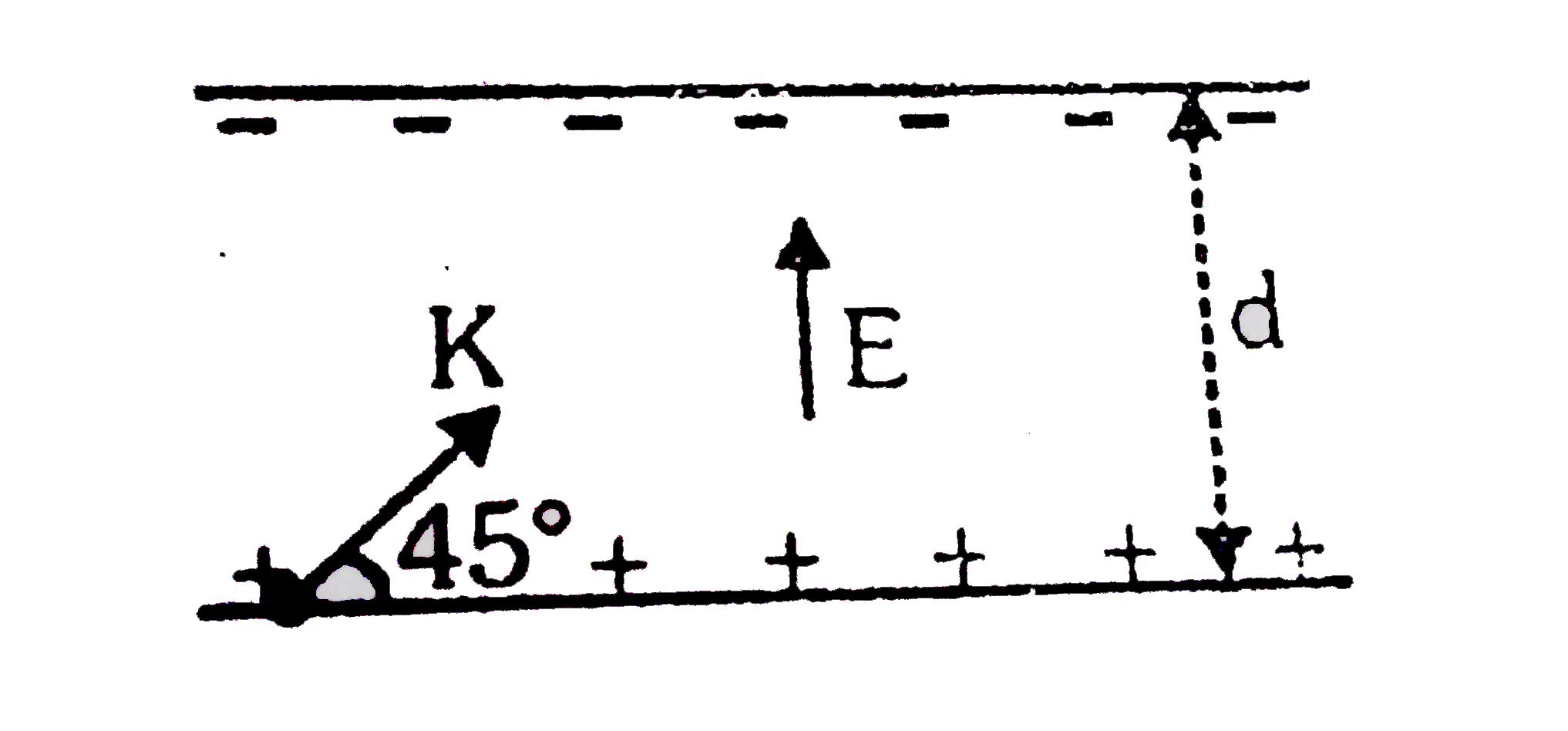
An electron is projected as in figure with kinetic energy K, at an angle `theta=45^(@)` between two charged plates. The magnitude of the electric field so that the electron just fails to strike the upper plate, should be greater than:

A

`K/(qd)`

B

`(2K)/(qd)`

C

`K/(2qd)`

D

iInifinite

Text Solution

Verified by Experts

The correct Answer is:

C

If particle will loose KE (in that direction) against work done by electric field `K/2=qEdrArr E=K/(2qd)`
Promotional Banner

Topper's Solved these Questions

  • MISCELLANEOUS

    ALLEN|Exercise Exersice-03|7 Videos
  • MISCELLANEOUS

    ALLEN|Exercise ASSERTION-REASON|18 Videos
  • MISCELLANEOUS

    ALLEN|Exercise Part -II Example Some worked out Examples|1 Videos
  • KINEMATICS (MOTION ALONG A STRAIGHT LINE AND MOTION IN A PLANE)

    ALLEN|Exercise BEGINNER S BOX-7|8 Videos
  • PHYSICAL WORLD, UNITS AND DIMENSIONS & ERRORS IN MEASUREMENT

    ALLEN|Exercise EXERCISE-IV|8 Videos

Similar Questions

Explore conceptually related problems

An electron is projected as shown in fig. with kinetic energy K, at an angle theta=45^(@) between two charged plates. Ignore the gravity. At what distance from the starting point will the electron strike the lower plate?

The electrons in a particle beam each have a kinetic energy of 1.6 xx 10^(-17)J . What are the magnitude and direction of the electric field that stops these electrons in a distance of 10.0cm

A potential difference of 600 V is applied across the plates of a parallel plate condenser. The separation between the plates is 3 mm. An electron projected vertically, parallel to the plates, with a velocity of 2xx10^(6)m//s moves undeflected between the plates. Find the magnitude of the magnetic field (in T) in the region between the condenser plates. (Neglect the edge effects) square . (Charge of the electron =1.6xx10^(-19)C )

An electron enters the region between the plates of a parallel plate capacitor at an angle theta to the plates. The plate width is l , the plate separation is d . The electron follows the path shown just missing the upper plate. Neglect gravity. Then,

An electron having charge e and mass m starts from the lower plate of two metallic plates separated by a distance d . If the potential difference between the plates is V , the time taken by the electron to reach the upper plate is given by .

An electron is emitted with negligible speed from th nagative plate of a parallel plate capacitor charged ot a potential difference V. The separtion between the plates is d and a magnetic field B exists in the space as shown in . Show that the electron will fail to strike the upper plate if ltdgt ((2m_e V)/(eB_0^2))^(1/2) .

The parallel plate capacitor has potential difference of 100 V and separation between the plate is 1 mm. An electron is projected along x axis in between the plates. If the electron comes out of the plates along the x axis undevated then the magnitude and direction of magnetic field that must be applied between the plates : (particle is projected with a velocity of 10^5 m//s along x axis)

Figure shows three arrangements of an electrons e and two protons p(where Dgtd) (a) Rank the arrangement according to the magnitude of the net electrostatic force on the electron due to the protons placing the largest first. (b) In situation (c), is the angle between the net force on the electrons and the line labeled horiontal less than or more than 45^(@) ?

The potential difference between two large parallel plates is varied as v = at, a is a positive constant and t is time. An electron starts from rest at t=0 from the plate which is at lower potential. If the distance between the plates is L, mass of electron m and charge on electron -e then find the velocity of the electron when it reaches the other plate.

An electron is projected as shown with speed u . If electron just fails to strike the upper plate, find range. (distance from starting point at which electron strike the lower plate again). Consider only electric force.

ALLEN-MISCELLANEOUS-Exercise-01
  1. Two infinite linear charges are placed parallel to each other at a dis...

    Text Solution

    |

  2. An electron of mass M(e), initially at rest, moves through a certain d...

    Text Solution

    |

  3. An electron is projected as in figure with kinetic energy K, at an ang...

    Text Solution

    |

  4. A proton sists at coordinates (x,y)=(0, 0), and an electron at (d, h),...

    Text Solution

    |

  5. A positive point charge 50mu C is located in the plane xy at a point w...

    Text Solution

    |

  6. Three point charges of 1C, 2C and 3C are placed at the corners of an e...

    Text Solution

    |

  7. Rank the work required to assemble the charge distribution below from ...

    Text Solution

    |

  8. The are AB with the centre C and infinitely long wire having linear ch...

    Text Solution

    |

  9. The diagram shows the electric field lines produced by an electrostali...

    Text Solution

    |

  10. A charge +q is placed at the origin O of x-y axes as shoen in the figu...

    Text Solution

    |

  11. Two identical thin rings, each of radius R, are coaxially placed at a...

    Text Solution

    |

  12. Two identical particles of mass m carry a charge Q each. Initially one...

    Text Solution

    |

  13. In a regular polygon of n side, each corner is at a distance r from th...

    Text Solution

    |

  14. An alpha particle of energy 5 MeV is scattered through 180^(@) by a fi...

    Text Solution

    |

  15. In a uniform electric field a charge of 3 C experiences a force of 300...

    Text Solution

    |

  16. Uniform electric field of magnitude 100 Vm^-1 in space is directed alo...

    Text Solution

    |

  17. The equation of an equipotential line in an electric field is y = 2 x...

    Text Solution

    |

  18. In a certain region of space, the potential is given by : V=k[2x^(2)-y...

    Text Solution

    |

  19. (Figure 3.141) shows two equipotential lines in the x plane for an ele...

    Text Solution

    |

  20. The refreactive index of space changes with y, who function is given ...

    Text Solution

    |
