Home
Class 11
PHYSICS
In the diagram (given below), the broken...

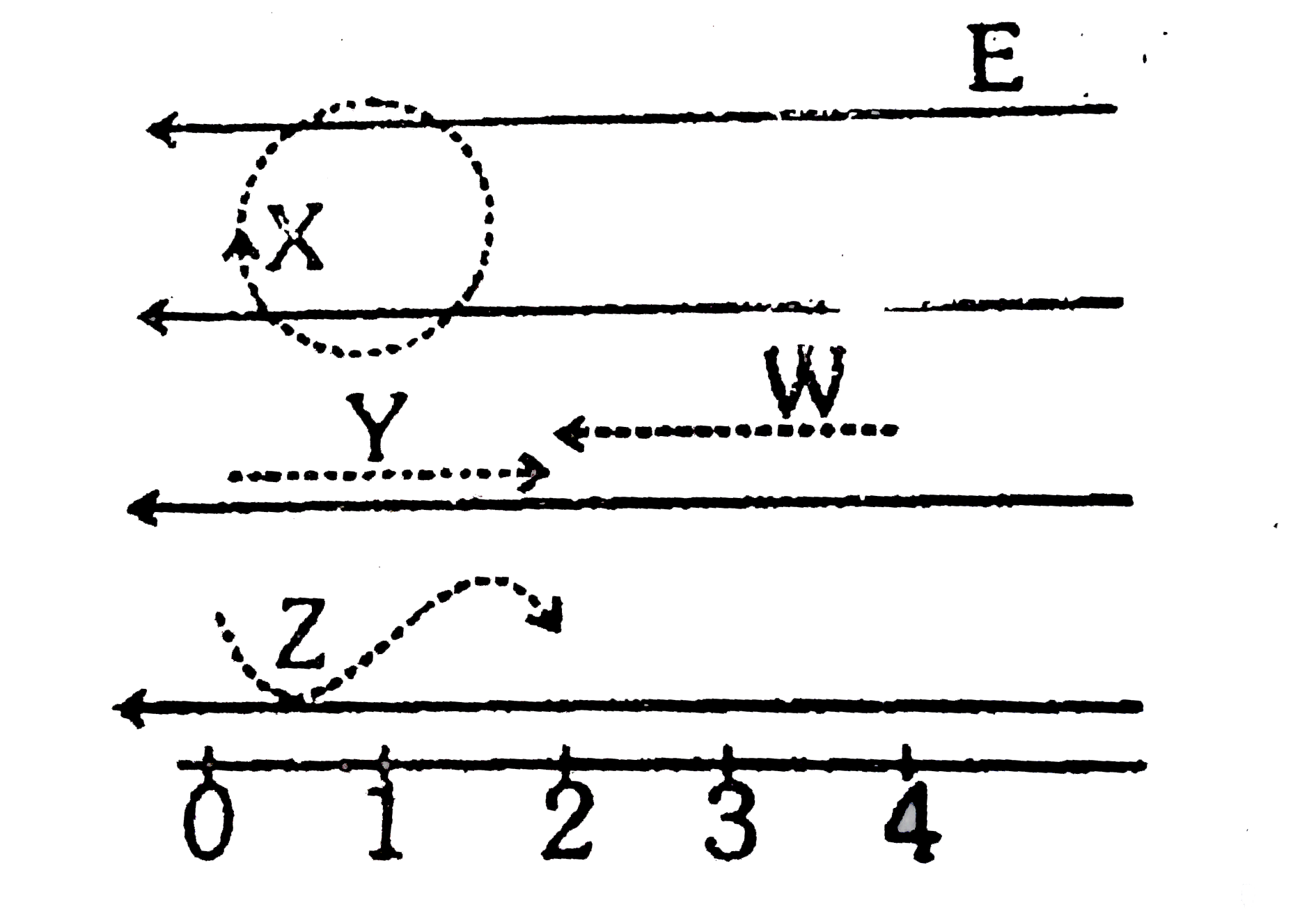
In the diagram (given below), the broken lines represent the paths followed by particles W, X, Y and Z respectively through the contant field E. The number below the field represent meters.

Suppose particle Z has a charge of `+2C`, and is begins and end at rest. If E is `5N//C`, how much work is done on particle Z

A

`10 J`

B

`20 J`

C

`40 J`

D

`80 J`

Text Solution

Verified by Experts

The correct Answer is:

B

`W= int F_("ext").ds`
`rArr (5xx2)xx2`
Promotional Banner

Topper's Solved these Questions

  • MISCELLANEOUS

    ALLEN|Exercise Comprehension 9|2 Videos
  • MISCELLANEOUS

    ALLEN|Exercise Exersice-04[A]|34 Videos
  • MISCELLANEOUS

    ALLEN|Exercise Comprehension 7|3 Videos
  • KINEMATICS (MOTION ALONG A STRAIGHT LINE AND MOTION IN A PLANE)

    ALLEN|Exercise BEGINNER S BOX-7|8 Videos
  • PHYSICAL WORLD, UNITS AND DIMENSIONS & ERRORS IN MEASUREMENT

    ALLEN|Exercise EXERCISE-IV|8 Videos

Similar Questions

Explore conceptually related problems

In the diagram (given below), the broken lines represent the paths followed by particles W, X, Y and Z respectively through the contant field E. The number below the field represent meters. Suppose that the field strength E is 10 N//C and particle Y has a charge of -10 C . When is the mass of particle Y

In the diagram (given below), the broken lines represent the paths followed by particles W, X, Y and Z respectively through the contant field E. The number below the field represent meters. If the particles are positively charged, which particles increased their electric potential energy constant, none of the particle increased their electric potential energy

In the diagram ( given below ) the broken lines represents the paths followed by particles W,,X,Y and Z respectively through the constant field E. The numbers below the field represents meters. In previous question if the particles started from rest and all are positively charge which particles must have been acted upon by a force other than that produced by the electric field. A. W and Y B. X and Z C. X,Y and Z D. W,X,Y and Z

For each inequation , given below, represent the solution on a number line: 3(2x-1) ge 2 (2x+3), x in Z

The cyclotron is a device which is used to accelerate charged particles such as protons, deutrons, alpha particles, etc. to very high energy. The principle on which a cyclotron works is based on the fact that an electric field can accelerate a charged particle and a magnetic field can throw it into a circular orbit. A particle of charge +q experiences a force qE in an electric field E and this force is independent of velocity of the particle. The particle is accelerated in the direction of the magnetic field. On the other hand, a magnetic field at right angles to the direction of motion of the particle throws the particle in a circular orbit in which the particle revolves with a frequency that does not depend on its speed. A modest potential difference is used as a sources of electric field. If a charged particle is made to pass through this potential difference a number of times, it will acquire an enormous by large velocity and hence kinetic energy. Which of the following cannot be accelerated in a cyclotron?

The charge on a particle Y is double the charge on particle X .These two particles X and Y after being accelerated through the same potential difference enter a region of uniform magnetic field and describe circular paths of radii R_(1) and R_(2) respectively. The ratio of the mass of X to that of Y is

Two recangular plates A and B placed at a distance 2a apart, are connected to a battery to produce an electric field. There are insulators between plantes C and other two plates. A magnetic field exists along z-axis. A charged particle of mass m and charge q passes through a hole at the middle of the plate A with velocity v and strikes at Q which is the middle of the bottom edge of plate B after passing through a hole inplate C. If E = mv^(2)//qa , what will be the speed of the particle at Q?

The diagram, given below, represents two inequations P and Q on real number lines : Represent each of the following sets on different number lines : (a) P cup Q (b) P cap Q (c ) P - Q (d) Q - P (e ) P cap Q (f) P cap Q

Let the equations of a line and plane be (x+3)/2=(y-4)/3=(z+5)/2a n d4x-2y-z=1, respectively, then a. the line is parallel to the plane b. the line is perpendicular to the plane c. the line lies in the plane d. none of these

Let the equations of a line and plane be (x+3)/2=(y-4)/3=(z+5)/2a n d4x-2y-z=1, respectively, then a. the line is parallel to the plane b. the line is perpendicular to the plane c. the line lies in the plane d. none of these
