Home
Class 11
PHYSICS
Two identical particles of mass m carry ...

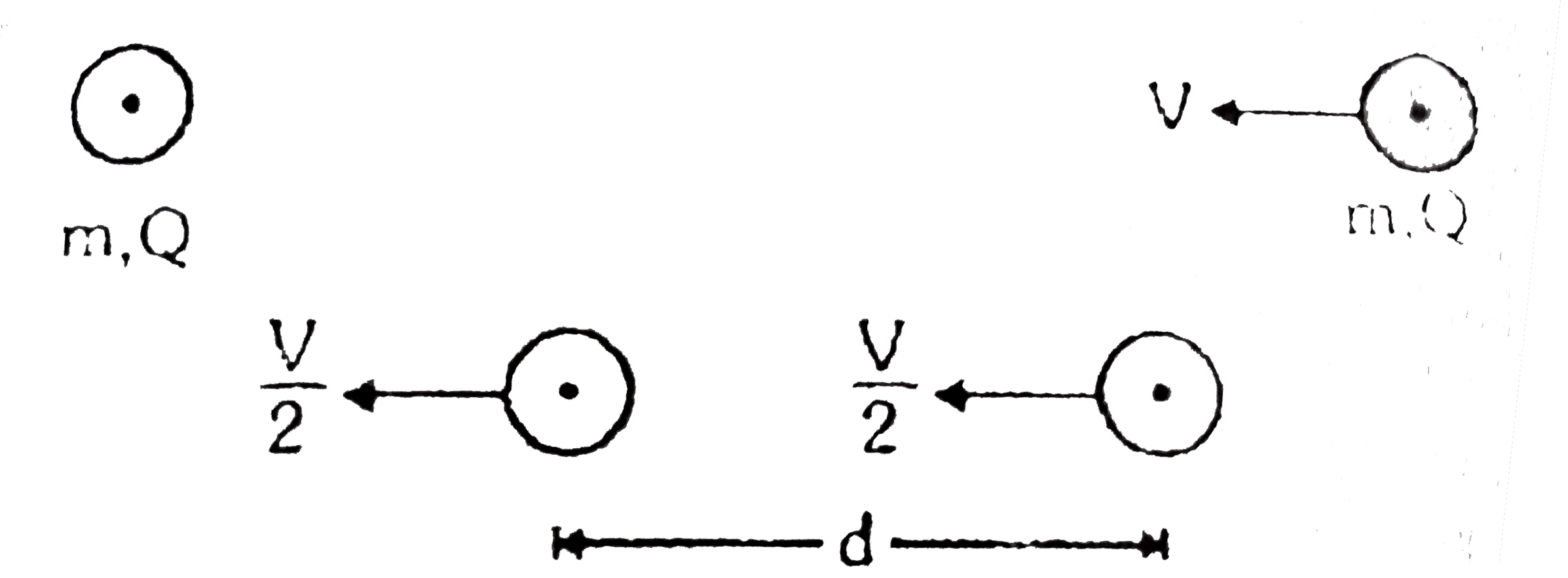
Two identical particles of mass m carry a charge Q each. Initially one is at rest on a smooth horizontal plane and the other is projected along the plane directly towards first particle from a large distance with speed v. The closest distance of approach be :

Text Solution

Verified by Experts

The correct Answer is:
`Q^(2)/(mpi in_(0)V^(2))`


Conservation of momentum (COM)
`0+mV=(m+m)V_(f), V_(f)=V/2`
COME: `1/2 mV^(2)=1/2 m(V/2)^(2)+1/2 m (V/2)^(2)+(Kq^(2))/d`
`d=Q^(2)/(pim in_(0) v^(2))`
Promotional Banner

Topper's Solved these Questions

  • MISCELLANEOUS

    ALLEN|Exercise Exersice-04[B]|16 Videos
  • MISCELLANEOUS

    ALLEN|Exercise Exercise-05(A)|35 Videos
  • MISCELLANEOUS

    ALLEN|Exercise Comprehension 9|2 Videos
  • KINEMATICS (MOTION ALONG A STRAIGHT LINE AND MOTION IN A PLANE)

    ALLEN|Exercise BEGINNER S BOX-7|8 Videos
  • PHYSICAL WORLD, UNITS AND DIMENSIONS & ERRORS IN MEASUREMENT

    ALLEN|Exercise EXERCISE-IV|8 Videos

Similar Questions

Explore conceptually related problems

Two charged particles of masses m and 2m are placed distance d apart on a smooth horizontal table. Because of their mutual attraction, they move towards each other and collide. Where will the collision occur with respect to the initial positions?

A particle of mass m is placed at rest on the top of a smooth wedge of mass M, which in turn is placed at rest on a smooth horizontal surface as shown in figure. Then the distance moved by the wedge as the particle reaches the foot of the wedge is :

A long straight wire carries a current i. A particle having a positive charge q and mass m, kept at distance x_0 from the wire is projected towards it with speed v. Find the closest distance of approach of charged particle to the wire.

Four identical positive point charges Q are fixed at the four corners of a square of side length l . Another charged particle of mass m and charge +q is projected towards centre of square from a large distance along the line perpendicular to plane of square. The minimum value of initial velocity v_(0) (in m/s) required to cross the square is ? (m = 1 gm, l = 4 sqrt(2) m, Q =1 mu c, q = 0.5 muc)

Two blocks of masses m_(1) and m_(2) are connected by a massless pulley A, slides along th esmooth sides of a rectangular wedge of mass m, which rests on a smooth horizontal plane. Find the distance covered by the wedge on the horizontal plane till the mass m_(1) is lowered by the vertical distance h.

A particle approaches from very large distance towards concave mirror along the principal axis. By the time the particle reaches the mirror the distance between the particle and its image will

Two particles each of mass m are connected by a light inextensible string and a particle of mass M is attached to the midpoint of the string. The system is at rest on a smooth horizontal table with string just taut and in a straight line. The particle M is given a velocity v along the table perpendicular to the string. Prove that when the two particles are about to collide : (i) The velocity of M is (Mv)/((M + 2m)) (ii) The speed of each of the other particles is ((sqrt2M (M + m))/((M + 2m)))v .

Two identical particles each of mass m are connected by a light spring of stiffness K. The initial deformation of the spring when the system was at rest, x_(0) . After releasing the system, if one of the particles has a speed v and the deformation of the spring is x, find the speed of the other particle neglecting friction.

A particle of mass 2 g and charge 1 muC is held at rest on a frictionless surface at a distance of 1m from a fixed charge of 1 mC. If the particle is released it will be repelled. The speed of the particle when it is at distance of 10 m from fixed charge is :

A particle of mass .m. and charge q is placed at rest in a uniform electric field E and then released. The K.E. attained by the particle after moving a distance y is

ALLEN-MISCELLANEOUS-Exersice-04[A]
  1. Consider three identical metal spheres A, B and C. Sphere A carries c...

    Text Solution

    |

  2. Consider the configuration of a system of four charges each of value (...

    Text Solution

    |

  3. Two identical particles of mass m carry a charge Q each. Initially one...

    Text Solution

    |

  4. Three point charges of 0.1 C each are placed at the corners of an equi...

    Text Solution

    |

  5. The escape speed of an electron launched from the surface of a 1cm dia...

    Text Solution

    |

  6. Three point charges q, 2q and 8q are to be placed on a . 9cm long st...

    Text Solution

    |

  7. A charge +Q is uniformly distributed over a thin ring with radius R....

    Text Solution

    |

  8. A simple pendulum of length l abd bob mass m is hanging in front of a ...

    Text Solution

    |

  9. Two fixed, equal, positive charges, each of magnitude 5xx 10^-5 C are ...

    Text Solution

    |

  10. Positive and negative charges of 1 muC each are placed at two points a...

    Text Solution

    |

  11. Two charges -2Q abd Q are located at the points with coordinates (-3a,...

    Text Solution

    |

  12. A point charge +q & mass 100 gm experiences a force of 100N at a po...

    Text Solution

    |

  13. A dipole is placed at origin of coordinate system as shown in figure, ...

    Text Solution

    |

  14. Two short dipoles p hat k & (p)/(2) hat(k) are located at (0,0,0) & (1...

    Text Solution

    |

  15. Show that, for a given dipole, V & E cannot have the same magnitude at...

    Text Solution

    |

  16. The length of each side of a cubical closed surface is l If charge q i...

    Text Solution

    |

  17. A point charge Q is located on the axis of a disc of radius R at a dis...

    Text Solution

    |

  18. A charge Q is uniformly distributed over a rod of length l. Consider a...

    Text Solution

    |

  19. A particle of mass m and charge -q moves diametrically through a unifo...

    Text Solution

    |

  20. A charge Q is distributed over two concentric conducting thin spherica...

    Text Solution

    |

