Home
Class 11
PHYSICS
Two identical charged sphere are suspend...

Two identical charged sphere are suspended by strings of equal length. The strings make an angle of `30^@` with each other. When suspended in liqquid of density 0.8 g/c, the angle remain the same. The dielectric constant of the liquid is [density of the material of sphere is 1.6 g/cc]

A

1

B

4

C

3

D

2

Text Solution

Verified by Experts

The correct Answer is:
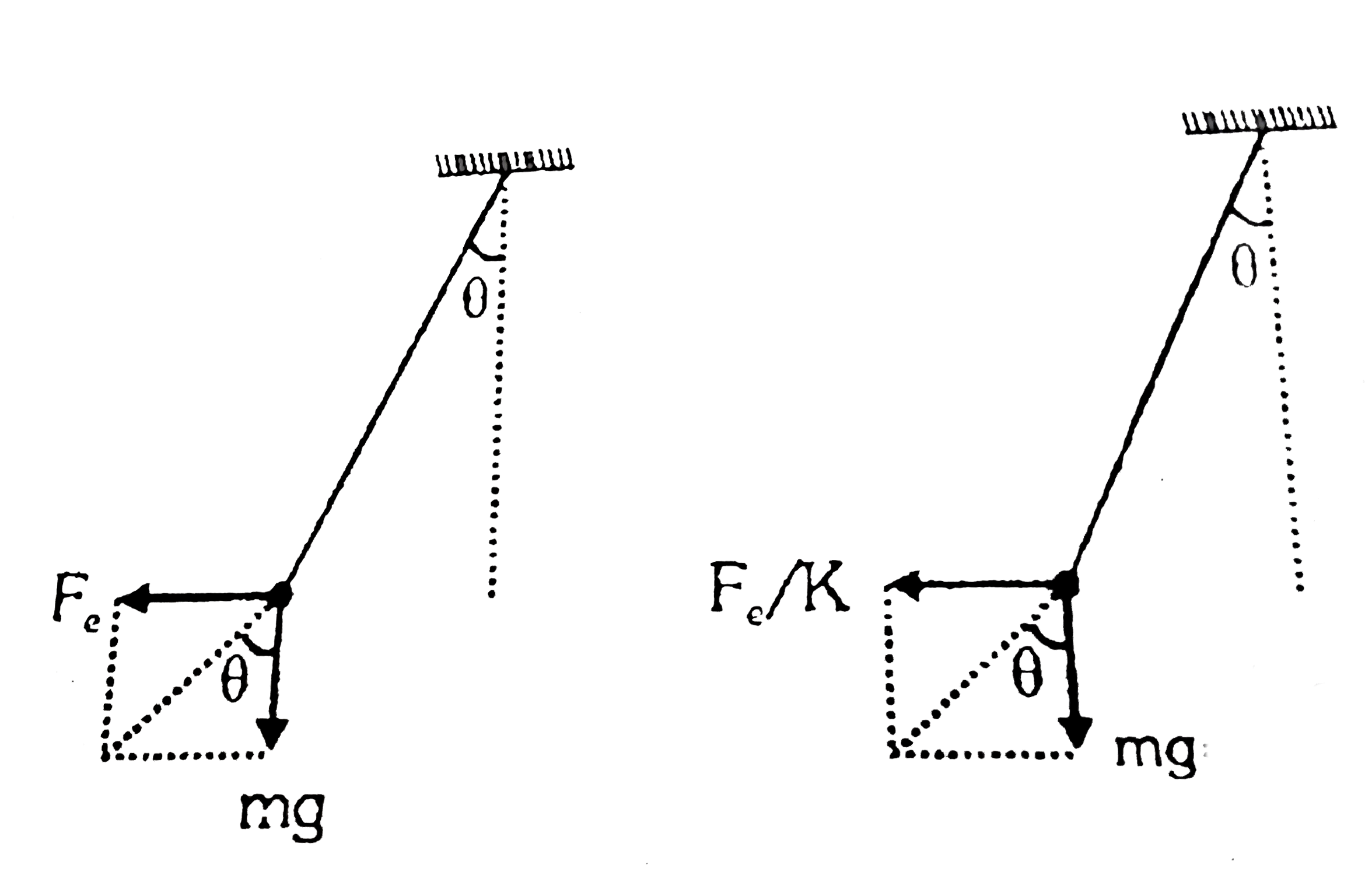
D


Therefore `K=2`
Promotional Banner

Topper's Solved these Questions

  • MISCELLANEOUS

    ALLEN|Exercise Exercise-05(B)|19 Videos
  • MISCELLANEOUS

    ALLEN|Exercise MCQ s WITH ONE OR MORE THAN ONE CORRECT ANSWER|6 Videos
  • MISCELLANEOUS

    ALLEN|Exercise Exersice-04[B]|16 Videos
  • KINEMATICS (MOTION ALONG A STRAIGHT LINE AND MOTION IN A PLANE)

    ALLEN|Exercise BEGINNER S BOX-7|8 Videos
  • PHYSICAL WORLD, UNITS AND DIMENSIONS & ERRORS IN MEASUREMENT

    ALLEN|Exercise EXERCISE-IV|8 Videos

Similar Questions

Explore conceptually related problems

Two identical charged spheres are suspended by strings of equal lengths. The strings make an angle of 30^@ with each other. When suspended in a liquid of density 0.8gcm^-3 , the angle remains the same. If density of the material of the sphere is 1.6gcm^-3 , the dielectric constant of the liquid is

Two identical charged spheres are suspended by strings of equal lengths. The strings make an angle of 30^@ with each other. When suspended in a liquid of density 0.8gcm^-3 , the angle remains the same. If density of the material of the sphere is 1.6gcm^-3 , the dielectric constant of the liquid is

Two identical charged spheres of material density rho , suspended from the same point by inextensible strings of equal length make an angle theta between the string. When suspended in a liquid of density sigma the angle theta remains the same. The dielectric constant K of the liquid is

In a liquid medium of dielectric constant K and of specific gravity 2, two identically charged spheres are suspended from a fixed point by threads of equal lengths. The angle between them is 90^(@) . In another medium of unknown dielectric constant K^(1) , and specific gravity 4, the angle between them becomes 120^(@) . If density of material of spheres is 8gm/cc then find K^(1) .

Two identical balls each having a density rho are suspended from as common point by two insulating strings of equal length. Both the balls have equal mass and charge. In equilibrium each string makes an angle theta with vertical. Now, both the balls are immersed in a liquid. As a result the angle theta does not change. The density of the liquid is sigma . Find the dielectric constant of the liquid.

Two identical balls each having a density rho are suspended from as common point by two insulating strings of equal length. Both the balls have equal mass and charge. In equilibrium each string makes an angle theta with vertical. Now, both the balls are immersed in a liquid. As a result the angle theta does not change. The density of the liquid is sigma . Find the dielectric constant of the liquid.

Two identical pith balls, each carrying charge q, are suspended from a common point by two strings of equal length l. Find the mass of each ball if the angle between the strings is 2theta in equilibrium.

A bob of mass 1 kg is suspended from an inextensible string of length 1 m. When the string makes an angle 60^(@) with vertical, speed of the bob is 4 m/s Net acceleration of the bob at this instant is

Two indentical pith balls, each carrying charge q, are suspended from a common point by two strings of equal length l. Find the mass of each ball if the angle between the strings is 2theta in equilibrium.

Two identical spheres of same mass and specific gravity (which is the ratio of density of a substance and density of water) 2.4 have different charges of Q and -3Q. They are suspended from two stings of a same length l fixed to points at the same horizontal level, but distant l from each other. When the entire set up is transferred inside a liquid of specific gravity 0.8, it is observed that the inclination of each string in equilibrium remains unchanged. Then the dielectric constant of the liquid is

ALLEN-MISCELLANEOUS-Exercise-05(A)
  1. A charge Q is placed at each of the opposite corners of a square. A ch...

    Text Solution

    |

  2. This question contains statements-1 and Statement-2. Of the four choic...

    Text Solution

    |

  3. Two points P and Q are maintained at the potentials of 10V and -4V res...

    Text Solution

    |

  4. Let P(r) = (Q)/(pi R^(4)) r be the charge desntiy distribution for a s...

    Text Solution

    |

  5. Charge q is uniformly distributed over a thin half ring of radius R. T...

    Text Solution

    |

  6. Let there be a spherically symmetric charge distribution with charge d...

    Text Solution

    |

  7. Two identical charged sphere are suspended by strings of equal length....

    Text Solution

    |

  8. Two identical charged spheres suspended from a common point by two mas...

    Text Solution

    |

  9. The electrostatic potential inside a charged spherical ball is given b...

    Text Solution

    |

  10. Two positive charges of magnitude q are placed at the ends of a side A...

    Text Solution

    |

  11. An insulating solid sphere of radius R has a uniform positive charge d...

    Text Solution

    |

  12. In a uniformly charged sphere of total charge Q and radius R, the elec...

    Text Solution

    |

  13. Two charges, each equal to q, are kept at x = −a and x = a on the x-ax...

    Text Solution

    |

  14. A charge Q is uniformly distributed over a long rod AB of length L as ...

    Text Solution

    |

  15. Assume that an electric field E=30 x^(2) hat(i) exist in space. Then, ...

    Text Solution

    |

  16. A uniformly charged solid sphere of radius R has potential V(0) (meas...

    Text Solution

    |

  17. A long cylindrical shell carries positive surface charge sigma in the ...

    Text Solution

    |

  18. The region between two concentric spheres of radii a and b (gt a) cont...

    Text Solution

    |

  19. The potential (in volts) of a charge distribution is given by V(z)=3...

    Text Solution

    |

  20. Within a spherical charge distribution of charge density rho(r), N equ...

    Text Solution

    |

