Home
Class 12
PHYSICS
An object is moving in x-y plane its vel...

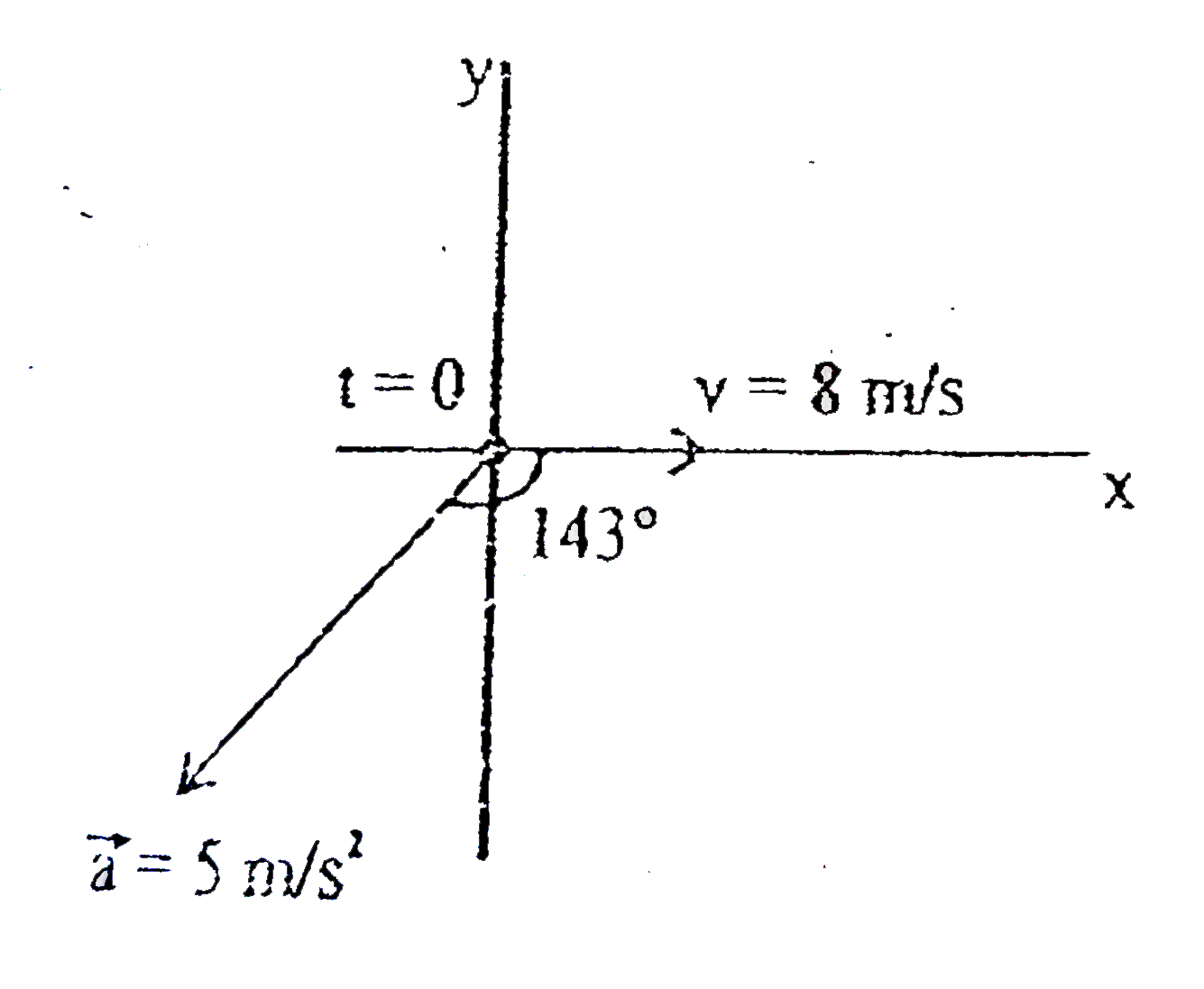
An object is moving in `x-y` plane its velocity and acceleration at `t=0` are represented in figure.

After how much time object crosses the `y-`axis:-

A

`4 sec`

B

`2 sec`

C

`3 sec`

D

None

Text Solution

Verified by Experts

The correct Answer is:
A

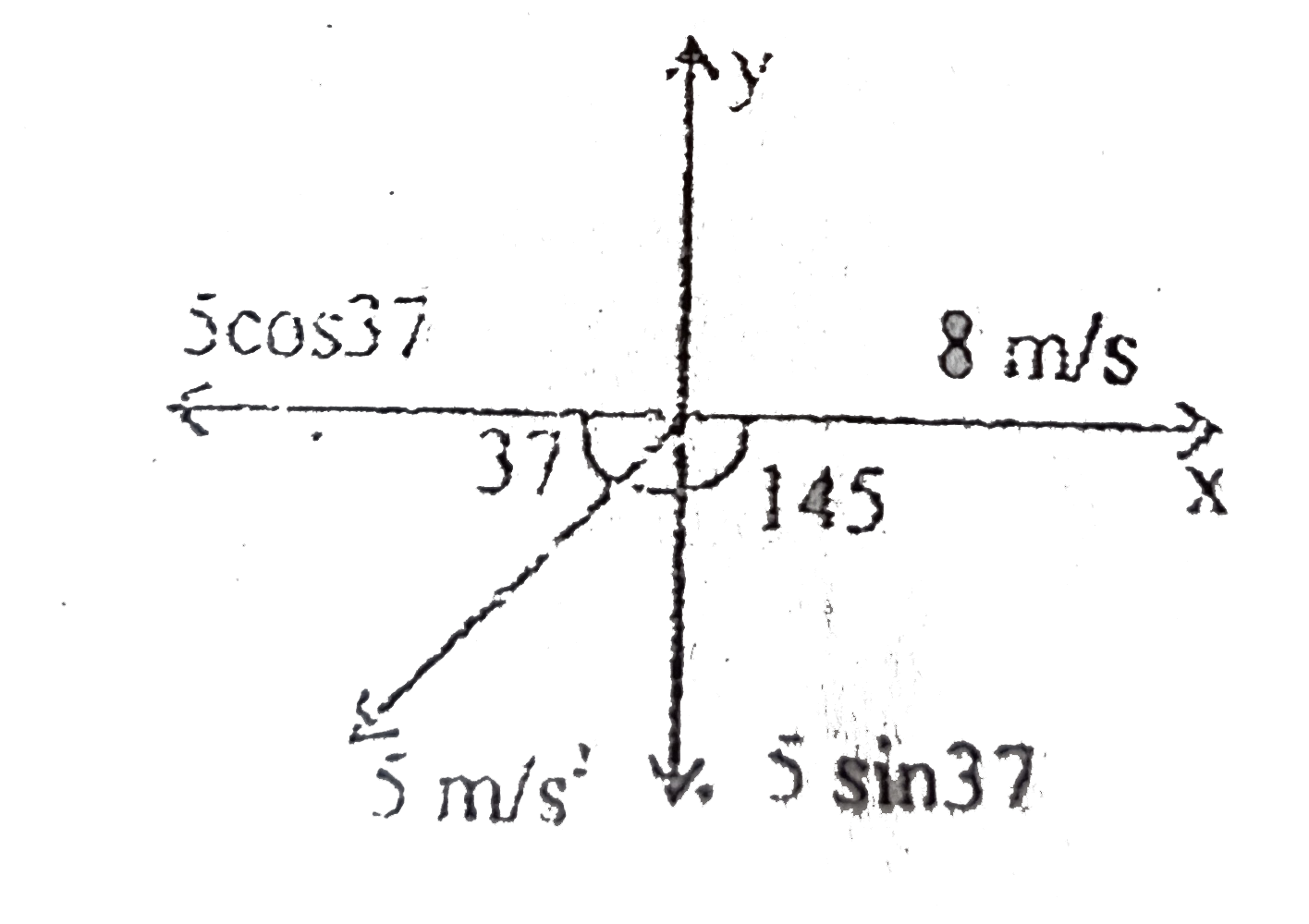
`vec(v)=8hat(i)` " "`vec(a)=-4hat(i)-3hat(j)`
when object crosses `y`-axis
`x=0`
`x=u_(x)t+(1)/(2)a_(x)t^(2)`

`0=8t+(1)/(2)(-4)t^(2)rArrt=4 sec`.
Promotional Banner

Topper's Solved these Questions

Similar Questions

Explore conceptually related problems

An object is moving in x-y plane its velocity and acceleration at t=0 are represented in figure. The ratio of magnitude of velocity to magnitude of component of acceleration along velocity at t=0 :-

A point mass is moving in the x-y plane. Its acceleration is a constant vector perpendicular to the x-axis. Which of the following do/does not charge with time ?

An object of mass m is moving with a constant velocity upsilon How much work should be done on the object in order to bring the object to rest ?

An object starts at the origin in a straight line. Its velocity versus time graph is shown in the figure. Which one of the following choices best gives the proper intervals (s) of time for which the object is moving away from the origin?

A particle starts from the origin of coordinates at time t = 0 and moves in the xy plane with a constant acceleration alpha in the y-direction. Its equation of motion is y = beta x^(2) . Its velocity component in the x-directon is

A particle at origin (0,0) moving with initial velocity u = 5 m/s hatj and acceleration 10 hati + 4 hatj . After t time it reaches at position (20,y) then find t & y

An object is moving in the x-y plane with the position as a function of time given by vecr = x(t)hati + y(t)hatj . Point O is at x = 0 , y = 0 . The object is definitely moving towards O when

A particle starts from the origin of coordinates at time t = 0 and moves in the xy plane with a constant acceleration alpha in the y-direction. Its equation of motion is y= betax^2 . Its velocity component in the x-direction is

The potential energy of an object of mass m moving in xy plane in a conservative field is given by U = ax + by , where x and y are position coordinates of the object. Find magnitude of its acceleration :-

An object is moving towards a stationary plane mirror with a speed of 2 m/s. Velocity of the image w.r.t. the object is

