Home
Class 12
PHYSICS
In figure, the ball A is released from r...

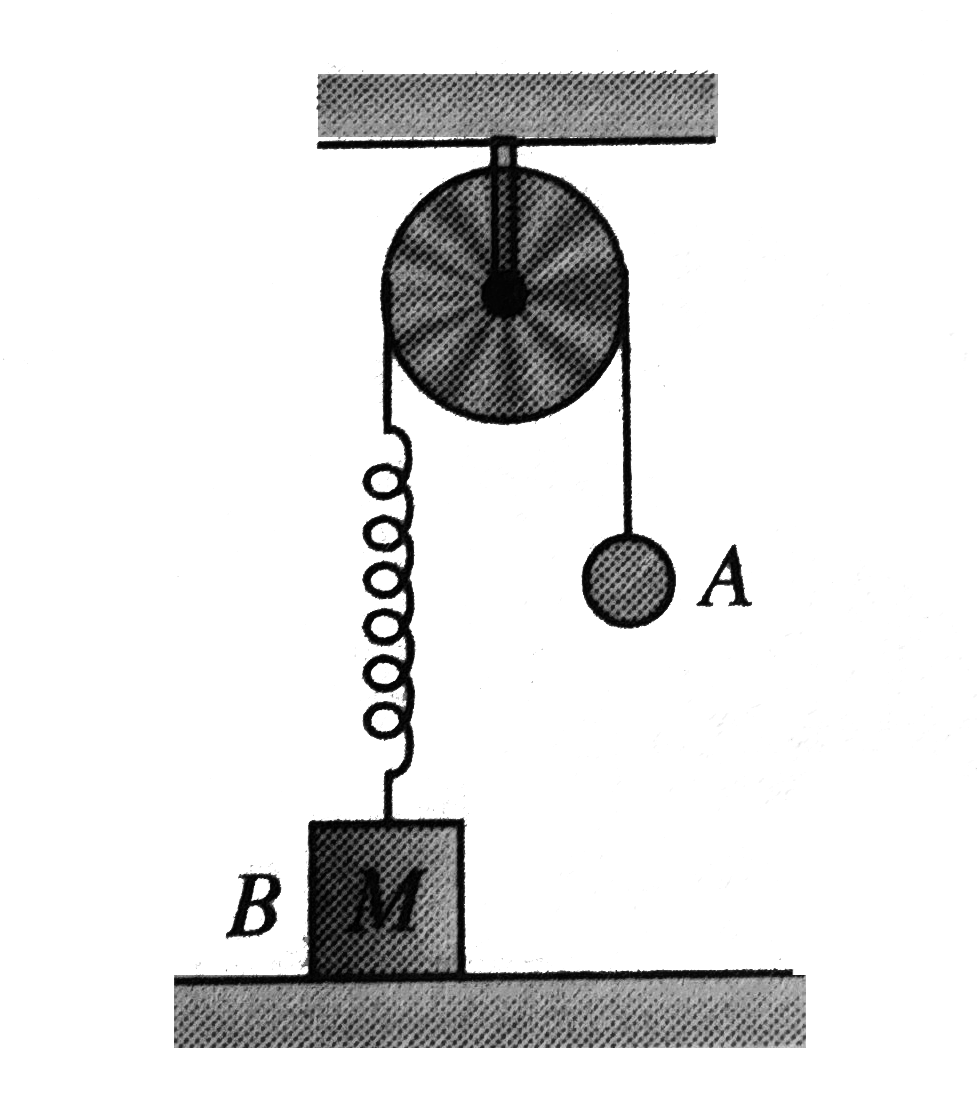
In figure, the ball A is released from rest, when the spring is at its natural (unstretched) length. For the block B of mass M to leave contact with ground at some stage, the minimum mass of A must be

A

`2M`

B

`M`

C

`M//2`

D

A function of `M` and the force constant of the spring.

Text Solution

Verified by Experts

The correct Answer is:

C

The spring will exert the maximum force when the ball is at its lowest postion. If the ball has descended through a distance `x` to reach this position, `mgx=(1)/(2)kx^(2)`. Where `k` is the force constant of the spring. For the block `B` to leave contact, spring force `=kx=Mg`
Promotional Banner

Topper's Solved these Questions

Similar Questions

Explore conceptually related problems

In figure, block A is released from rest, when spring is at its natural unstretched length. For block B of mass M to leave contact with the ground at some stage, the minimum mass of A must be

In the figure, block A is released from rest when the spring is its natural length for the block B of mass m to leave contact with the ground at some stage what should be the minimum mass of block A? .

The system is released from rest with spring intially in its natural length. If mass of the block m = 10 kg. and spring constant k = 100 N//m , then maximum extension in spring is :

A ball of mass m is attached to the lower end of a light vertical spring of force constant K . The upper end of the spring is fixed. The ball is released from rest with the spring at its normal ( unstretched ) length, and comed to rest again after descending through a distance x .

Block m is released from rest when spring is in its natural length ( assume pulley is ideal and block does not strike on ground during it's motion in vertical plane ) than :

A block suspended from a spring is released when the spring is unstretched. Then choose the correct options.

The block of mass m is released when the spring was in its natrual length. Spring constant is k. Find the maximum elongation of the spring.

Find the maximum tension in the spring if initially spring at its natural length when block is released from rest.

System shown in figure is released from rest . Pulley and spring is mass less and friction is absent everywhere. The speed of 5 kg block when 2 kg block leaves the constant of with ground is (force constant of spring k = 40 N//m and g = 10 m//s^(2))

The system is released from rest with both the springs in unstretched positions. Mass of each block is 1 kg and force constant of each spring is 10 N//m . In the equilibrium position, speed of the block placed horizontally is

ALLEN-TEST PAPER-Exercise (Physics)
  1. A constant force produces maximum velocity V on the block connected to...

    Text Solution

    |

  2. A particle with total energy E is moving in a potential energy region ...

    Text Solution

    |

  3. In figure, the ball A is released from rest, when the spring is at its...

    Text Solution

    |

  4. A charge moving with velocity V in X direction is subjected to a fiel...

    Text Solution

    |

  5. The potential energy for a force filed vecF is given by U(x,y)=cos(x+y...

    Text Solution

    |

  6. The potential energy of a particle of mass 5 kg moving in the x-y plan...

    Text Solution

    |

  7. As a particle moves along the x-axis, it is acted upon by a conservati...

    Text Solution

    |

  8. Water is flowing in a river at 2 m s^(-1). The river is 50 m wide and ...

    Text Solution

    |

  9. Which of the following statemente is / are INCORRECT? (a) Mechanical...

    Text Solution

    |

  10. Consider the following sketch of potential energy for a particle as a ...

    Text Solution

    |

  11. The potential energy of a 1 kg particle free to move along the x-axis ...

    Text Solution

    |

  12. The figure below shows a graph of potential energy U(s) verses positio...

    Text Solution

    |

  13. A force F acting on a body depends on its displacement S as FpropS^(-1...

    Text Solution

    |

  14. If vec(A)=2hat(i)+hat(j)+hat(k) and vec(B)=hat(i)+2hat(j)+2hat(k), fi...

    Text Solution

    |

  15. An insect starts from (2,3,4) and travels along (hat(i)+2hat(j)+2hat(k...

    Text Solution

    |

  16. For the given vector vec(A)=3hat(i)-4hat(j)+10hat(k), the ratio of mag...

    Text Solution

    |

  17. In the arrangement shown in figure coefficient of friction between 5kg...

    Text Solution

    |

  18. A block is kept at the corner of two walls and force 3N is applied on ...

    Text Solution

    |

  19. A plank of mass 2 kg and length 1 m is placed on horizontal floor.A sm...

    Text Solution

    |

  20. A block is moving along y-axis with velocity vec(v)(A)=4hat(j) on a pl...

    Text Solution

    |
