Home
Class 12
PHYSICS
Power of a force acting on a block varie...

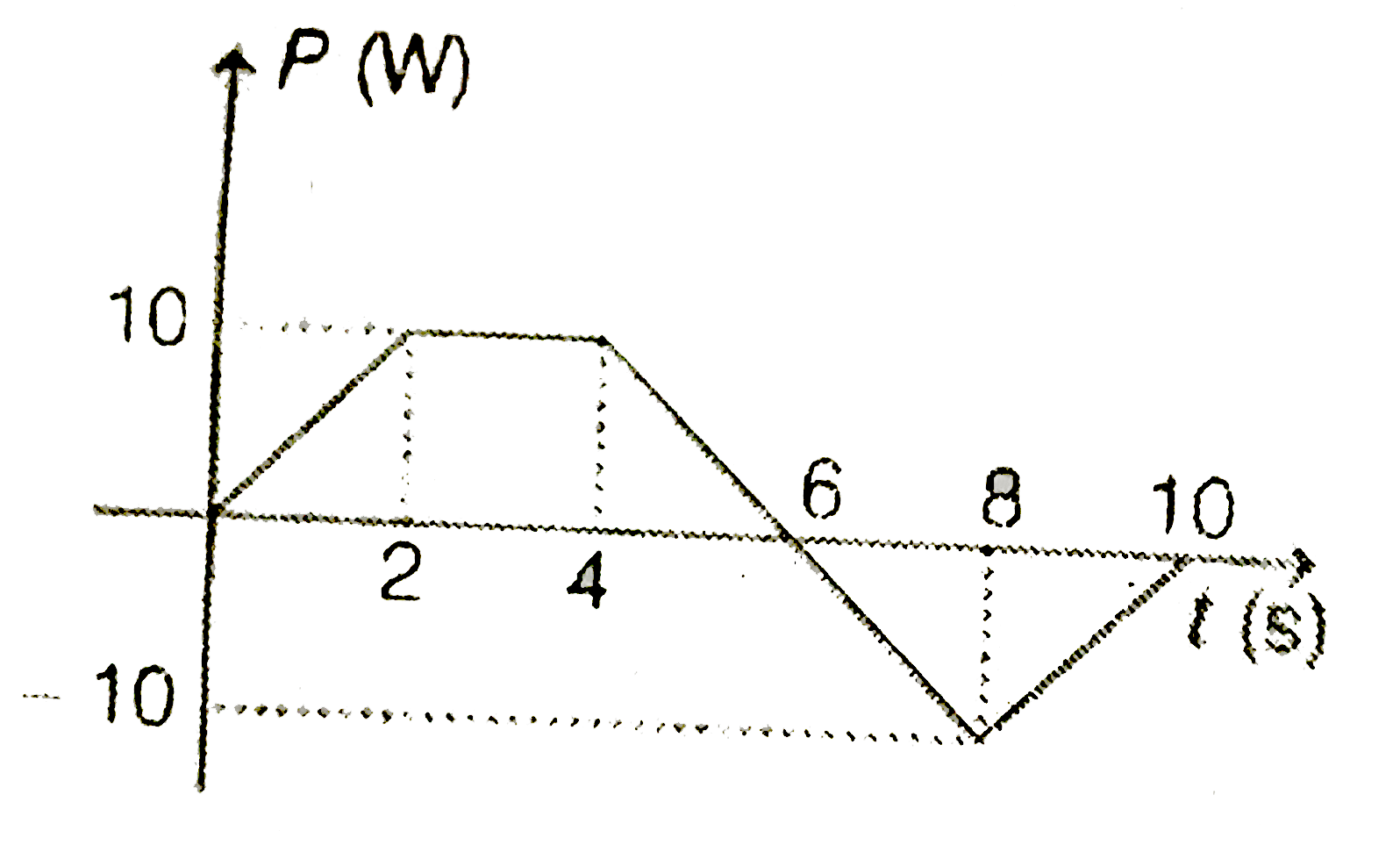
Power of a force acting on a block varies with time t as shown in figure. Then, angle between force acting on the block and its velocity is

A

Obtuse at `t=1s`

B

`90^(@)` at `t=3s`

C

Acute at `t=7s`

D

Both the stones reach the bottom at different times and with different speeds.

Text Solution

Verified by Experts

The correct Answer is:

D

Power, `P=vec(F).vec(v)` so
`P` positive `rArrthetalt90^(@)`, `P` negative `rArrthetagt90^(@)`
and `P` zero `rArrtheta=90^(@)`
Promotional Banner

Topper's Solved these Questions

Similar Questions

Explore conceptually related problems

List all the forces acting on the block B in figure.

The kinetic energy of a body moving along a straight line varies with time as shown in figure. The force acting on the body:

The frictional force acting on 1 kg block is

Force acting on a particle varies with displacement as shown in figure. Find the total work done by the force.

Acceleration of block A varies with time as shown in figure the value of coefficient of kinetic friction between block A and B is

For body of 50 kg. mass, the velocity time graph is shown in figure. Then force acting on the body is :-

Force acting on a block versus time graph is as shown in figure Choose the correct options. (g = 10 m//s^(-2))

The magnitude of force acting on a particle moving along x-axis varies with time (t) as shown in figure. If at t = 0 the velocity of particle is v_(0) , then its velocity at t=T_(0) will be

A force F acting on a particle varies with the position x as shown in figure. Find the work done by this force in displacing the particle from

On a stationary block of mass 2kg a horizontal forces F starts acting at t = 0 whose veriation with time is shown in figure .The coefficient of friction between the block and ground is 0.5 New answer the following question Find the velocity of the block when for the firsst time its acceleration become zero

ALLEN-TEST PAPER-Exercise (Physics)
  1. A block of mass m lies on a horizontal frictionless surface and is att...

    Text Solution

    |

  2. Two blocks of masses m(1) = 1 kg and m(2) = 2 kg are connected by a n...

    Text Solution

    |

  3. Power of a force acting on a block varies with time t as shown in figu...

    Text Solution

    |

  4. Two inclined frictionless tracks, one gradual and the other steep meet...

    Text Solution

    |

  5. A body A is projected upwards with velocity v1. Another body B of same...

    Text Solution

    |

  6. Track OABCD (as shown in figure ) is smooth. What minimum speed has to...

    Text Solution

    |

  7. In the ideal atwood machine arrangement shown, what is the change in k...

    Text Solution

    |

  8. A partical of mass 2kg is moving on the x-axis with a constant mechani...

    Text Solution

    |

  9. A chain of length L and of mass m is placed upon a smooth surface. The...

    Text Solution

    |

  10. Potential energy function along x-axis in a certain force field is giv...

    Text Solution

    |

  11. A pigeon in flight experience a force of air resistance given by F=bv^...

    Text Solution

    |

  12. A potential energy curve U(x) is shown in the figure. What value must ...

    Text Solution

    |

  13. The left and of the spring tied to a wall and at the right end is atta...

    Text Solution

    |

  14. A block weighing 40N travels down a smooth fixed curved track AB joine...

    Text Solution

    |

  15. Two atoms interact with each other according to the following force F ...

    Text Solution

    |

  16. The potential energy U(x) of a particle moving along x-axis is shown i...

    Text Solution

    |

  17. A particle is to move along the x-axis from x=0 to x=x(1) while a cons...

    Text Solution

    |

  18. A body with mass 1kg moves in one direction in the presence of a force...

    Text Solution

    |

  19. An escalator is used to move 5 people (60kg each) per minute from the ...

    Text Solution

    |

  20. A stone is dropped into a quiet lake and waves move in circles at the ...

    Text Solution

    |
