Home
Class 12
PHYSICS
Ball A of mass 1kg moving right with spe...

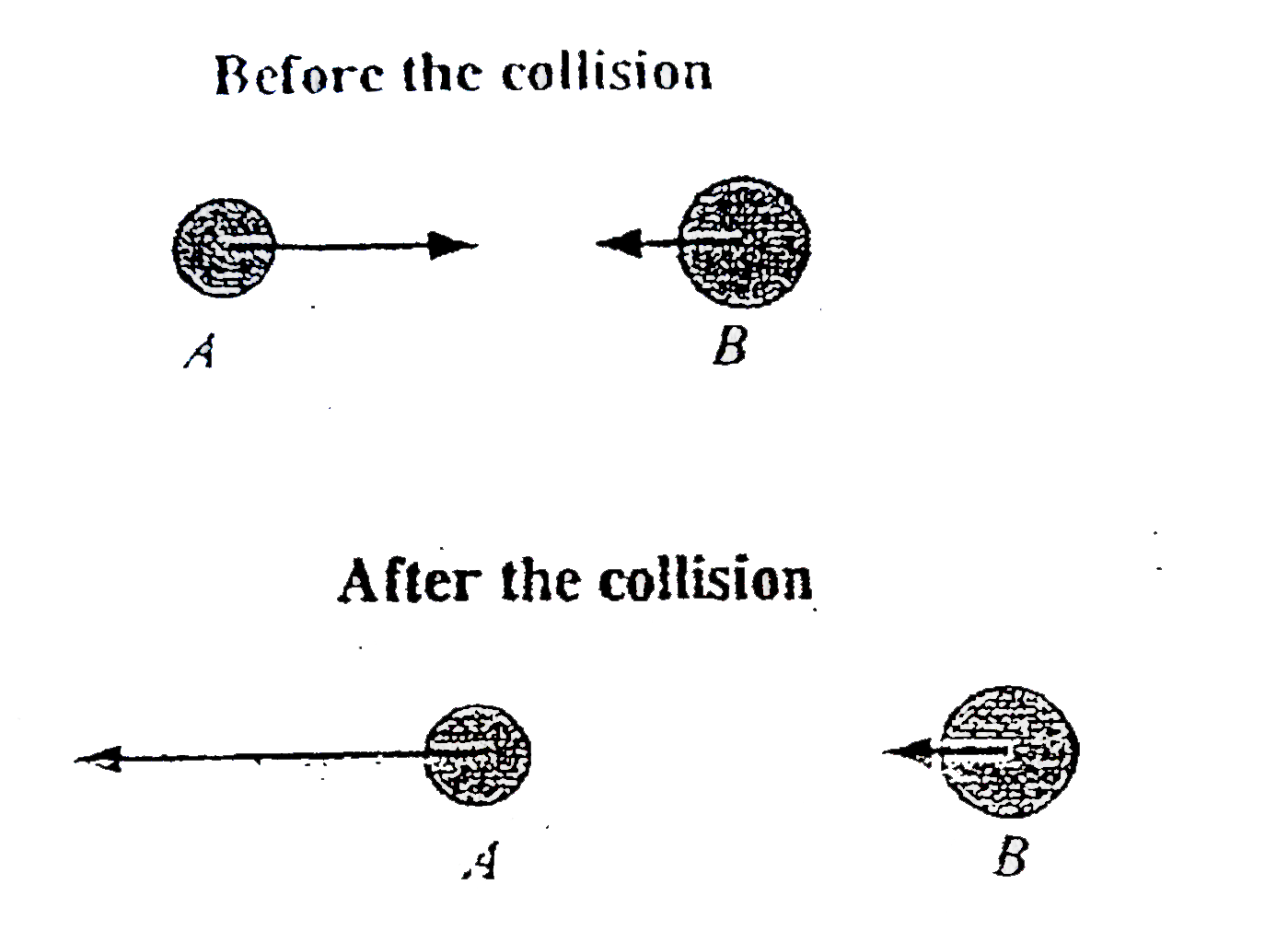
Ball `A` of mass `1`kg moving right with speed `2m//s` bounces off ball `B` of mass `1.5kg`, and then moves left with speed `4m//s`. Calculate magnitude of impulse (SI Units) received by ball `B`

A

`2`

B

`3`

C

`6`

D

`4`

Text Solution

Verified by Experts

The correct Answer is:

C

Ans.(3)
impulse on `A=-` impulse on `B`
`vec(P)=2hat(i),vec(P_(f))=-4hat(i)`, Impulse on `A=-6hat(i)`
`rArr` Impluse on `B=6hat(i)` Ns
Promotional Banner

Topper's Solved these Questions

Similar Questions

Explore conceptually related problems

A ball of mass 2kg moving with speed 5m/s collides directly with another ball of mass 3kg moving in the same direction with speed 4m/s. The coefficient of restitution is 2/3. Find the velocities of both ball after the collision.

A ball of mass 0*2 kg moving with a speed of 30 m/s strikes a bat returns in opposite direction with speed of 90m/s . Magnitude of change in momentu,m of ball will be

A ball of mass m moving with speed u collides with a smooth horizontal surface at angle theta with it as shown in figure. The magnitude of impulse imparted to surface by ball is [Coefficient of restitution of collision is e]

A ball of mass M moving with speed v collides perfectly inelastically with another ball of mass m at rest. The magnitude of impulse imparted to the first ball is

A ball of mass M moving with speed v collides perfectly inelastically with another ball of mass m at rest. The magnitude of impulse imparted to the first ball is

A ball of mass M moving with speed v collides perfectly inelastically with another ball of mass m at rest. The magnitude of impulse imparted to the first ball is

A spherical ball A of mass 4 kg, moving along a straight line strikes another spherical ball B of mass 1 kg at rest. After the collision, A and B move with velocities v_1 m s^(-1) and v_2 m s^(-1) respectively making angles of 30^@ and 60^@ with respect to the original direction of motion of A. The ratio v_1/v_2 will be

A ball of mass 5 kg moving with speed 8 m/s collides head on with another stationary ball of mass 15 kg. If collision is perfectly inelastic, then loss in kinetic energ is

A particle of mass 1kg is moving about a circle of radius 1m with a speed of 1m//s . Calculate the angular momentum of the particle.

A particle of mass 1kg is moving about a circle of radius 1m with a speed of 1m//s . Calculate the angular momentum of the particle.

ALLEN-TEST PAPER-Exercise (Physics)
  1. In a head on collision between two identical particles A and B moving ...

    Text Solution

    |

  2. A machine gun fires 10 bullets per second in horizontal direction. Mas...

    Text Solution

    |

  3. Ball A of mass 1kg moving right with speed 2m//s bounces off ball B o...

    Text Solution

    |

  4. A cricket ball of mass 160g is moving horizontally directly towards a ...

    Text Solution

    |

  5. A particle of mass 4 m which is at rest explodes into masses m, m & 2m...

    Text Solution

    |

  6. Two girls of equal mass m jump off from the border line of a stationar...

    Text Solution

    |

  7. Two identical ball bearing in contact with each other and resting on a...

    Text Solution

    |

  8. Three different projectiles, each with the same mass, are fired with s...

    Text Solution

    |

  9. Three bodies are moving as shown below. The total kinetic energy of th...

    Text Solution

    |

  10. Two particles are projected at the same instant with speeds v(1) and v...

    Text Solution

    |

  11. Two particles of equal masses moving with same collide perfectly inela...

    Text Solution

    |

  12. The linear density of a non-uniform rod of length 2m is given by lamda...

    Text Solution

    |

  13. If the volume of a sphere increases at constant rate ((dv)/(dt)=4). I...

    Text Solution

    |

  14. Potential Energy U(x) and associated force F(x) bears the relation F(x...

    Text Solution

    |

  15. Electric current in a wire is time rate of flow of charge. The charge ...

    Text Solution

    |

  16. A metal rod extends on the x-axis from x=0m to x=4m. Its linear densit...

    Text Solution

    |

  17. An airplane takes off at an angle 30^(@) with the horizontal ground tr...

    Text Solution

    |

  18. If vectors vec(A)=(hat(i)+2hat(j)+3hat(k))m and vec(B)=(hat(i)-hat(j)...

    Text Solution

    |

  19. Position of a particle moving along straight line is given by x(t)=(A)...

    Text Solution

    |

  20. Acceleration time graph of a particle moving along a straight line is ...

    Text Solution

    |
