Home
Class 12
PHYSICS
Two pucks are initially moving along a f...

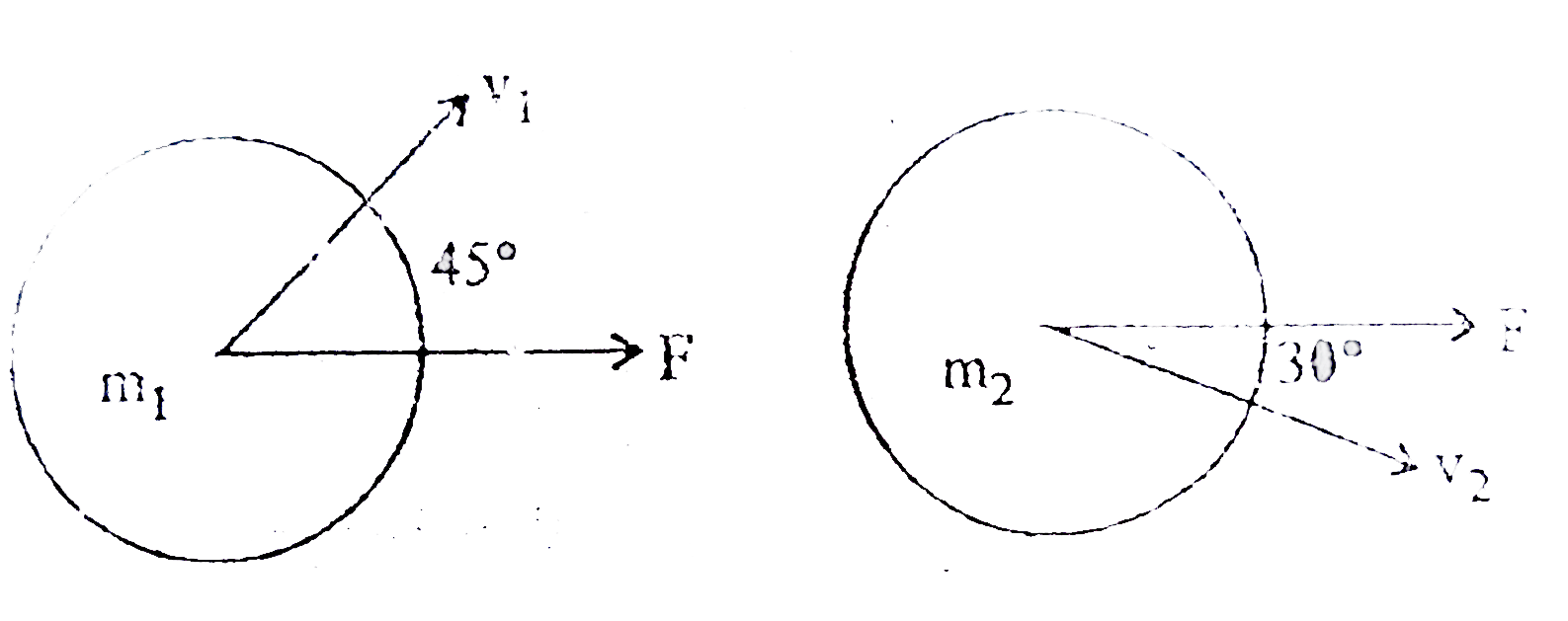
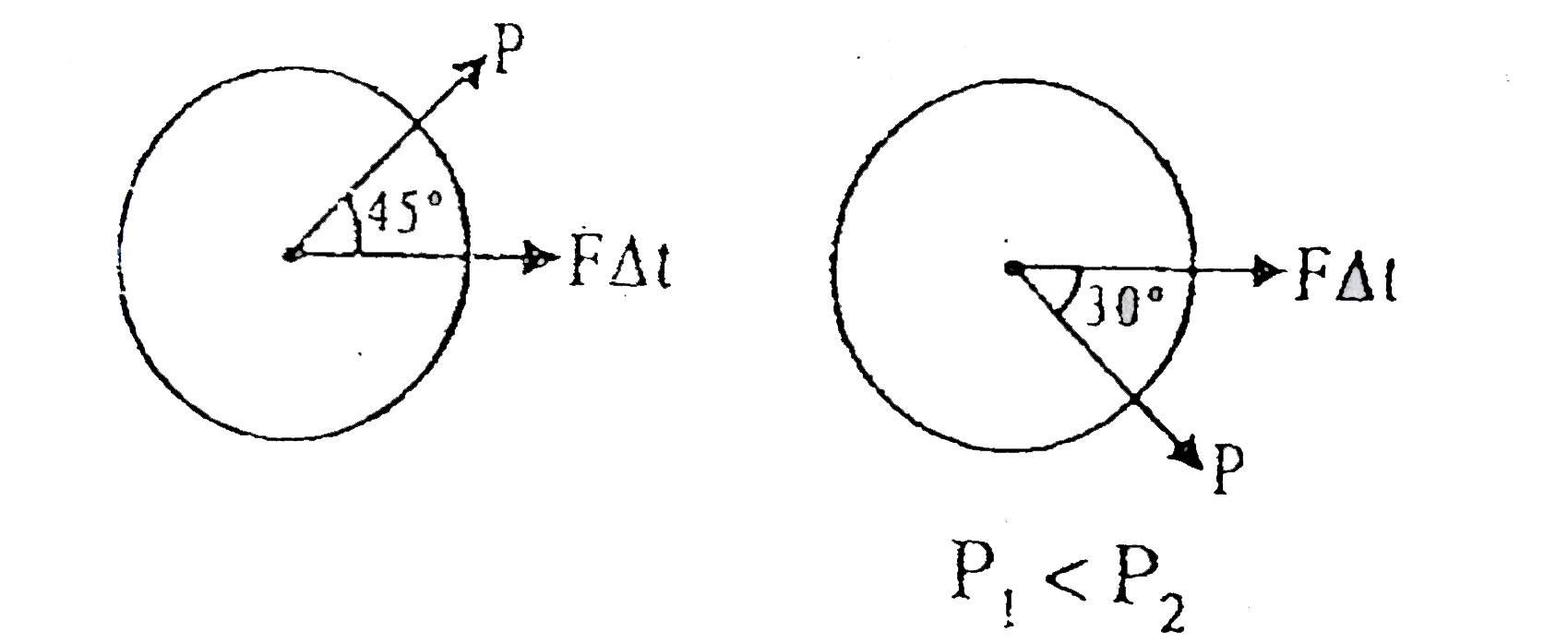
Two pucks are initially moving along a frictionless surface as shown in the diagram. The pucks have mass `m_(1)ltm_(2)` and begin with equal magnitude of momentum. A constant force `vec(F)` is applied to each puck direactly to the right for the same amount of non`-`zero time. After the pushes are complete, what is the relationship for the size of the moments of pucks (`p_(1)` and `p_(2)`) ?

A

`P_(1)ltP_(2)`

B

`P_(1)=P_(2)`

C

`P_(1)gtP_(2)`

D

More information about the masses, speeds, force and time are required to answer the question

Text Solution

Verified by Experts

The correct Answer is:
A

Promotional Banner

Topper's Solved these Questions

Similar Questions

Explore conceptually related problems

Two object are initially at rest on a frictionless surface. Object 1 has a greater mass than object 2. The same constant force start to act on each object. The force is removed from each object after it accelerates over a distance d. after the force is removed from both objects, which statement is correct (p:momentum, K: kinetic energy)?

A small puck is sliding to the right with momentum vec(P)_(1) on a horizontal, frictionless surface, as shown in figure. A force is applied to the puck for a short time and its momentum afterward is vec(P)_(f) . Which lettered arrow shows the direction of the impulse that was delovered to the puck ?

Two blocks of mass m and 2m are kept on a smooth horizontal surface. Theya are connected by an ideal spring of force constant k. Initially the spring is unstretched. A constant force is applied to the heavier block in the direction shown in figure. Suppose at time t displacement of smaller block is x_(1) then displacement of the heavier block at this moment would be

Two blocks of mass m and 2m are kept on a smooth horizontal surface. Theya are connected by an ideal spring of force constant k. Initially the spring is unstretched. A constant force is applied to the heavier block in the direction shown in figure. Suppose at time t displacement of smaller block is x_(1) then displacement of the heavier block at this moment would be

A particle of mass 2kg moves with an initial velocity of vec(v)=4hat(i) +4hat(j) ms^(-1) . A constant force of vec(F) =20hat(j)N is applied on the particle. Initially, the particle was at (0,0). The x-coordinates of the particle when its y-coordinates again becomes zero is given by

A particle of mass 2kg moves with an initial velocity of vec(v)=4hat(i) +4hat(j) ms^(-1) . A constant force of vec(F) =20hat(j)N is applied on the particle. Initially, the particle was at (0,0). The x-coordinates of the particle when its y-coordinates again becomes zero is given by

Two blocks of masses M_1 and M_2 are placed in contact with each other on a frictionless horizontal surface. If a force F is applied on the block of mass M_1 , what is the contact force between the two blocks?

Three blocks of masses m_(1), m_(2) and M are arranged as shown in figure. All the surfaces are fricationless and string is inextensible. Pulleys are light. A constant force F is applied on block of mass m_(1) . Pulleys and string are light. Part of the string connecting both pulleys is vertical and part of the strings connecting pulleys with masses m_(1) and m_(2) are horizontal. {:((P),"Accleration of mass " m_(1),(1) F/(m_(1))),((Q),"Acceleration of mass" m_(2),(2) F/(m_(1)+m_(2))),((R),"Acceleration of mass M",(3) "zero"),((S), "Tension in the string",(4) (m_(2)F)/(m_(1)+m_(2))):}

A block of mass 200kg is set into motion on a frictionless , horizontal surface with the help of frictionless pulley and a rope system as shown in figure. What horizontal force F should be applied to produce in the block an acceleration of 1 m//s^(2) ?

A block of mass 200kg is set into motion on a frictionless , horizontal surface with the help of frictionless pulley and a rope system as shown in figure. What horizontal force F should be applied to produce in the block an acceleration of 1 m//s^(2) ?

ALLEN-TEST PAPER-Exercise (Physics)
  1. A machinist starts with three identical square plates but cuts one cor...

    Text Solution

    |

  2. A block of mass m lies on a horizontal frictionless surface and is att...

    Text Solution

    |

  3. Two pucks are initially moving along a frictionless surface as shown i...

    Text Solution

    |

  4. Three particles A, B and C of equal mass move with equal speed V = 5 m...

    Text Solution

    |

  5. A canon shell moving along a straight line bursts into two parts. Just...

    Text Solution

    |

  6. Assertion :- velocity time graph of two paticles undergoing head-on co...

    Text Solution

    |

  7. Statement-1 : For any collision, coefficient of restitution (e lies b...

    Text Solution

    |

  8. Assertion :- To observe the motion of planets, the sun may be assumed ...

    Text Solution

    |

  9. Assertion :- The mechanical energy of earth-moon system remains same w...

    Text Solution

    |

  10. The average velocity of a particle moving on a straight line is zero i...

    Text Solution

    |

  11. The sum of kinetic and potential energies of a system of objects is co...

    Text Solution

    |

  12. Assertion :- Newton's first law defines inertial frame of reference. ...

    Text Solution

    |

  13. A man of mass 80kg pushes box of mass 20kg horizontally. The man moves...

    Text Solution

    |

  14. Assertion :- A particle has positive acceleration it means that its sp...

    Text Solution

    |

  15. Assertion :- The shape of trajactory depends on the acceleration and i...

    Text Solution

    |

  16. Assertion :- In projectile motion a particle is projected at some angl...

    Text Solution

    |

  17. Assertion :- A block is hanged from spring. Spring force on block grav...

    Text Solution

    |

  18. Assertion :- Tension in massless string may be different at different ...

    Text Solution

    |

  19. Assertion :- Work done by frictional force may be sometimes path indep...

    Text Solution

    |

  20. Assertion :- Work done is positive when force acts in the direction of...

    Text Solution

    |

