Home
Class 12
PHYSICS
N similar slabs of cubical shape of edge...

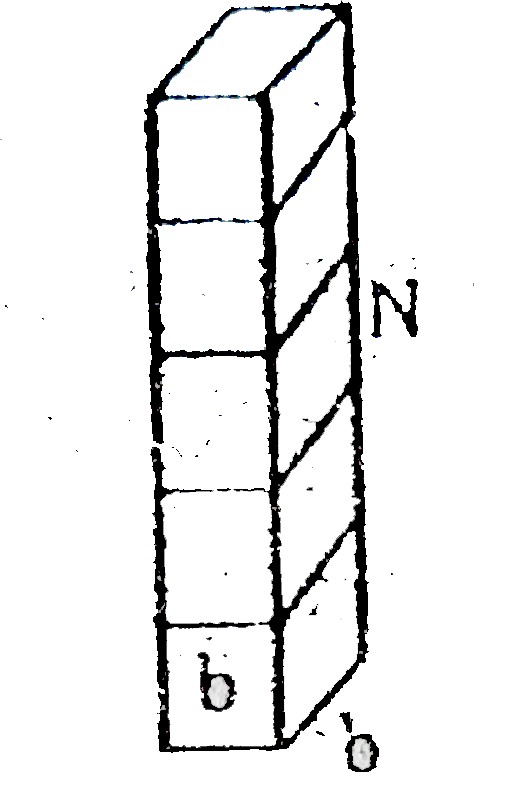
N similar slabs of cubical shape of edge b are lying on ground. Density of material of slab is p. Work done ot arrange them one over the other is -

A

`(N^(2)-1)b^(3)pg`

B

`(N-1)b^(4)pg`

C

`1//2(N^(2)-N)b^(4)pg`

D

`(N^(2)-N)b^(4)pg`

Text Solution

Verified by Experts

The correct Answer is:

C
Promotional Banner

Topper's Solved these Questions

Similar Questions

Explore conceptually related problems

Two transparent slabs have the same thickness as shown in figure. One in made of material A of refractive index 1.5. The other is made of two materilas B and C with thickness in the ratio 1:2. The refractive index of C is 1.6. If a monochromatic parallel beam passing through the slabs has the same number of wavelengths inside both, the refractive index of B is

Two transparent slabs having equal thickness but different refractive indices mu_1 and mu_2 , are pasted side by side to form a composite slab. This slab is placed just after the double slit in a Young's experiment so that the light from one slit goes through one material and the light from the other slit goes through the other material. What should be the minimum thickness of the slab so that there is a minimum at the point P_0 which is equidistant from the slits ?

The n transparent slabs of refractive index1.5 each having thickness 1cm, 2 cm,…to n cm are arranged one over another. A point object is seen through this combineation with near perpendicular light. If the shift of object by the combination is 1 cm, then find the value of n.

The figure shows two blocks of mass m_(1) and m_(2) placed one above the other. These is no friction between the lower block and ground. The lower block is being pushed by a constant horizontal force F. There is sufficient friction between the blocks so that they do not slip over each other. Draw the free body diagram of the upper block in the frame of groung and in the frame of lower block. Find the work done by various forces on the upper block in the two frames as the arrangement moves through 'S'

When a current through the medium, an electric field exists as well as a potential which varies in space. Suppose that there is a break in a high - voltage transmission line and the free end of a wire of length L is lying on the ground. An electric current flows through the regions of soil adjoining the conductor. If a man happens to be walking near by a potential difference, which is called the step voltage appears between the points where his feet touch the ground, Consequently, an electric current whose strength depends on this potential difference flows through the man. Let us calculate the step voltage. Since the conductor is quite long, we assume that the current flows from it to the ground in a direction perpendicular to the conductor. The equipotential surfaces are the surfaces of semi-cylinders whose axes coincide with the conductor. Suppose that the man is walking in a direction perpendicular to the conductor with a step of length 'b' the distance between the conductor and the foot closer to it being d. Assuming that the current flows uniformly from the conductor over the semi cylindrical region we obtain the following expression for the current density at a distance from the conductor: j=i/(pirL) In this case , the field strength along the radii perpendicular to the conductor is E_r=j/sigma=l/(pirLsigma) Consequently , the step voltage is V_(st)=int_d^(d+b) Edr =1/(pisigmaL)ln((d+b)/d) For example , If l=500A , d=1 m , b=65 cm and L=30 m we find that V_(st) =270 V. Much higher voltages may appear under other conditions and other shapes of conductors. When a part of a high- voltage transmission line falls on the ground, it creates a hazard

Scientists are working hard to develop nuclear fusion reactor Nuclei of heavy hydrogen, _(1)^(2)H , known as deuteron and denoted by D , can be thought of as a candidate for fusion rector . The D-D reaction is _(1)^(2) H + _(1)^(2) H rarr _(2)^(1) He + n+ energy. In the core of fusion reactor, a gas of heavy hydrogen of _(1)^(2) H is fully ionized into deuteron nuclei and electrons. This collection of _1^2H nuclei and electrons is known as plasma . The nuclei move randomly in the reactor core and occasionally come close enough for nuclear fusion to take place. Usually , the temperature in the reactor core are too high and no material will can be used to confine the to plasma for a time t_(0) before the particles fly away from the core. If n is the density (number volume ) of deuterons , the product nt_(0) is called Lawson number. In one of the criteria , a reactor is termed successful if Lawson number is greater then 5 xx 10^(14) s//cm^(2) it may be helpfull to use the following boltzmann constant k = 8.6 xx 10^(-5)eV//k, (e^(2))/(4 pi s_(0)) = 1.44 xx 10^(-9) eVm Assume that two deuteron nuclei in the core of fusion reactor at temperature energy T are moving toward each other, each with kinectic energy 1.5 kT , when the seperation between them is large enough to neglect coulomb potential energy . Also neglate any interaction from other particle in the core . The minimum temperature T required for them to reach a separation of 4 xx 10^(-15) m is in the range

There are two cylinder shaped wooden billets, each having mass M, in a vertical wall sewage, which contains water in it. The two billets have same size and same material , they touch each other and walls of sewage. One of them is totally under water, whilst the other one is immersed only half into water. Friction is negligible if density of wood is given by (3)/(x)p_(omega) (p_(omega) "is density of water") then find x

In the adjacent diagram, AO is a ray of light incident on a rectangular glass slab. (a) Complete the path of the ray till it emerges out of the slab. (b) In the diagram, mark the angle of incidence (i) and the angle of refraction (r) at the first interface. how is the refractive index of glass related to the angles i and r ? (c) Mark angle of emergence by the letter e. how are the angles i and e related ? (d) Which two rays are parallel to each other ? Name them (e) Indicate in the diagram the lateral displacement between the emergent ray and the incident ray. state one factor that affects the lateral displacement.

There are two cylinder shaped wooden billets, each having a mass of mass 45kg , in a vertical wall sewage, which contains water in it. the two billets have the same size and the same material, they touch each other and the walls of the sewage. One of them is totally under the water, whilst only half of the other one is immersed into the water. Friction is negligible everywhere. (density of water is 1000kg//m^(3) and g=10m//s^(2) ). Choose the correct option(s)

The regular three dimensional arrangement of points in a crystal is known as crystal lattice and the smallest repeating pattern in the lattice is called unit cell. The unit cells are characterised by the edge lengths a, b, c and the angles between them alpha, beta and gamma respectively. Based on this, there are seven crystal systems. In a cubic unit cell: a=b=c and alpha = beta=gamma=90^(@) The number of points in simple, body centred and face centred cubic cells are 1,2 and 4 respectively In both the hcp and ccp of spheres, the number of tetrahedral voids per sphere is two while the octahedral voids is one. In a face centred cubic cell, an atom at the face contributes to the unit cell

ALLEN-TEST PAPER-Exercise (Physics)
  1. Moment of inertia of a rigid body is expressed in units of kg m^(2). T...

    Text Solution

    |

  2. A mass m(1) moves with a great velocity. It strikes another mass m(2) ...

    Text Solution

    |

  3. N similar slabs of cubical shape of edge b are lying on ground. Densit...

    Text Solution

    |

  4. A ball collides elastically with a massive wall moving towards it with...

    Text Solution

    |

  5. A block of mass m=1/3 kg is kept on a rough horizontal plane. Friction...

    Text Solution

    |

  6. Consider two observers moving with respect to each other at a speed v ...

    Text Solution

    |

  7. Consider following statement (A) Work done by pseudo force in non-in...

    Text Solution

    |

  8. Forces acting on a particle have magnitude of 14N, 7N and 7N act in th...

    Text Solution

    |

  9. The graph below shows how the force on a mass depends on the position ...

    Text Solution

    |

  10. The kinetic energy of a particle continuously increases with time. The...

    Text Solution

    |

  11. Force acting on a block moving along x-axis is given by F = - ((4)/...

    Text Solution

    |

  12. In the figure, a block slides along a track from one level to a higher...

    Text Solution

    |

  13. A block of mass 2.0 kg is given an initial speed along the floor towar...

    Text Solution

    |

  14. A particle moves on x-axis such that its KE varies as a relation KE=3t...

    Text Solution

    |

  15. The potential energy (in joules ) function of a particle in a region o...

    Text Solution

    |

  16. AB is a quarter of a smooth horizontal circular track of radius R,A pa...

    Text Solution

    |

  17. The potential energy of a particle of mass 1 kg moving in X-Y plane is...

    Text Solution

    |

  18. A block of mass m is pushed up agains a spring, compressing it by a di...

    Text Solution

    |

  19. A train of mass 100 metric tons is ascending uniformly on an incline o...

    Text Solution

    |

  20. in which fo the following cases the centre of mass of a rod is certain...

    Text Solution

    |
