Home
Class 11
PHYSICS
A man can row a boat with 4 km/h in stil...

A man can row a boat with 4 km/h in still water. If he is crossing a river where the current is 2 km/h.
(a) In what direction will his boat be headed if he wants to reach a point on the other bank, directly opposite to starting point ?
(b) If width of the river isa 4 km, how long will the man take to cross the river, with the condition in part (a) ?
(c ) In what direction should he head the boat if he wants to cross the river in shortest time and what is this minimum time ?
(d) How long will it take him to row 2 km up the stream and then back to his starting point ?

Text Solution

Verified by Experts
(a) Velocity of a boat on still water is its capacity to move on water surface and aquals to its velocity relative to water.
`vec(v)_(b//w)=` Velocity of boat relative to water = Velocity of boat on still water

On flowing water, the water carries the boat along with it. Thus velocity `vec(v)_(b)` of the boat relative to the ground equals to vector sum of `vec(v)_(b//w)` and `vec(v)_(w)`. The boat crosses the river with the velocity `vec(v)_(b)`.
`vec(v)_(b)=vec(v)_(b//w)+vec(v)_(w)`
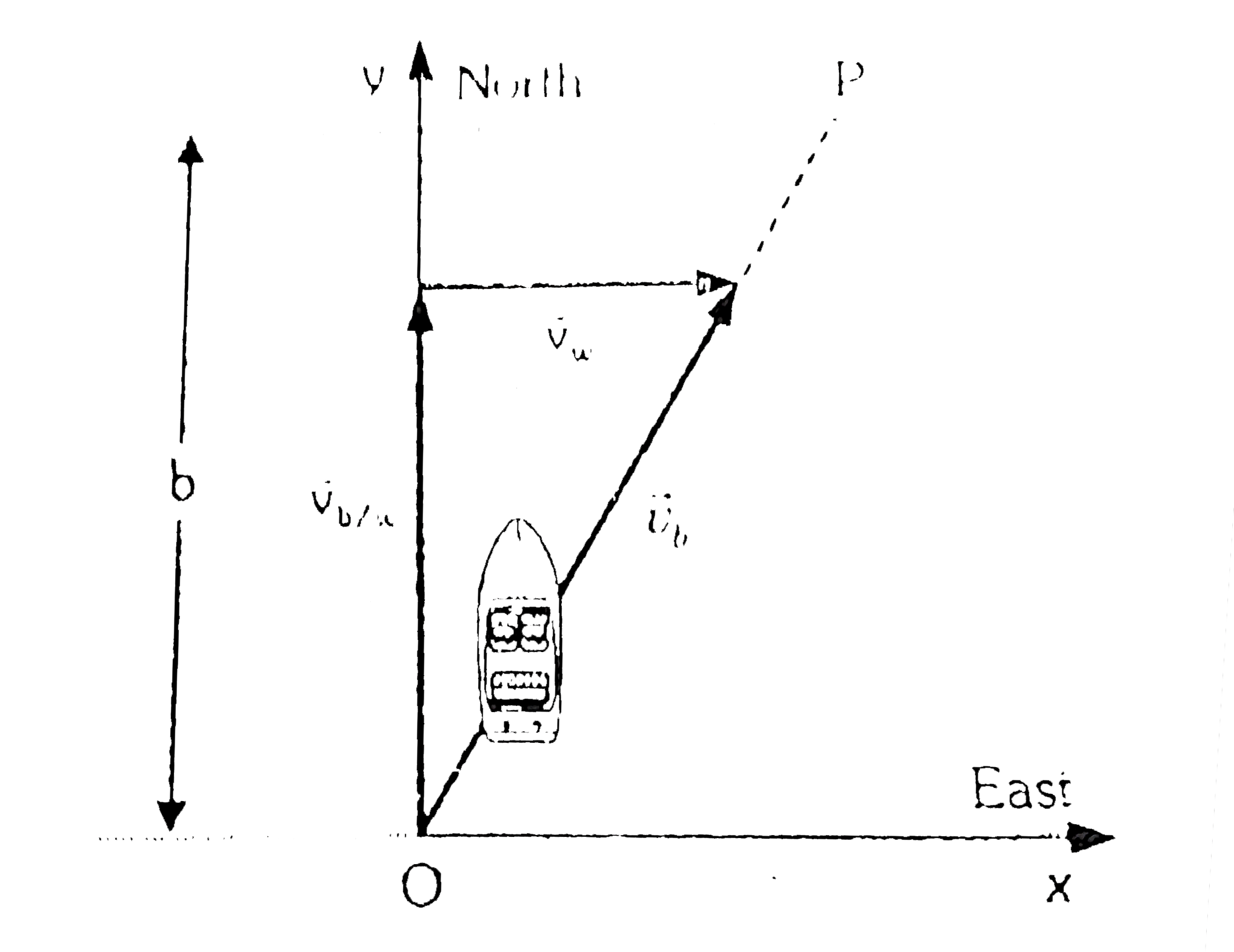
(b) To cross the river perpendicular to current the boat must be steered in a direction so that one of the components of its velocity `(vec(v)_(b//w))` relative to water becomes equal and opposite to water flow velocity `vec(v)_(w)` to neutralize its effect. It is possible only when velocity of boat relative to water is greater than water flow velocity. In the adjoining figure it is shown that the boat starts from the point O and moves along the line OP (y-axis) due north relative to ground with velocity `vec(v)_(b)`. To achieve this it is steered at an anglr `theta` with the y-axis.
`v_(b//w) sin theta=v_(w) rarr 5 sin theta=3 rArr theta=37^(@)`

(c) The boat will cover river width b with velocity
`v_(b)=v_(b//wy)=v_(b//w) sin 37^(@)=4 m//s` in time t, which is given by
`t=b//v_(b) rarr t=50 s`
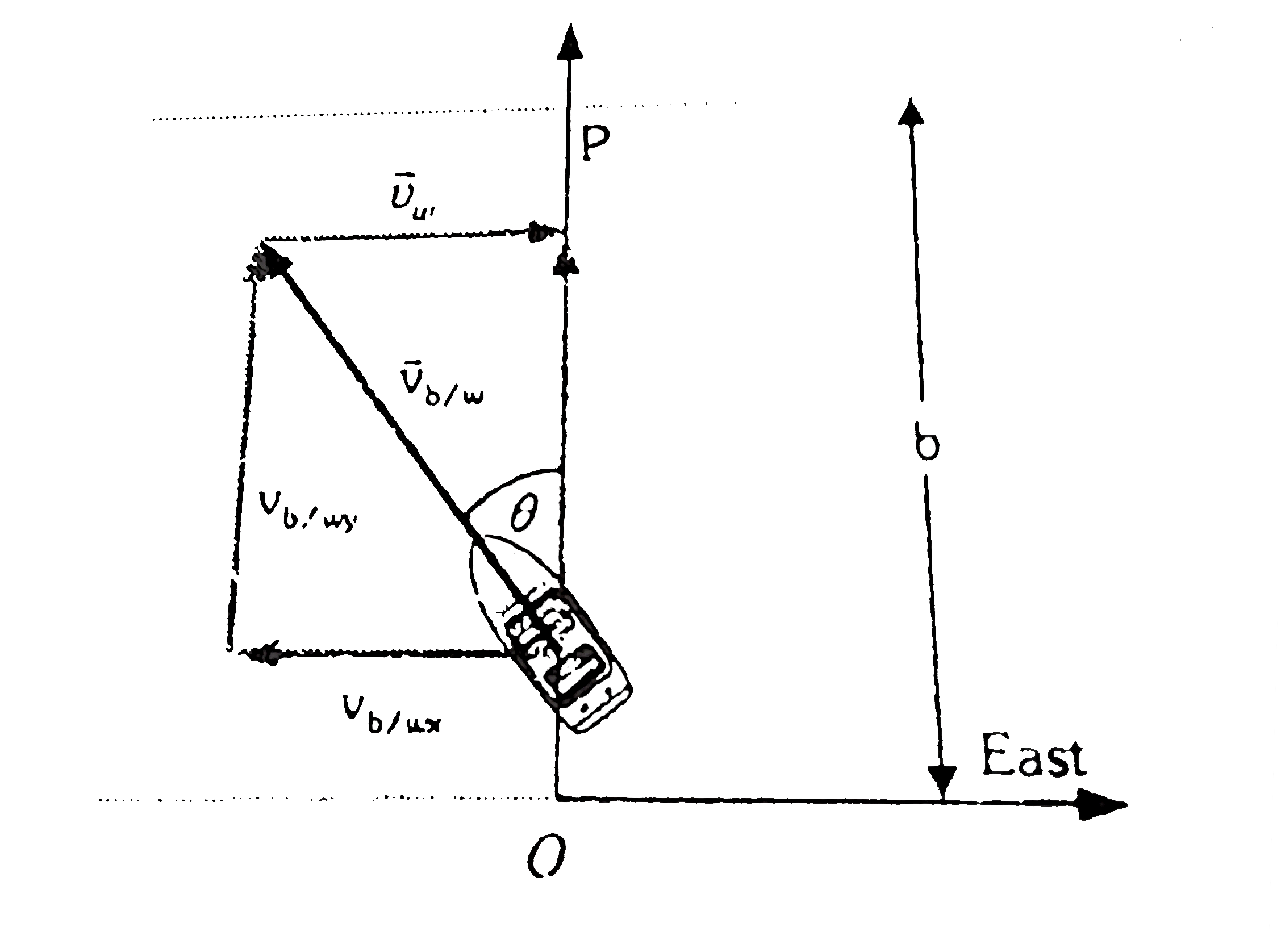
(d) To cross the river in minimum time, the component perpendicular to current of its velocity relative to ground must be kept to maximum value. It is achieved by steering the boat always perpendicular to current as shown in the adjoining figure. The boat starts from O at the south bank and reaches point P on the north bank. Time t taken by the boat is given by
`t=b//v_(b//w) rarr t=40 s`
Drift is the displacement along the river current measured from the starting point. Thus, it is given by the following equation. We denote it by `x_(d)`.
`x_(d)=v_(bx)t`
Substituting `v_(bx)=v_(w)=3 m//s`, from the figure, we have `x_(d)=120 m`
Promotional Banner

Topper's Solved these Questions

  • KINEMATICS

    ALLEN|Exercise EXERCISE-01|55 Videos
  • KINEMATICS

    ALLEN|Exercise EXERCISE-02|57 Videos
  • ERROR AND MEASUREMENT

    ALLEN|Exercise Part-2(Exercise-2)(B)|22 Videos
  • KINEMATICS (MOTION ALONG A STRAIGHT LINE AND MOTION IN A PLANE)

    ALLEN|Exercise BEGINNER S BOX-7|8 Videos

Similar Questions

Explore conceptually related problems

A man can row a boat with 4km/h in still water, if he is crossing a river where the current is 2 km/h. (a) In what direction will his boat be holded, if he wants to reach a point on the other bank, directly opposite to starting point? (b) If width of the river 4km, how long will the man take to cross the river, with the condition in part (a)? (c) In what direction shou ld he heat the boat if he wants to cross the river in shorest time and what is this minimum time? (d) How long will it take him to row 2 km up the stream and then back to his starting point?

A boat man can row with a speed of 10 km h^(-1) in still water. If the river flows steadily at 5 km //h , in which direction should the boatman row in order to reach a point on the other bank directly opposite to the point from where he stared ? The width of the river is 2 km .

The rowing speed of a man relative to water is 5 kmh^(-1) and the speed of water flow is 3 kmh^(-1) . At angle to the river flow should he head if he wants to reach a point on the other bank, directly opposite to starting point ?

A man can swim at a speed 2ms^(-1) in still water. He starts swimming in a river at an angle 150^(@) with direction of flow of water and reaches at the exactly oppsite point on the opposite bank. (a) Find the speed of flowing water. (b) If width of river is 1 km then calculate the time taken also

A man can swim at a speed 2ms^(-1) in still water. He starts swimming in a river at an angle 150^(@) with direction of flow of water and reaches at the exactly oppsite point on the opposite bank. (a) Find the speed of flowing water. (b) If width of river is 1 km then calculate the time taken also

A man can swin with speed 6 km/h in still water. If he tries of swim across a river flowing with speed 5km/h, how fast does a leaf floating on water appears to go , to the man ?

A river flows with a speed more than the maximum speed with which a person can swim in still water. He intends to cross the river by the shortest possible path (i.e., he wants to reach the point on the opposite bank which directly opposite to the starting point). Which of the following is correct ?

A man can swim in still water at a speed of 6 kmph and he has to cross the river and reach just opposite point on the other bank. If the river is flowing at a speed of 3 kmph, and the width of the river is 2 km, the time taken to cross the river is (in hours)

A boat can be rowed at 5 m/s on still water. It is used to cross a 200m wide river from the south bank to the north bank. The river current has uniform velocity of 3 m/s due east. (a) In which direction must it be steered to cross the river perpendicular to current ? (b) How long will it take to cross the river in a direction perpendicular to the river flow ? (c) In which direction must the boat be steered to cross the river in minimum time ? How far will it drift ?

Width of a river is 30 m, velocity is 4 m//s and rowing velocity is 5 m//s (a) Make the velocity diagram for crossing the river in shortest time. Then, find this shortest time, net velocity of boatman and drigt along the river. (b) Can the boatman reach a point just oppsite on the other shore? If yes then make the velocity diagram, the direction in which the should row his boat and the time taken to cross the river in this case. (c) How long will it iake hom to row 10 m up the stream and then back to his starting point?

ALLEN-KINEMATICS-EXERCISE-2
  1. A man can row a boat with 4 km/h in still water. If he is crossing a r...

    Text Solution

    |

  2. A student performs an experiment to determine how the range of a ball ...

    Text Solution

    |

  3. A student performs an experiment to determine how the range of a ball ...

    Text Solution

    |

  4. A student performs an experiment to determine how the range of a ball ...

    Text Solution

    |

  5. A circus wishes to develop a new clown act. Fig. (1) shows a diagram o...

    Text Solution

    |

  6. A circus wishes to develop a new clown act. Fig. (1) shows a diagram o...

    Text Solution

    |

  7. A circus wishes to develop a new clown act. Fig. (1) shows a diagram o...

    Text Solution

    |

  8. A circus wishes to develop a new clown act. Fig. (1) shows a diagram o...

    Text Solution

    |

  9. A circus wishes to develop a new clown act. Fig. (1) shows a diagram o...

    Text Solution

    |

  10. A circus wishes to develop a new clown act. Fig. (1) shows a diagram o...

    Text Solution

    |

  11. When a particle is undergoing motion, the diplacement of the particle ...

    Text Solution

    |

  12. When a particle is undergoing motion, the diplacement of the particle ...

    Text Solution

    |

  13. When a particle is undergoing motion, the diplacement of the particle ...

    Text Solution

    |

  14. When a particle is undergoing motion, the diplacement of the particle ...

    Text Solution

    |

  15. A projectile is projected with some initial velocity and some initial ...

    Text Solution

    |

  16. A projectile is projected with some initial velocity and some initial ...

    Text Solution

    |

  17. A projectile is projected with some initial velocity and some initial ...

    Text Solution

    |

  18. Figure shows the x-t plot of a particle in one-dimensional motion. Two...

    Text Solution

    |

  19. The position-time (x-t) graphs for two children A and B returning from...

    Text Solution

    |

  20. A particle is moving along x-axis with accelerationa = a(0) (1 – t//T)...

    Text Solution

    |

  21. A particle travels a distance of 20 m in the 7^(th) seconds and 24 m i...

    Text Solution

    |