Home
Class 11
PHYSICS
If two particle are projected as shown t...

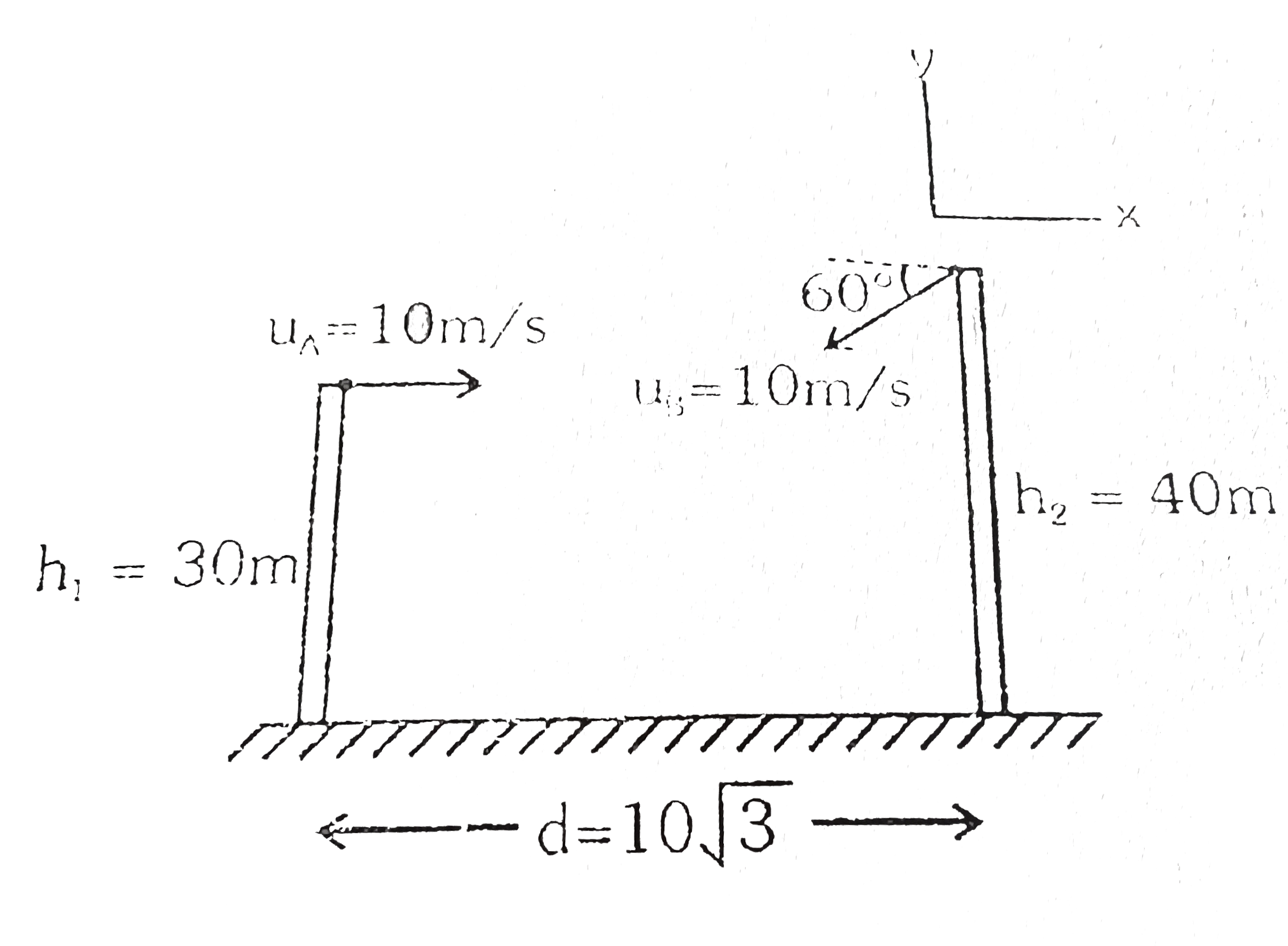
If two particle are projected as shown then find i.e.,

(i) Particle collide or not.
(ii) If collide, then find collision time

Text Solution

Verified by Experts
`tan theta=10/(10sqrt(3))=1/sqrt(3)`
`theta=30^(@)`
`theta=tan^(-1)=(u_(AB_(y))/u_(AB_(x)))=tan^(-1)((5sqrt(3))/15)=30^(@)`
Here `u_(AB_(y))=u_(A_(y))-u_(B_(y))=0-(-10 sin 60^(@))=5sqrt(3) m//s`
`u_(AB_(x))=u_(A_(x))-u_(B_(x))=10-(-10 cos 60^(@))=15 m//s`
So `u_(AB)` is along AB particle will collide.
`u_(AB)=sqrt(15^(2)+(5sqrt(3))^(2))=10sqrt(3) m//s`
`t=s_(AB)/u_(AB)=sqrt(10^(2)+(10sqrt(3))^(2))/(10sqrt(3))=20/(10sqrt(3))`
`t=2/sqrt(3)` sec.
Promotional Banner

Topper's Solved these Questions

  • KINEMATICS

    ALLEN|Exercise EXERCISE-01|55 Videos
  • KINEMATICS

    ALLEN|Exercise EXERCISE-02|57 Videos
  • ERROR AND MEASUREMENT

    ALLEN|Exercise Part-2(Exercise-2)(B)|22 Videos
  • KINEMATICS (MOTION ALONG A STRAIGHT LINE AND MOTION IN A PLANE)

    ALLEN|Exercise BEGINNER S BOX-7|8 Videos

Similar Questions

Explore conceptually related problems

A plane mirror is inclined at angle (alpha gt theta) with horizontal surface. A particle is projected from point Pat t = 0 with a velocity V at an angle alpha with horizontal. The image of the particle is observed from the frame of the particle projected. Assuming the particle does not collide with the mirror, find (i) The time when image will come momentarily at rest with respect to the particle. (ii) Path of image as seen by the particle.

Two particles P and Q are projected from two points in the same plane as shown. Find the condition for collision of two paricles.

Two particles A and B are projected simultaneously in a vertical plane as shown in figure. They collide at time t in air. Write down two necessary equations for collision to take place.

A particle is projected along an inclined plane as shown in figure. What is the speed of the particle when it collides at point A ? (g = 10 m/s^2)

A particle is projected from the ground with speed u at angle 60^@ from horizontal. It collides with a second particle of same mass moving with horizontal speed u in same direction at highest point of its trajectory. If collision is perfectly inelastic then find horizontal distance travelled by them after collision when they reached at ground

A charged point particle having positive charge q , mass m is projected in x-z plane with a speed v_(0) at an angle theta with the x-"axis" , while another identical particle is projected simultaneously along the y-"axis" from the origin (see figure) with an equal speed v_(0) . An electric field vecE= -E_(0)hatk exists in the x-z plane, while a magnetic field vecB=B_(0)hatk exists in the region y gt 0 ( F_(0) , B_(0) gt 0 ). It is observed that both the particles collide after some time. Assume that the space is gravity free. ( i ) Find the time after which the particles collide and the coordinates of the point of collision. ( ii ) Find the velocity v_(0) and the angle theta in terms of the other variables. ( iii ) What is the maximum value of the z- coordinate of the first particle ?

Two particles are projected from the two towers simultaneously, as shown in the figure. What should be value of 'd' for their collision.

Two projectiles collide in air, then for just after and before the collision

A particle of mass m collides with another stationary particle of mass M such that the second particle starts moving and the first particle stops just after the collision. Then which of the following conditions must always be valid ?

A particle A of mass m initially at rest slides down a height of 1.25 m on a frictionless ramp, collides with and sticks to an identical particles B of mass m at rest as shown in the figure. Then, particles A and B together collide elastically with particle G of mass 2m at rest. The speed of particle G after the collision with combined body (A+B) would be (Take, g =10 ms^(-2))

ALLEN-KINEMATICS-EXERCISE-2
  1. If two particle are projected as shown then find i.e., (i) Partic...

    Text Solution

    |

  2. A student performs an experiment to determine how the range of a ball ...

    Text Solution

    |

  3. A student performs an experiment to determine how the range of a ball ...

    Text Solution

    |

  4. A student performs an experiment to determine how the range of a ball ...

    Text Solution

    |

  5. A circus wishes to develop a new clown act. Fig. (1) shows a diagram o...

    Text Solution

    |

  6. A circus wishes to develop a new clown act. Fig. (1) shows a diagram o...

    Text Solution

    |

  7. A circus wishes to develop a new clown act. Fig. (1) shows a diagram o...

    Text Solution

    |

  8. A circus wishes to develop a new clown act. Fig. (1) shows a diagram o...

    Text Solution

    |

  9. A circus wishes to develop a new clown act. Fig. (1) shows a diagram o...

    Text Solution

    |

  10. A circus wishes to develop a new clown act. Fig. (1) shows a diagram o...

    Text Solution

    |

  11. When a particle is undergoing motion, the diplacement of the particle ...

    Text Solution

    |

  12. When a particle is undergoing motion, the diplacement of the particle ...

    Text Solution

    |

  13. When a particle is undergoing motion, the diplacement of the particle ...

    Text Solution

    |

  14. When a particle is undergoing motion, the diplacement of the particle ...

    Text Solution

    |

  15. A projectile is projected with some initial velocity and some initial ...

    Text Solution

    |

  16. A projectile is projected with some initial velocity and some initial ...

    Text Solution

    |

  17. A projectile is projected with some initial velocity and some initial ...

    Text Solution

    |

  18. Figure shows the x-t plot of a particle in one-dimensional motion. Two...

    Text Solution

    |

  19. The position-time (x-t) graphs for two children A and B returning from...

    Text Solution

    |

  20. A particle is moving along x-axis with accelerationa = a(0) (1 – t//T)...

    Text Solution

    |

  21. A particle travels a distance of 20 m in the 7^(th) seconds and 24 m i...

    Text Solution

    |

