

Home
Class 11
PHYSICS
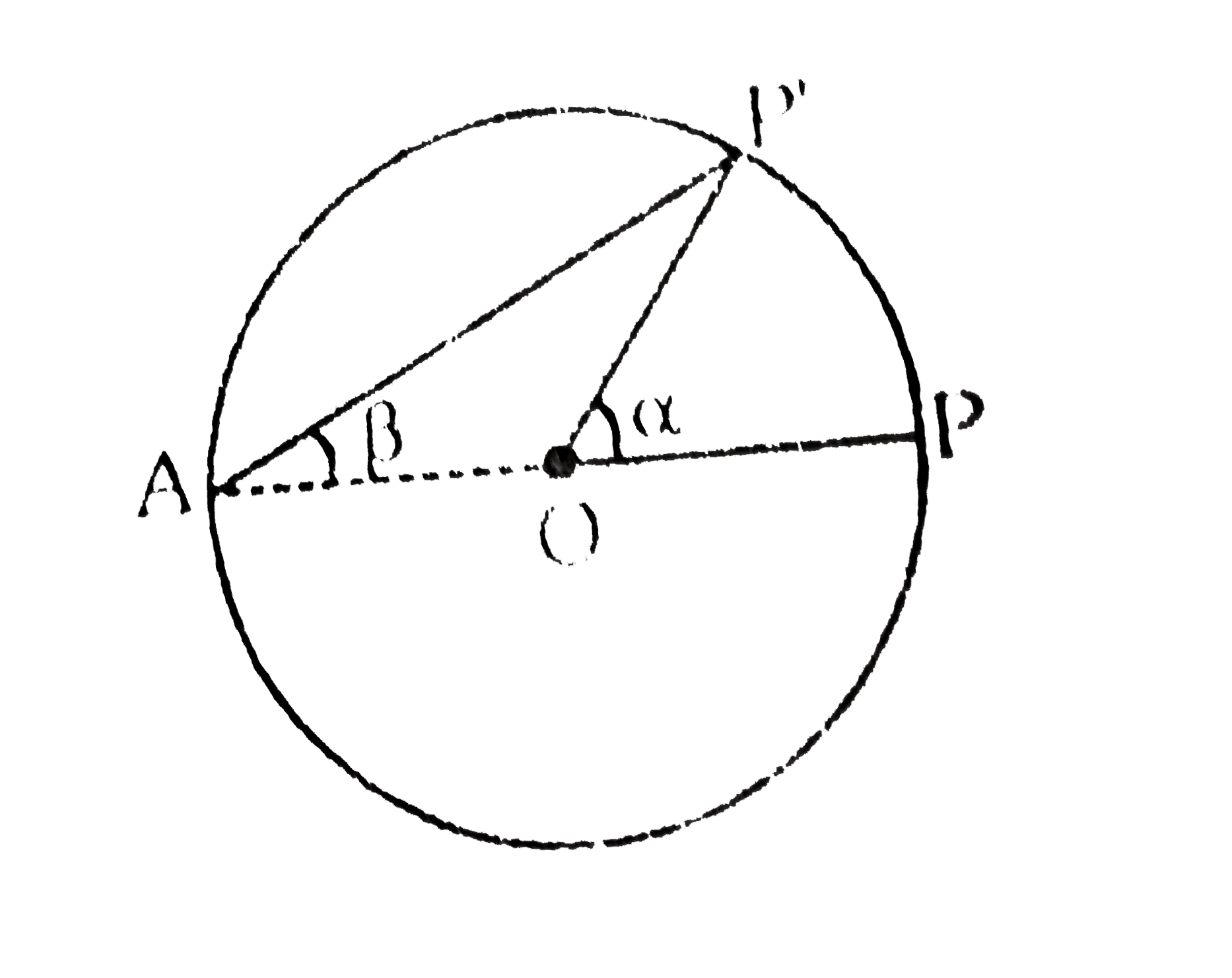
Angular velocity of a particle is given ...

Angular velocity of a particle is given w.r.t. the point which the position vector of particle is considered.
Here `omega_(PO)=(dalpha)/(dt)`
`omega_(PA)=(dbeta)/(dt)`
Prove that `omega_(PO)=2omega_(PA)`

Promotional Banner

Topper's Solved these Questions

  • KINEMATICS

    ALLEN|Exercise EXERCISE-01|55 Videos
  • KINEMATICS

    ALLEN|Exercise EXERCISE-02|57 Videos
  • ERROR AND MEASUREMENT

    ALLEN|Exercise Part-2(Exercise-2)(B)|22 Videos
  • KINEMATICS (MOTION ALONG A STRAIGHT LINE AND MOTION IN A PLANE)

    ALLEN|Exercise BEGINNER S BOX-7|8 Videos

Similar Questions

Explore conceptually related problems

The angular velocity of a particle is given by omega=1.5t-3t^(@)+2 , Find the time when its angular acceleration becomes zero.

The angular velocity of a particle is vec(w) = 4hati + hatj - 2hatk about the origin. If the position vector of the particle is 2hati + 3hatj - 3hatk , then its linear velocity is

The position vector of a particle is r = a sin omega t hati +a cos omega t hatj The velocity of the particle is

For a particle of a rotating rigid body, v = r omega , which of the following are correct ?

The displacement of a particle along the x- axis it given by x = a sin^(2) omega t The motion of the particle corresponds to

The displacement of a particle along the x-axis is given by x = a sin^(2) omega t . The motion of the particle corresponds to

A particle, with restoring force proportional to displacement and resulting force proportional to velocity is subjected to a force F sin omega t . If the amplitude of the particle is maximum for omega = omega_(1) , and the energy of the particle is maximum for omega=omega_(2) , then

A particle, with restoring force proportional to displacement and resulting force proportional to velocity is subjected to a force F sin omega t . If the amplitude of the particle is maximum for omega = omega_(1) , and the energy of the particle is maximum for omega=omega_(2) , then

Position vector of a particle moving in x-y plane at time t is r=a(1- cos omega t)hat(i)+a sin omega t hat(j) . The path of the particle is

the angular velocity omega of a particle varies with time t as omega = 5t^2 + 25 rad/s . the angular acceleration of the particle at t=1 s is

ALLEN-KINEMATICS-EXERCISE-2
  1. Angular velocity of a particle is given w.r.t. the point which the pos...

    Text Solution

    |

  2. A student performs an experiment to determine how the range of a ball ...

    Text Solution

    |

  3. A student performs an experiment to determine how the range of a ball ...

    Text Solution

    |

  4. A student performs an experiment to determine how the range of a ball ...

    Text Solution

    |

  5. A circus wishes to develop a new clown act. Fig. (1) shows a diagram o...

    Text Solution

    |

  6. A circus wishes to develop a new clown act. Fig. (1) shows a diagram o...

    Text Solution

    |

  7. A circus wishes to develop a new clown act. Fig. (1) shows a diagram o...

    Text Solution

    |

  8. A circus wishes to develop a new clown act. Fig. (1) shows a diagram o...

    Text Solution

    |

  9. A circus wishes to develop a new clown act. Fig. (1) shows a diagram o...

    Text Solution

    |

  10. A circus wishes to develop a new clown act. Fig. (1) shows a diagram o...

    Text Solution

    |

  11. When a particle is undergoing motion, the diplacement of the particle ...

    Text Solution

    |

  12. When a particle is undergoing motion, the diplacement of the particle ...

    Text Solution

    |

  13. When a particle is undergoing motion, the diplacement of the particle ...

    Text Solution

    |

  14. When a particle is undergoing motion, the diplacement of the particle ...

    Text Solution

    |

  15. A projectile is projected with some initial velocity and some initial ...

    Text Solution

    |

  16. A projectile is projected with some initial velocity and some initial ...

    Text Solution

    |

  17. A projectile is projected with some initial velocity and some initial ...

    Text Solution

    |

  18. Figure shows the x-t plot of a particle in one-dimensional motion. Two...

    Text Solution

    |

  19. The position-time (x-t) graphs for two children A and B returning from...

    Text Solution

    |

  20. A particle is moving along x-axis with accelerationa = a(0) (1 – t//T)...

    Text Solution

    |

  21. A particle travels a distance of 20 m in the 7^(th) seconds and 24 m i...

    Text Solution

    |