Home
Class 11
PHYSICS
A river of width 'd' with straight paral...

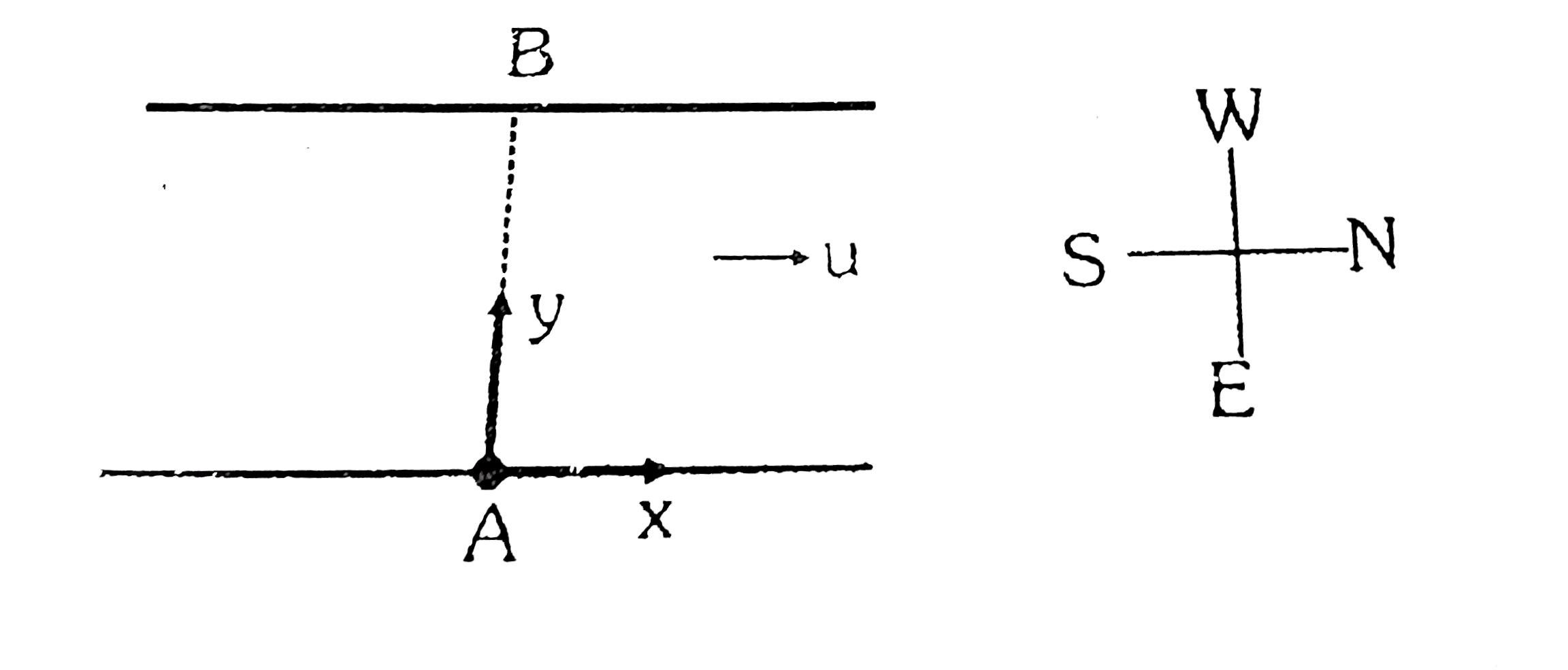
A river of width 'd' with straight parallel banks flows due North with speed u. A boat, whose speed is v relative to water, starts from A and crosses the river. If the boat is steered due West and u varies with y as `u=(y(d-y)v)/d^(2)` then answer the following questions.
The time take by boat to cross the river is

Text Solution

Verified by Experts
Promotional Banner

Topper's Solved these Questions

  • KINEMATICS

    ALLEN|Exercise EXERCISE-01|55 Videos
  • KINEMATICS

    ALLEN|Exercise EXERCISE-02|57 Videos
  • ERROR AND MEASUREMENT

    ALLEN|Exercise Part-2(Exercise-2)(B)|22 Videos
  • KINEMATICS (MOTION ALONG A STRAIGHT LINE AND MOTION IN A PLANE)

    ALLEN|Exercise BEGINNER S BOX-7|8 Videos

Similar Questions

Explore conceptually related problems

A river of width 'd' with straight parallel banks flows due North with speed u. A boat, whose speed is v relative to water, starts from A and crosses the river. If the boat is steered due West and u varies with y as u=(y(d-y)v)/d^(2) then answer the following questions. Equation of trajectory of the boat is

A river of width 'd' with straight parallel banks flows due North with speed u. A boat, whose speed is v relative to water, starts from A and crosses the river. If the boat is steered due West and u varies with y as u=(y(d-y)v)/d^(2) then answer the following questions. Absolute velocity of boat when it reaches the opposite bank is A. 4/3 v , towards East B. v, towards West C. 4/3 v , towards West D. vec(v) , towards East

A river of width a with straight parallel banks flows due north with speed u. The points O and A are on opposite banks and A is due east of O. Coordinate axes O_x and O_y are taken in the east and north directions respectively. A boat, whose speed is v relative to water, starts from O and crosses the river. If the boat is steered due east and u varies with x as : u = x(a-x) v/a^2. Find (a) equation of trajectory of the boat, (b) time taken to cross the river, (c) absolute velocity of boatman when he reaches the opposite bank, (d) the displacement of boatman when he reaches the opposite bank from the initial position.

A man who can swim at a velocity v relative to water wants to cross a river of width b, flowing with a speed u.

A man who can swim at a velocity v relative to water wants to cross a river of width b, flowing with a speed u.

Two ports, A and B, on a north-south line ar separated by a river of width D. The river flows east with speed u. A boat crosses the river starting from port A. The speed of the boat relative to the river is v. Assume v=2u Q. The boat crosses the river from A to the other side in shortest possible time, then how far is the boat from the port B after crossing the river

A boat crosses river of width 60sqrt(7)m inshortest possible path.Speed of river is 8m/s and speed of the boat in , still water is 6m/s .Find the time taken by boat(in seconds) to cross the river.

Two ports, A and B, on a north-south line ar separated by a river of width D. The river flows east with speed u. A boat crosses the river starting from port A. The speed of the boat relative to the river is v. Assume v=2u Q. Suppose the boat wants to cross the river from A to the other side in the shortest possible time. Then what should be the direction of the velocity of boat relative to river?

A man can swim in still water at a speed of 6 kmph and he has to cross the river and reach just opposite point on the other bank. If the river is flowing at a speed of 3 kmph, and the width of the river is 2 km, the time taken to cross the river is (in hours)

Two ports, A and B, on a north-south line ar separated by a river of width D. The river flows east with speed u. A boat crosses the river starting from port A. The speed of the boat relative to the river is v. Assume v=2u Q. What is the direction of the velocity of boat relative to river theta , sothat it crosses directly on a line from A to B?

ALLEN-KINEMATICS-EXERCISE-2
  1. A river of width 'd' with straight parallel banks flows due North with...

    Text Solution

    |

  2. A student performs an experiment to determine how the range of a ball ...

    Text Solution

    |

  3. A student performs an experiment to determine how the range of a ball ...

    Text Solution

    |

  4. A student performs an experiment to determine how the range of a ball ...

    Text Solution

    |

  5. A circus wishes to develop a new clown act. Fig. (1) shows a diagram o...

    Text Solution

    |

  6. A circus wishes to develop a new clown act. Fig. (1) shows a diagram o...

    Text Solution

    |

  7. A circus wishes to develop a new clown act. Fig. (1) shows a diagram o...

    Text Solution

    |

  8. A circus wishes to develop a new clown act. Fig. (1) shows a diagram o...

    Text Solution

    |

  9. A circus wishes to develop a new clown act. Fig. (1) shows a diagram o...

    Text Solution

    |

  10. A circus wishes to develop a new clown act. Fig. (1) shows a diagram o...

    Text Solution

    |

  11. When a particle is undergoing motion, the diplacement of the particle ...

    Text Solution

    |

  12. When a particle is undergoing motion, the diplacement of the particle ...

    Text Solution

    |

  13. When a particle is undergoing motion, the diplacement of the particle ...

    Text Solution

    |

  14. When a particle is undergoing motion, the diplacement of the particle ...

    Text Solution

    |

  15. A projectile is projected with some initial velocity and some initial ...

    Text Solution

    |

  16. A projectile is projected with some initial velocity and some initial ...

    Text Solution

    |

  17. A projectile is projected with some initial velocity and some initial ...

    Text Solution

    |

  18. Figure shows the x-t plot of a particle in one-dimensional motion. Two...

    Text Solution

    |

  19. The position-time (x-t) graphs for two children A and B returning from...

    Text Solution

    |

  20. A particle is moving along x-axis with accelerationa = a(0) (1 – t//T)...

    Text Solution

    |

  21. A particle travels a distance of 20 m in the 7^(th) seconds and 24 m i...

    Text Solution

    |

