Home
Class 11
PHYSICS
A particle A is projected with speed V(A...

A particle `A` is projected with speed `V_(A)` from a point making an angle `60^(@)` with the horizontal. At the same instant, second particle `B` (lie in the same horizontal plane) is thrown vertically upwards from a point directly below the maximum height point of parabolic path of `A`, with velocity `V_(B)`. if the two particles collide then the ratio of `V_(A)//V_(B)` should be:

A

1

B

`2/sqrt(3)`

C

`sqrt(3)/2`

D

`sqrt(3)`

Text Solution

Verified by Experts

The correct Answer is:
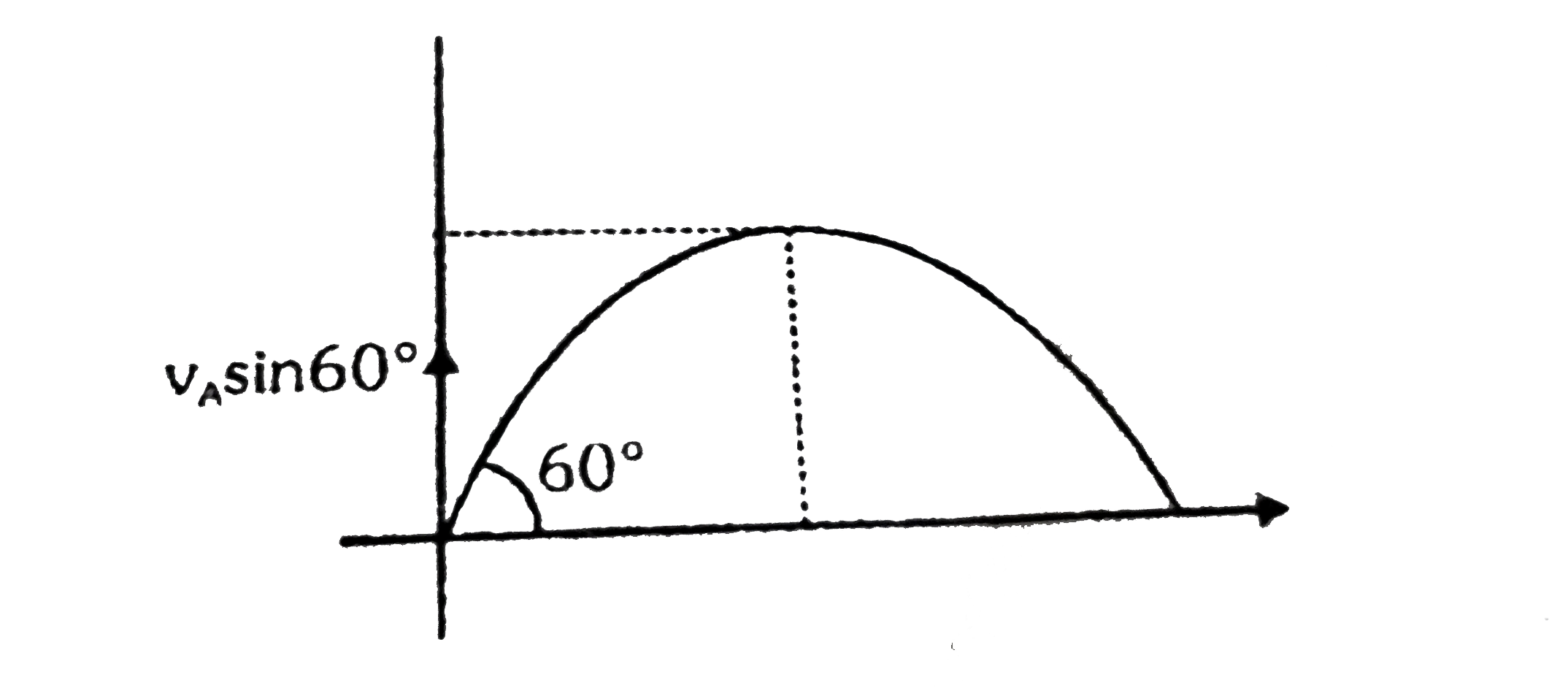
B

At maximum height vertical component of velocity becomes zero.
`v^(2)=u^(2)+2as`

For A : `0=v_(A)^(2)sin^(2)60^(@)-2gh`
`2gh=v_(A)^(2)sin^(2)60^(@)=v_(A)^(2)(3//4)`
`v_(A)=sqrt((8gh)/3)`
For B : `0=v_(B)^(2)-2gh`
`v_(B)=sqrt(2gh), v_(A)/v_(B)=2/sqrt(3)`
Promotional Banner

Topper's Solved these Questions

  • KINEMATICS

    ALLEN|Exercise EXERCISE-03|6 Videos
  • KINEMATICS

    ALLEN|Exercise Assertion-Reason|20 Videos
  • KINEMATICS

    ALLEN|Exercise EXERCISE-01|55 Videos
  • ERROR AND MEASUREMENT

    ALLEN|Exercise Part-2(Exercise-2)(B)|22 Videos
  • KINEMATICS (MOTION ALONG A STRAIGHT LINE AND MOTION IN A PLANE)

    ALLEN|Exercise BEGINNER S BOX-7|8 Videos

Similar Questions

Explore conceptually related problems

A particle A is projected with speed V_(A) from a point making an angle 60^(@) with the horizontal. At the same instant, a second particle B is thrown vertically upwards from a point directly below the maximum height point of parabolic path of A, with velocity V_(B) . If the two particles collide then the ratio of V_(A)//V_(B) should be:

Two particle are projected with same initial velocities at an angle 30^(@) and 60^(@) with the horizontal .Then

A particle is projected with a velocity u making an angle theta with the horizontal. At any instant its velocity becomes v which is perpendicular to the initial velocity u. Then v is

A projectile is thrown upward with a velocity v_(0) at an angle alpha to the horizontal. The change in velocity of the projectile when it strikes the same horizontal plane is

A particle P is projected with velocity u_1 at an angle of 30^@ with the horizontal. Another particle Q is thrown vertically upwards with velocity u_2 from a point vertically below the highest point of path of P . Determine the necessary condition for the two particles to collide at the highest point. .

Two projectiles thrown from the same point at angles 60^@ and 30^@ with the horizontal attain the same height. The ratio of their initial velocities is

A particle is projected horizontally with a speed u from the top of plane inclined at an angle theta with the horizontal. How far from the point of projection will the particle strike the plane ?

A particle is projected with velocity v at an angle theta aith horizontal. The average angle velocity of the particle from the point of projection to impact equals

A ball is projected horizontally with a speed v from the top of the plane inclined at an angle 45^(@) with the horizontal. How far from the point of projection will the ball strikes the plane?

A particle of mass m is projected with a velocity v at an angle of theta with horizontal. The angular momentum of the particle at the highest point of its trajectory is equal to :

ALLEN-KINEMATICS-EXERCISE-02
  1. A particle is projected from a point P(2,0,0) m with a velocity 10 m//...

    Text Solution

    |

  2. A body is thrown horizontally with a velocity sqrt(2gh) from the top o...

    Text Solution

    |

  3. A particle A is projected with speed V(A) from a point making an angle...

    Text Solution

    |

  4. A body is projected at time t = 0 from a certain point on a planet's s...

    Text Solution

    |

  5. A particle moves in x-y plane and at time t is at the point (t^2, t^3 ...

    Text Solution

    |

  6. The figure shows the velocity time graph of the particle which moves a...

    Text Solution

    |

  7. An object may have

    Text Solution

    |

  8. A particle moves with constant speed v along a regular hexagon ABCDEF ...

    Text Solution

    |

  9. A particle moves along x-axis according to the law x=(t^(3)-3t^(2)-9t+...

    Text Solution

    |

  10. A particle moving along a straight line with uniform acceleration has ...

    Text Solution

    |

  11. A particle moves along x-axis and its x-coordinate changes with time a...

    Text Solution

    |

  12. The co-ordinates of a particle in x-y plane are given as x=2+2t+4t^(2)...

    Text Solution

    |

  13. A particle leaves the origin with an initial velocity vec(v)=(3hat(i)+...

    Text Solution

    |

  14. Pick the correct statements:

    Text Solution

    |

  15. Which of the following statements are true for a moving body?

    Text Solution

    |

  16. If the velocity of the particle is given by v=sqrt(x) and initially pa...

    Text Solution

    |

  17. The velocity-time graph of a particle moving along a straight line is ...

    Text Solution

    |

  18. The fig. shows the v-t graph of a particle moving in straight line. Fi...

    Text Solution

    |

  19. In a projectile motion let t(OA)=t(1) and t(AB)=t(2).The horizontal di...

    Text Solution

    |

  20. A particle is projected from a point P with a velocity v at an angle t...

    Text Solution

    |

