Home
Class 11
PHYSICS
A particle is rotating in a cirlce of ra...

A particle is rotating in a cirlce of radius 1 m with constant speed 4 m/s. In time 1s, match the following (in `SI` unit)
`{:(,"Table-1",,"Table-2"),("(A)","Displacement","(P)","8 sin 2"),("(B)","Distance","(Q)",4),("(C)","Average velocity","(R)","2 sin 2"),("(D)","Average acceleration","(S)","4 sin 2"):}`

Text Solution

Verified by Experts

The correct Answer is:
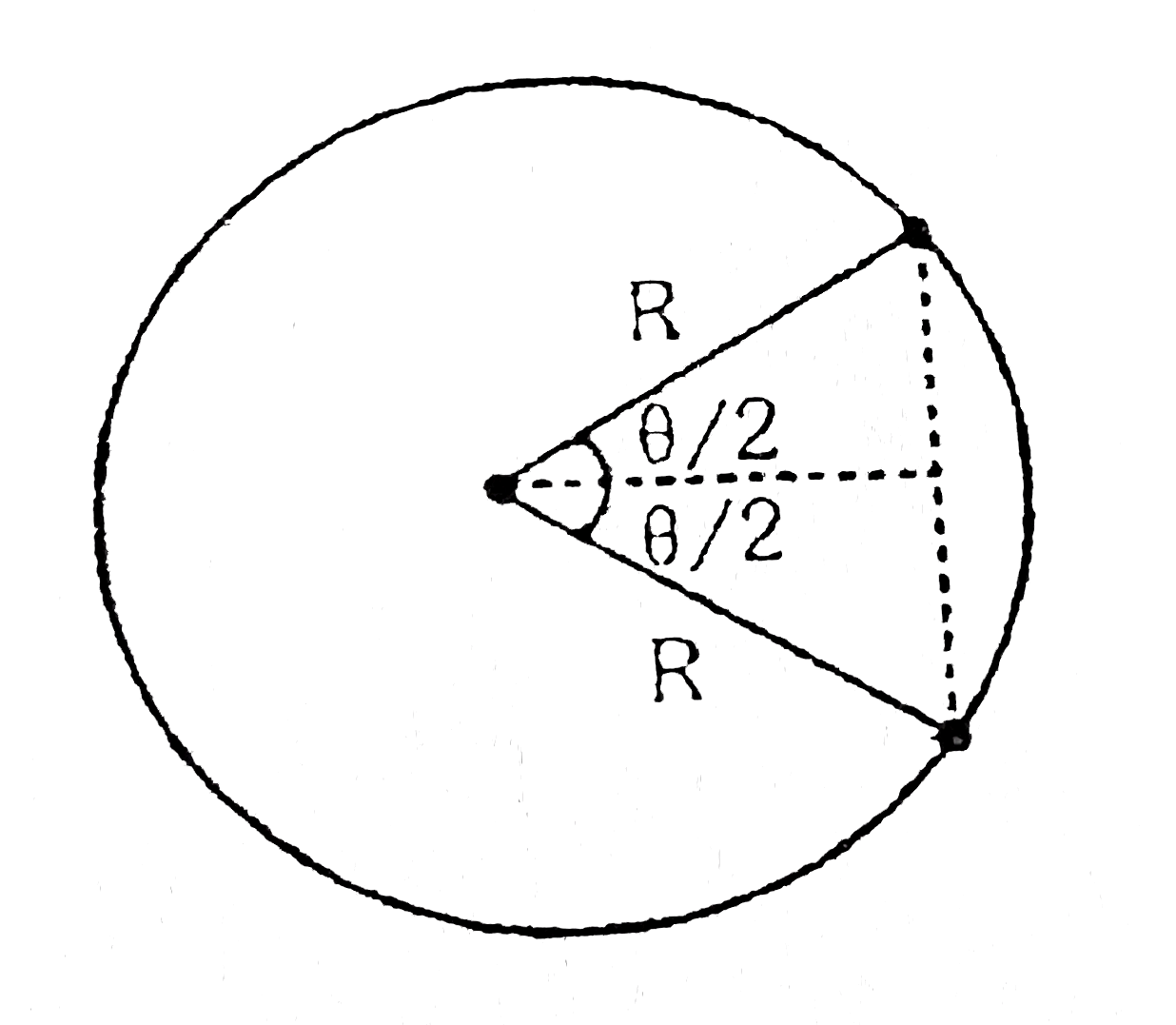
(A)-r, (B)-q, (C)-r (D)-p

`Rtheta=vt, theta=(4xx1)/1=4` radius

`:.` Displacement `=2R sin theta//2=2 sin 2`
Distance `=vt=4m`
Average velocity `=("Displacement")/("time")=2 sin 2`
Average acceleration `=("Change in velocity")/("time")`
`=(2xx4 sin 2)/(1)=8 sin 2`
Promotional Banner

Topper's Solved these Questions

  • KINEMATICS

    ALLEN|Exercise Assertion-Reason|20 Videos
  • KINEMATICS

    ALLEN|Exercise Comprehension#1|3 Videos
  • KINEMATICS

    ALLEN|Exercise EXERCISE-02|57 Videos
  • ERROR AND MEASUREMENT

    ALLEN|Exercise Part-2(Exercise-2)(B)|22 Videos
  • KINEMATICS (MOTION ALONG A STRAIGHT LINE AND MOTION IN A PLANE)

    ALLEN|Exercise BEGINNER S BOX-7|8 Videos

Similar Questions

Explore conceptually related problems

A particle is revolving in a circular path of radius 2 m with constant angular speed 4 rad/s. The angular acceleration of particle is

A particle moves in a circle of radius R = 21/22 m with constant speed 1 m//s. Find, (a) magnitude of average velocity and (b) magnitude of average acceleration in 2 s.

Match the following. |{:(,"Table-1",,"Table-2"),((A),"Coefficient of viscosity",(P),[M^(2)L^(-1)T^(-2)]),((B),"Surface tension",(Q),[ML^(0)T^(-2)]),((C),"Modulus of elasticity",(R),[ML^(-1) T^(-2)]),((D),"Energy per unit volume",(S),"None"),(,"of a fiuid",,):}|

A particle is moving on a circular path of radius 1 m with 2 m/s. If speed starts increasing at a rate of 2m//s^(2) , then acceleration of particle is

Match the following {:(,"Table - 1",,"Table - 2",),((A),sigma^(2)//epsi_(0),(P),C^(2)//J - m,),((B),epsi_(0),(Q),"Farad",),((C),("ampere - second")/("Volt"),(R),J//m^(3),),((D),(V)/(E),(S),"metre",):}

Match the following |{:(,"Table-1",,"Table-2"),((A),"Stress"xx"Strain",(P),J),((B),(YA)/l,(Q),N//m),((C),Yl^(3),(R),J//m^(3)),((D),(Fl)/(AY),(S),m):}|

A particle is moving with speed v= 2t^(2) on the circumference of a circle of radius R. Match the quantities given in Table-1 with corresponding results in Table-2 {:(,"Table-1",,"Table-2"),("(A)","Magnitude to tangential acceleration of particle","(P)","decreases with time"),("(B)","Magnitude of centripetal acceleration of particle","(Q)","increases with time"),("(C)","Magnitude of angular speed of particle with respect to centre of circle","(R)","remains constant"),("(D)","Angle between the total acceleration and centripetal acceleration of partilce","(S)","depends upon the value of radius R"):}

Match the following {:(,,"Table-1",,"Table-2"),(,(A),L,(P),[M^(0)L^(0)T^(-2)]),(,(B),"Magnetic Flux",(Q),[ML^(2)T^(-2)A^(-1)]),(,(C),LC,(R),[ML^(2)T^(-2)A^(-2)]),(,(D),CR^(2),(S),"None"):}

For the velocity -time graph shown in figure, in a time interval from t=0 to t=6 s , match the following: {:(,"Column I",,,"Column II"),((A),"Change in velocity",,(p),-5//3 SI "unit"),((B),"Average acceleration",,(q),-20 SI "unit"),((C),"Total displacement",,(r),-10 SI "unit"),((D),"Acceleration ay t=3s",,(s),-5 SI "unit"):}

A particle is moving in a circel of radius R = 1m with constant speed v =4 m//s . The ratio of the displacement to acceleration of the foot of the perpendicular drawn from the particle onto the diameter of the circel is

