Home
Class 11
PHYSICS
A balloon rise up with constant net acce...

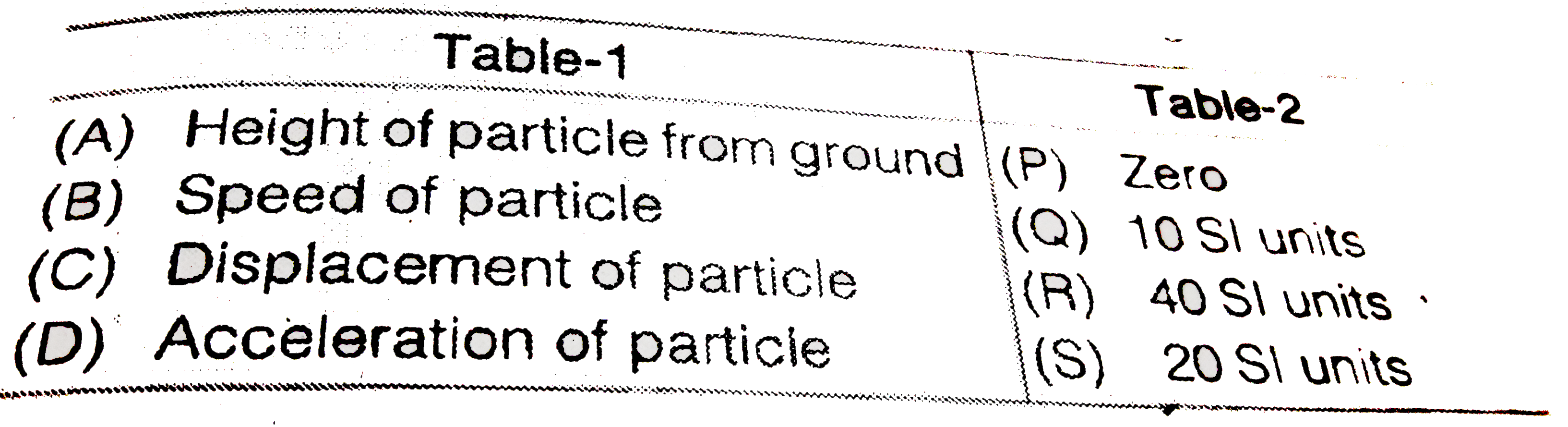
A balloon rise up with constant net acceleration of `10m//s^(2)`. After `2s` a particle from the balloon. After further `2s` match the following (Take `g=10m//s^(2)`)

Text Solution

Verified by Experts

The correct Answer is:

(A)-r, (B)-p, (C)-s, (D)-q`

Velocity & height of the bolloon after 2 sec:
`v=0+10xx2=20 m//s uarr h=1//2xx10xx4=20 m`
Initial velocity of drop particle is equal to the velocity of balloon `=20 m`
`:' u_(s)=20 m//s a_(s)=g darr`
After further `2s v_(s)=0`
`:.` height `=(u_(s)+v_(s))/2xx2=20 m` from initial position of balloon
`:.` Height from ground `=20+2v=40 m`
Promotional Banner

Topper's Solved these Questions

  • KINEMATICS

    ALLEN|Exercise Assertion-Reason|20 Videos
  • KINEMATICS

    ALLEN|Exercise Comprehension#1|3 Videos
  • KINEMATICS

    ALLEN|Exercise EXERCISE-02|57 Videos
  • ERROR AND MEASUREMENT

    ALLEN|Exercise Part-2(Exercise-2)(B)|22 Videos
  • KINEMATICS (MOTION ALONG A STRAIGHT LINE AND MOTION IN A PLANE)

    ALLEN|Exercise BEGINNER S BOX-7|8 Videos

Similar Questions

Explore conceptually related problems

A balloon rises up with constant net acceleration of 10 m//s^(2) . After 2 s a particle drops from the balloon. After further 2 s match the following : ("Take" g=10 m//s^(2)) {:(,"Column I",,,"Column II"),((A),"Height of perticle from ground",,(p),"Zero"),((B),"Speed of particle",,(q),10 SI "units"),((C),"Displacement of Particle",,(r),40 SI "units"),((D),"Acceleration of particle",,(s),20 SI "units"):}

A balloon starts rising from the ground with a constant acceleration of 1.25m//s^(2) . After 8 s, a stone is released from the balloon. Find the time taken by the stone to reach the ground. (Take g=10m//s^(2) )

A balloon starts rising from the ground with an acceleration of 1.25 m//s^(2) . A stone is released from the balloon after 10s. Determine (1) maximum height of ston from ground (2) time taken by stone to reach the ground

A balloon of mass 10 kg is raising up with an acceleration of 20 ms^(-2) . If a mass of 4 kg is removed from the balloon its acceleration becomes ( take, g=10ms^(-2) )

A balloon is moving along with constant upward acceleration of 1 m//s^2 . A stone is thrown from the balloon downwards with speed 10 m//s with respect to the balloon. At the time of projectile balloon is at height 120 m from the ground and is moving with speed 20 m//s . Find the time required to fall on the ground by the stone after the projection.

A balloon os mass 2 KG is rising up with an acceleration of 4m/s^2 . The upward force acting on the balloon is (g = 10 ms^-2)

A balloon rises rest on the ground with constant acceleration 1 m s^(-2) . A stone is dropped when balloon has risen to a height of 39.2 m . Find the time taken by the stone to teach the ground.

A man in a balloon, rising vertically with an acceleration of 5 m//s^(2) , releases a ball 10 s after the balloon is let go from the ground. The greatest height above the ground reached by the ball is

A particle is projected with velocity 20sqrt(2)m//s at 45^(@) with horizontal. After 1s , find tangential and normal acceleration of the particle. Also, find radius of curvature of the trajectory at that point. (Take g=10m//s^(2))

A rocket is fired vertically from the ground. It moves upwards with a constant acceleration 10m//s^(2) after 30 sec the fuel is finished. After what time from the instant of firing the rocket will attain the maximum height? g=10m//s^(2) :-
