Home
Class 11
PHYSICS
An object A is kept fixed at the point ...

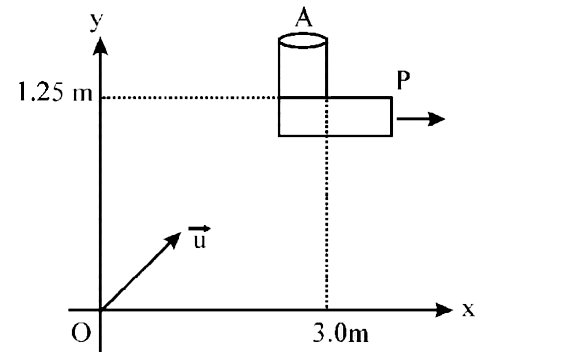
An object `A` is kept fixed at the point ` x= 3 m` and `y = 1.25 m` on a plank `p` raised above the ground . At time ` t = 0 ` the plank starts moving along the `+x` direction with an acceleration ` 1.5 m//s^(2) `. At the same instant a stone is projected from the origin with a velocity `vec(u)` as shown . A stationary person on the ground observes the stone hitting the object during its downward motion at an angle ` 45(@)` to the horizontal . All the motions are in the ` X -Y `plane . Find ` vec(u)` and the time after which the stone hits the object . Take ` g = 10 m//s`

Text Solution

Verified by Experts

The correct Answer is:
`u=7.29 ms^(-1), t=1s`

Let 't' be the time after which the stone hits the object and `theta` be the abgle which the velocity vector `vec(u)` makes with horizontal. According to question, we have following three conditions.
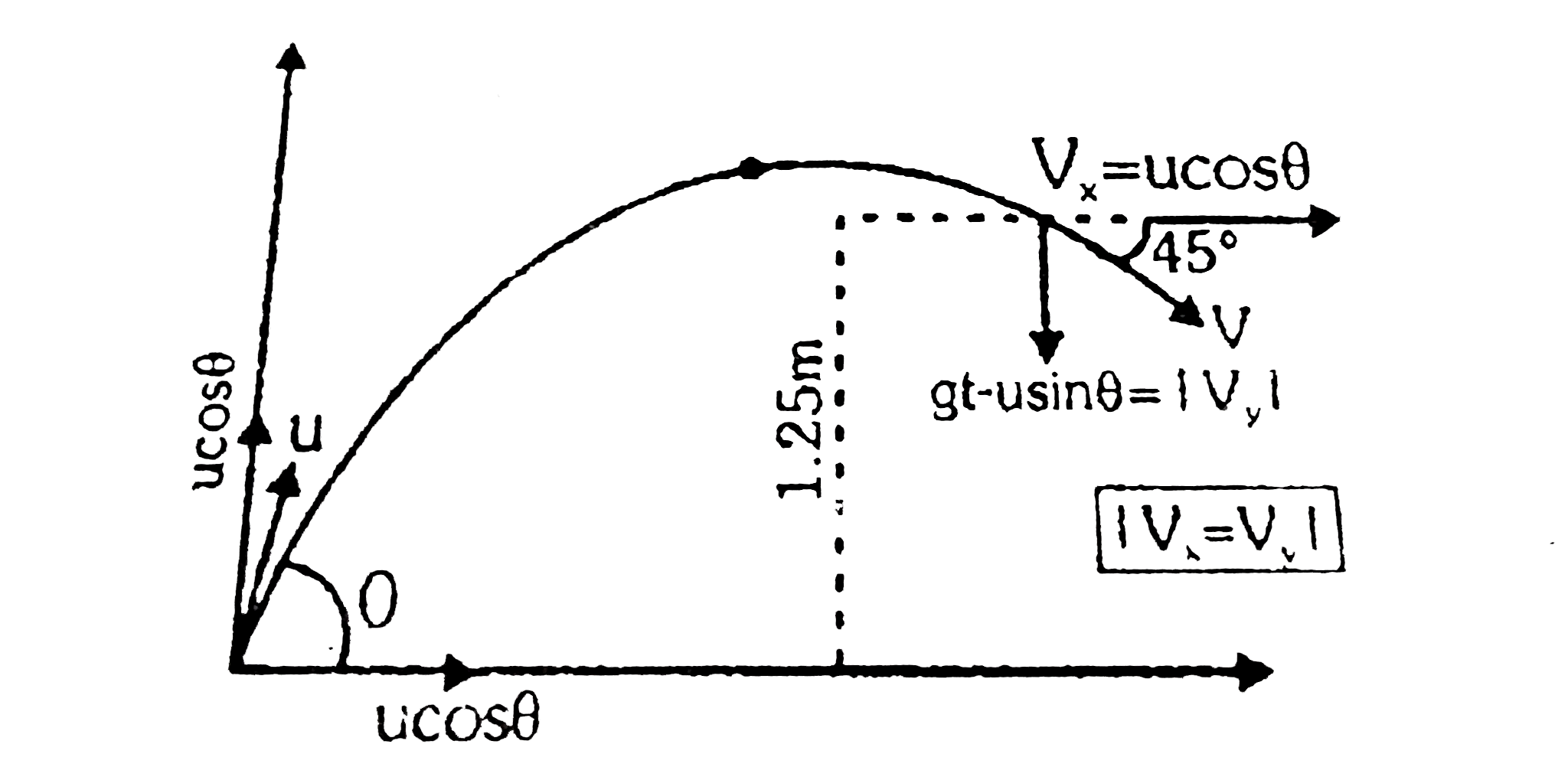
(i) Vertical displacement of stome is `1.25 m`
`:' 1.25=(u sin theta)t-1/2 g t^(2)` where `g=10 m//s^(2)`
`rArr (u sin theta)t=1.25+5t^(2)` ...(i)
(ii) horizontal displacement of stone
`=3 +` dispplacement of object A.
Therefore `(u cos theta)t=3 +1/2 at^(2)`
where `a=1.5 m//s^(2) rArr (u cos theta)t=3 +0.75 t^(2)` ...(ii)
Horizontal component of velocity (of stone)
`=` vertical component (because velocity vector is inclined) at `45^(@)` with horizontal.
Therefore `(u cos theta)=g t-(u sin theta)` ...(iii)
The right hand side is written `g t-u sin theta` because the stone is in its downward motion.
Therefore, `g t gt u sin theta`
In upward motion `u sin theta gt g t`
Multiplying equation (iii) with t we can write,
`(u cos theta) t+(u sin theta)t=10 t^(2)` ...(iv)
Now `(iv)-(ii)-(i)` gives `4.25 t^(2)-4.25=0` or `t=1 s`
Substituting `t=1s` in (i) and (ii) we get
`u sin theta=6.25 m//s`
`rArr u_(y)=6.25 m//s` and `u cos theta=3.75 m//s`
`rArr u_(x)=3.75 m//s` therefore `vec(u)=u_(x)hat(i)+u_(y)hat(j)`
`rArr vec(u)=(3.75hat(i)+6.25hat(j)) m//s`
Promotional Banner

Topper's Solved these Questions

  • KINEMATICS

    ALLEN|Exercise Integer Type Question|3 Videos
  • KINEMATICS

    ALLEN|Exercise PHY|61 Videos
  • KINEMATICS

    ALLEN|Exercise MCQ with one or more than one correct Question|1 Videos
  • ERROR AND MEASUREMENT

    ALLEN|Exercise Part-2(Exercise-2)(B)|22 Videos
  • KINEMATICS (MOTION ALONG A STRAIGHT LINE AND MOTION IN A PLANE)

    ALLEN|Exercise BEGINNER S BOX-7|8 Videos

Similar Questions

Explore conceptually related problems

A balloon starts rising from the ground with a constant acceleration of 1.25m//s^(2) . After 8 s, a stone is released from the balloon. Find the time taken by the stone to reach the ground. (Take g=10m//s^(2) )

A balloon starts rising from the ground with an acceleration of 1.25 m//s^(2) . A stone is released from the balloon after 10s. Determine (1) maximum height of ston from ground (2) time taken by stone to reach the ground

A balloon starts rising from ground from rest with an upward acceleration 2m//s^(2) . Just after 1 s, a stone is dropped from it. The time taken by stone to strike the ground is nearly

A stone is allowed to fall from the top of a tower 100m high and at the same time another stone is projected vertically upwards from the ground with a velocity of 25m/s. Calculate when and where the two stones will meet.

A particle moves in the x-y plane with a constant acceleration of 1.5m//s^(2) in the direction making an angle of 37^(@) with the x-axis. At t=0 the particle is at the origin and its velocity is 8.0m/s along the x- aixs . Find the velocity and the position of the particle at t = 4.0s.

A stone is projected vertically up from the ground with velocity 40 ms^(-1) . The interval of time between the two instants at which the stone is at a height of 60 m above the ground is (g = 10 "ms"^(-2))

A particle movesin the X-Y plane with a constasnt acceleration of 1.5 m/s^2 in the direction making an angle of 37^0 with the X-axis.At t=0 the particle is at the orign and its velocity is 8.0 m/s along the X-axis. Find the velocity and the position of the particle at t=4.0 s.

A block is placed over a plank. The coefficient of friction between the block and the plank is mu= 0.2. Initially both are at rest, suddenly the plank starts moving with acceleration a_(0) = 4m//s^(2). The displacement of the block in 1 is (g=10m//s^(2))

Two objects of masses 100g and 200g are moving along the same line in the same direction with velocities of 2m//s and 1m//s , respectively. They collide and after the collison, the first object moves at a velocity of 1.67 m//s in the same direction. Determine the velocity of the second object.

A stone is projected from point P on the inclined plane with velocity v_(0) = 10 m//sec directed perpendicular to the plane. The time taken (in second) by the stone to strike the horizontal ground S is (Given PO = l = 10 meter)(Take g = 10m//s^(2) )

