Home
Class 12
CHEMISTRY
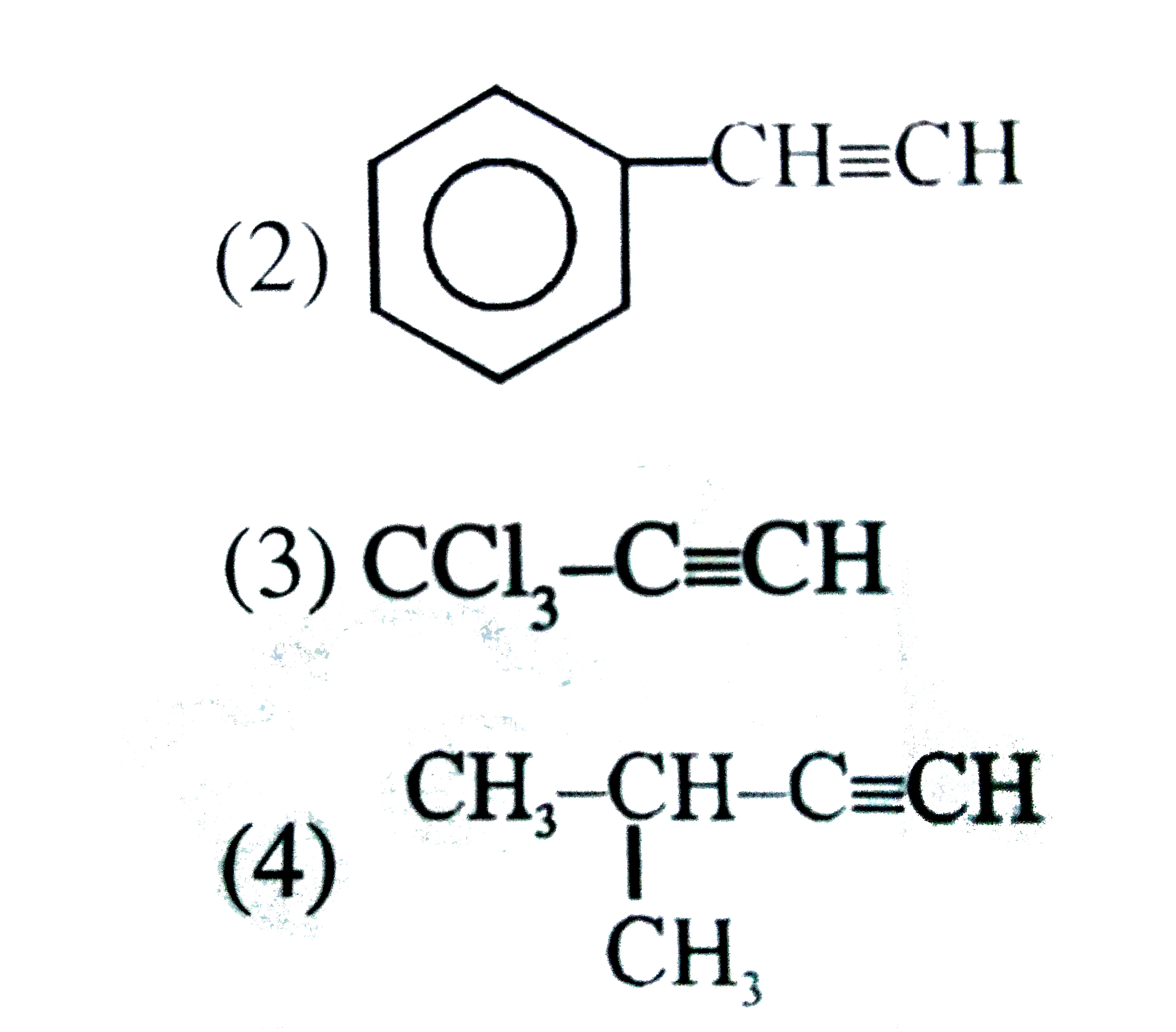
Which gives ketonic group after hydrobor...

Which gives ketonic group after hydroboration oxidation :

A

`CH_(3)-CH_(2)-C-=CH`

B

C

`C Cl_(3)-C-=CH`

D

`CH_(3)-underset(CH_(3))underset(|)(CH)-C-=CH`

Text Solution

AI Generated Solution

The correct Answer is:

To determine which compound gives a ketonic group after hydroboration-oxidation, we will analyze each option step by step. ### Step 1: Understand Hydroboration-Oxidation Hydroboration-oxidation is a two-step reaction: 1. **Hydroboration**: A boron hydride (BH3) adds across a double or triple bond. The boron atom attaches to the less substituted carbon atom, while hydrogen attaches to the more substituted carbon atom. 2. **Oxidation**: The boron is replaced by a hydroxyl group (OH) using hydrogen peroxide (H2O2) in a basic medium. ### Step 2: Analyze Each Compound #### Option 1: CH3CH2C≡CH 1. **Hydroboration**: - BH2 adds to the terminal carbon (less substituted), and H adds to the adjacent carbon. - Resulting structure: CH3CH2C=CH2 (double bond formed). 2. **Oxidation**: - Replace BH2 with OH. - Resulting structure: CH3CH2CH2CHO (an aldehyde). 3. **Conclusion**: This option does not yield a ketone. #### Option 2: C6H5C≡CH 1. **Hydroboration**: - BH2 adds to the carbon with the triple bond that is less substituted (the one attached to the phenyl ring), and H adds to the other carbon. - Resulting structure: C6H5C=CH2. 2. **Oxidation**: - Replace BH2 with OH. - Resulting structure: C6H5C(OH)=CH2 (enol form). 3. **Tautomerization**: - Converts to C6H5C=O (an aldehyde). 4. **Conclusion**: This option does not yield a ketone. #### Option 3: CCl3C≡CH 1. **Hydroboration**: - Due to the electron-withdrawing effect of Cl, BH2 adds to the carbon with the triple bond that has a partial negative charge. - Resulting structure: CCl3C=CH2. 2. **Oxidation**: - Replace BH2 with OH. - Resulting structure: CCl3C(OH)=CH2 (enol form). 3. **Tautomerization**: - Converts to CCl3C=O (a ketone). 4. **Conclusion**: This option yields a ketone. #### Option 4: CH3C≡CCH3 1. **Hydroboration**: - BH2 adds to the terminal carbon (less substituted), and H adds to the adjacent carbon. - Resulting structure: CH3C=CH2. 2. **Oxidation**: - Replace BH2 with OH. - Resulting structure: CH3C(OH)=CH2 (enol form). 3. **Tautomerization**: - Converts to CH3C=O (an aldehyde). 4. **Conclusion**: This option does not yield a ketone. ### Final Answer After analyzing all options, **Option 3 (CCl3C≡CH)** is the only compound that yields a ketone after hydroboration-oxidation.
Promotional Banner

Topper's Solved these Questions

  • CHEMISTRY AT A GLANCE

    ALLEN|Exercise INORGANIC CHEMISTRY|300 Videos
  • Chemical Equilibrium

    ALLEN|Exercise All Questions|30 Videos
  • ELECTROCHEMISTRY

    ALLEN|Exercise EXERCISE -05 [B]|38 Videos

Similar Questions

Explore conceptually related problems

Propene on hydroboration and oxidation produces

Which of the following statements is wrong about hydroboration oxidation ?

Which of the following is true regarding the hydroboration oxidation of alkene ?

Which of the following alkenes will give same product by any method out of hydration, hydroboration-oxidation and oxymercuration-demercuration?

The reaction (C ) to (H) is called hydroboration oxidation of alkene. Which statement is true about the reaction ?

Addition of water molecule across double bond to yield Antimarkownikov's product. Can be accomplished by Hydroboration followed by oxidation. Reaction follows as: Product of hydroboration oxidation of 1-methyl cyclopentene is

Hydration reaction of alkene is catalyzed by dilute acid. Selection of acid is important . Conjugate base of the acid should not interfere in the reaction. There are other means by which alkenes can be converted to alcohols. Oxymercuration demercuration gives Markovnikoff's alcohols while hydroboration oxidation give Anti Markovnikoff's alcohol. The reagent required to perform the given transformation is

Acid-catalysed hydration oxymercuration-demercu-ration, and hydroboration oxidation reaction will give the same product with:

The major product formed during the hydroboration-oxidation of 1-methylcyclopentene is-

Iso - butylene when subjected to hydroboration oxidation reaction yields

ALLEN-CHEMISTRY AT A GLANCE-ORGANIC CHEMISTRY
  1. During debromination of meso-dibromobutane, the major compound formed ...

    Text Solution

    |

  2. Which is maximum reactive towords acid catalysed dehydration :

    Text Solution

    |

  3. Which gives ketonic group after hydroboration oxidation :

    Text Solution

    |

  4. Complete the following reaction

    Text Solution

    |

  5. on oxymercuration demercuaration produces the major product

    Text Solution

    |

  6. How many chiral compounds are possible on monochlorination of 2-methyl...

    Text Solution

    |

  7. Ozonolysis of an organic compound A produces acetone and propionaldehy...

    Text Solution

    |

  8. Arrange the following in decreasing order of reactivity towards electr...

    Text Solution

    |

  9. Which of the following is most basic

    Text Solution

    |

  10. Ph-CH=CH-Ph underset(C Cl(4))overset(Cl(2))rarr X overset(2NaNH(2))rar...

    Text Solution

    |

  11. Which Intermediate formed during addition of halogen on alkenes ?

    Text Solution

    |

  12. CH(3)-C-=CHunderset(dil.H(2)SO(4))overset(HgSO(4))(to) product Produ...

    Text Solution

    |

  13. Product, Product is

    Text Solution

    |

  14. No. of structural isomeric alkenes (molecular formula =C(6)H(12)) whic...

    Text Solution

    |

  15. Arrange the following towards their reactivity for electrophilic addit...

    Text Solution

    |

  16. Arrange the following towards reactivity for heat of combustion :-

    Text Solution

    |

  17. Benzene + Acetylchloride overset(AlCl(3))(to) product Name of the abov...

    Text Solution

    |

  18. Which of the following Alkane can not be prepared by hydrogenation o...

    Text Solution

    |

  19. From how many alkyl halide we get pentane on reaction with Zn + HCl ...

    Text Solution

    |

  20. C(2)H(5)Br+CH(3)-underset(CH(3))underset(|)(CH)-Broverset((Na)dry ethe...

    Text Solution

    |
