Home
Class 12
CHEMISTRY
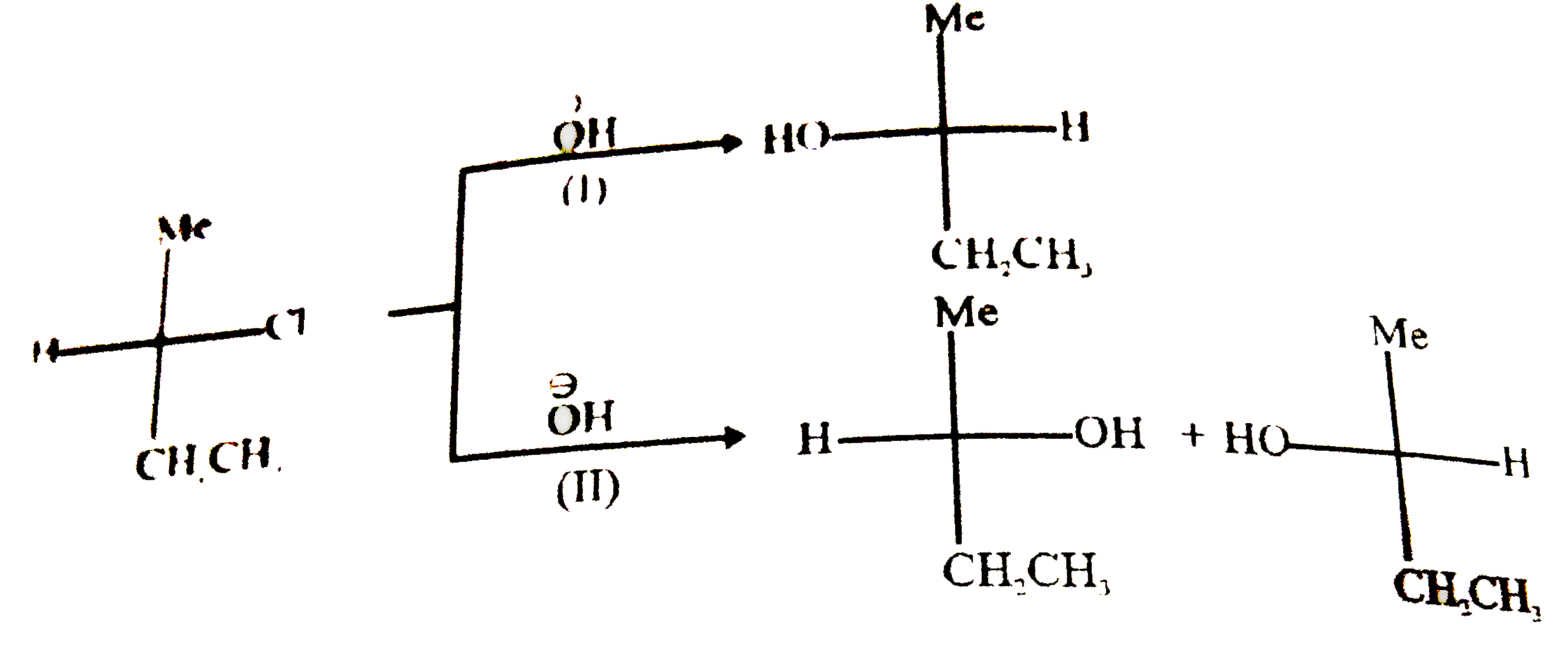
Reaction I^(st) and II^(nd) are...


Reaction `I^(st)` and `II^(nd)` are

A

(A) Both `S_(N)` 1

B

(B) Both `S_(N)` 1

C

(C) `(I)S_(N)1,(II)S_(N)2`

D

(D) `(I)S_(N)2,(II)S_(N)1`

Text Solution

Verified by Experts

The correct Answer is:

D
Promotional Banner

Topper's Solved these Questions

  • CHEMISTRY AT A GLANCE

    ALLEN|Exercise INORGANIC CHEMISTRY|300 Videos
  • Chemical Equilibrium

    ALLEN|Exercise All Questions|30 Videos
  • ELECTROCHEMISTRY

    ALLEN|Exercise EXERCISE -05 [B]|38 Videos

Similar Questions

Explore conceptually related problems

Gases released in reaction (I) and (II) are:

Statement-I : In the expansion of (1+ x)^n ifcoefficient of 31^(st) and 32^(nd) terms are equal then n = 61 Statement -II : Middle term in the expansion of (1+x)^n has greatest coefficient.

Two uniformly charged solid spheres are such that E_1 is electric field at surface of 1^(st) sphere due to itself. E_2 is electric field at surface of 2^(nd) sphere due to itself. r_1, r_2 are radius of 1^(st) and 2^(nd) sphere respectively. If E_1/E_2=r_1/r_2 then ratio of potential at the surface of spheres 1^(st) and 2^(nd) due to their self charges is :

Two unknown frequency tuning forks are used in resonance column apparatus. When only first tuning fork is excited the 1^(st) and 2^(nd) resonating lengths noted are 10 cm and 30 cm respectively. When only second tuning fork is excited 1^(st) and 2^(nd) resonating lengths noted are 30 cm and 90 cm respectively. The ratio of the frequency of the 1^(st) to 2^(nd) tuning fork is.

(I)(Reactant) In this reaction I and II are ,

The ratio of difference in wavelengths of 1^(st) and 2^(nd) lines of Lyman series in H-like atom to difference in wavelength for 2^(nd) and 3^(rd) lines of same series is :-

reactions I and II are limited mainly to naphthalene compounds. These reactions are called, respectively:

After completion of the reactions (I and II) , the organic compounds (s) in the reaction mixtures is :

Which set represent 1st order reactions out of (I) , (II) and (III)

The 1^(st) , 2^(nd) and 3^(rd) terms of an arithmetic series are a , b and a^(2) where 'a' is negative. The 1^(st) , 2^(nd) and 3^(rd) terms of a geometric series are a , a^(2) and b respectively. The sum of infinite geometric series is

ALLEN-CHEMISTRY AT A GLANCE-ORGANIC CHEMISTRY
  1. Among the following alkyl bromide correct order of S(N)1 reactivity is...

    Text Solution

    |

  2. The product of the reaction is CH(3)-CH(2)-overset(O)overset(||)(C)-OA...

    Text Solution

    |

  3. Reaction I^(st) and II^(nd) are

    Text Solution

    |

  4. Which of the following compound undergo hydrolysis most easily :

    Text Solution

    |

  5. Consider the reaction CH(3) CH(2) CH(2) Br + NaCN rarr CH(3) CH(2) C...

    Text Solution

    |

  6. Which of the following compound will give curdy precipiate with AgNO(3...

    Text Solution

    |

  7. Arrange the following group in order of their decreasing leaving abili...

    Text Solution

    |

  8. (CH(3))(2)"CHCl + Nal" rarr (CH(3))(2)"CHl+ NaCl" The above reaction...

    Text Solution

    |

  9. The correct order for E(2) reaction with alc. KOH will be :-

    Text Solution

    |

  10. Which of the following reaction is correct :

    Text Solution

    |

  11. Which one of the following compounds is more reactive towards S(N)2 re...

    Text Solution

    |

  12. Which of the following statement is incorrect :-

    Text Solution

    |

  13. Which of the following is correctly match :- (A) Chloramphenicol to ...

    Text Solution

    |

  14. C(2)F(3)Cl(3) is named as :-

    Text Solution

    |

  15. Which one of the following will give racemised product in C(2)H(5)OH...

    Text Solution

    |

  16. Arrange the following group in order of their nucleophilic strength :-

    Text Solution

    |

  17. Which of the following molecule would have a carbon halogen bond most ...

    Text Solution

    |

  18. Which of the following is the most reactive towards nucleophilic subst...

    Text Solution

    |

  19. An S(N)2 reaction at an asymmetric carbon of a compound always g...

    Text Solution

    |

  20. The synthesis of alkyl fluorides is best accomplished by :

    Text Solution

    |
