Home
Class 12
PHYSICS
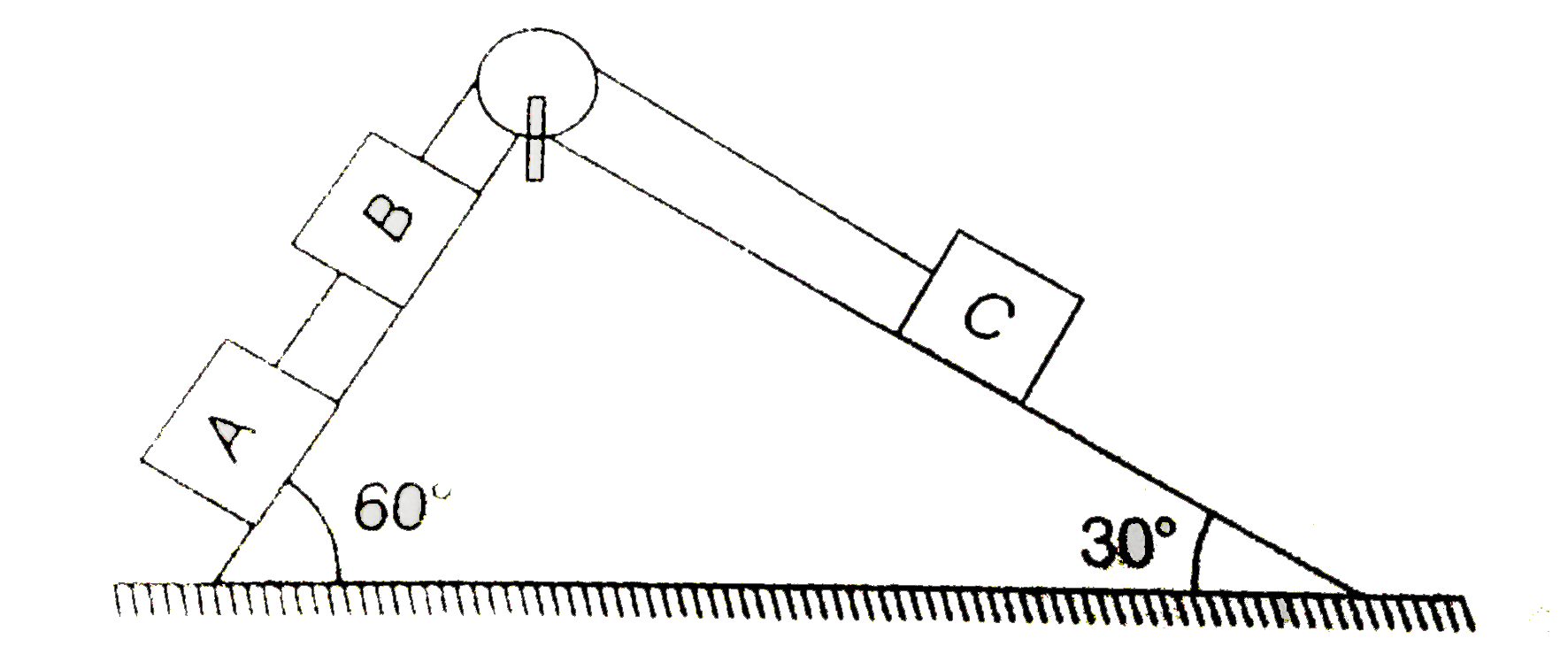
In the adjacent figure, mass of A, B and...

In the adjacent figure, mass of A, B and C are 1 kg , 3 kg and 2 kg, respectively. Find

(a) the acceleration of the system, and
(b) tensions in the string .
Neglect friction. (g`=10ms^(-2)`)

Text Solution

Verified by Experts
(a) `m_(A)g sin60^(@)-T_(1)=m_(A)a`..........(1)
`T_(1)-T_(2)+m_(B)gsin60^(@)=m_(B)a` .............(2)
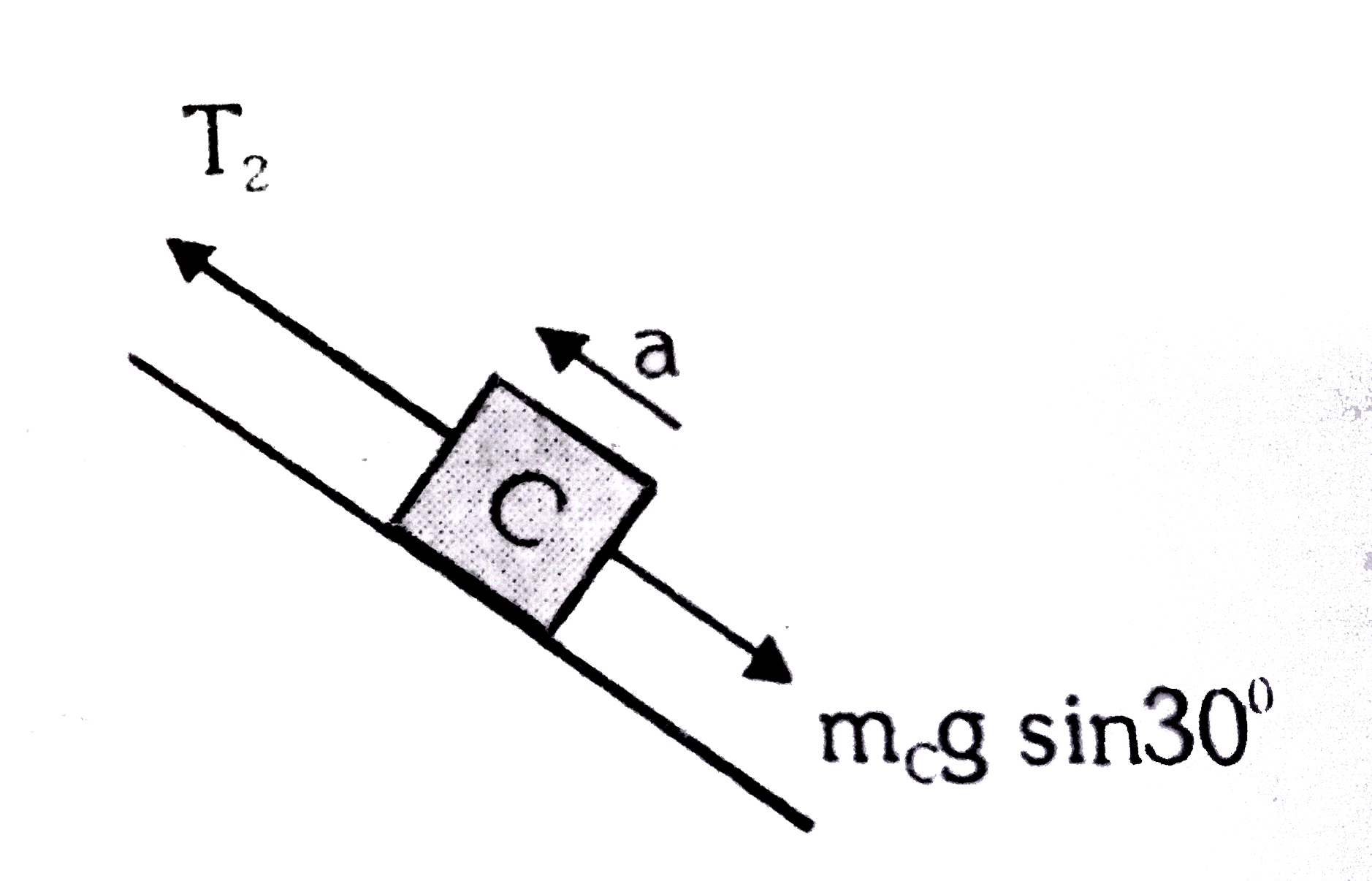
`T_(2)-m_(C)gsin30^(@)=m_(C)a`.........(3)
`therefore` Acceleration of the system `a=(24.64)/(6)=4.1 m//s^(2)`
(b) For the tension `T_(1)` in the string between A and B, `m_(A)g sin60^(@)-T_(1)=(m_(A))(a)`
(b) For the tension `T_(1)` in the string between A and B, `m_(A)gsin60^(@)-T_(1)=(m_(A))(a)`
`rArrT_(1)=(1)(10xxsqrt(3)/(2)-4.1)=4.56N`
For the tension `T_(2)` in the string between B and C
`T_(2)-m_(C)g sin30^(@)=m_(C)a`
`rArr T_(2)=m_(C)(a+g sin30^(@))=2[4.1+10((1)/(2))]=18.2N`
Promotional Banner

Topper's Solved these Questions

  • NEWTONS LAWS OF MOTION

    ALLEN|Exercise SWOE|44 Videos
  • NEWTONS LAWS OF MOTION

    ALLEN|Exercise EXERCISE-I|52 Videos
  • NEWTON'S LAWS OF MOTION & FRICTION

    ALLEN|Exercise EXERCISE (JA)|4 Videos
  • RACE

    ALLEN|Exercise Basic Maths (Wave Motion & Dopplers Effect) (Stationary waves & doppler effect, beats)|24 Videos

Similar Questions

Explore conceptually related problems

In the adjacent figure, masses of A,B and C are 1kg ,3kg and 2kg respectively. Find (a) the acceleration of the system and (b) tension in the strings. Neglect friction. (g=10m//s^(2))

If coeffiecient of friction between the block of mass 2kg and table is 0.4 then out acceleration of the system and tension in the string. (g=10m//s^(2))

In the above example, if two blocks have masses 1kg and 2kg respectively then find their acceleration and tension in different string.

A block A of mass 6kg is applied on a frictionless table. A thread tied to it passes over a frictionless pulley and carries a body B of mass 4kg at the other end. Find the acceleration of the system and tension in the thread (given g=10ms^(-2) )

In the arrangement shown in Figure, m_A=2kg and m_B=1kg . String is light and inextensible. Find the acceleration of centre of mass of both the blocks. Neglect friction everywhere.

In the arrangement shown in Figure, m_A=2kg and m_B=1kg . String is light and inextensible. Find the acceleration of centre of mass of both the blocks. Neglect friction everywhere.

Two block of mass 4 kg and 2 kg are attached by an inextensible light string as shown in figure. Both the blocks are pulled vertically upwards by a force F=120N Find (a) the acceleration of the blocks, (b) tension in the string. (Take g= 10 ms^(-2) )

Two block of mass 4 kg and 2 kg are attached by an inextensible light string as shown in figure. Both the blocks are pulled vertically upwards by a force F=120N Find (a) the acceleration of the blocks (b) tension in the string. (Take g= 10 ms^(-2) )

Consider the situation shown in figure .Both the pulleys and the string and light and all the surfaces are smooth. (a) Find the acceleration of 1kg block. (b) Find the tension in the string. (g = 10 m//s^(2)) .

In the arrangement shown in figure pulleys are mass of block A,b and C is m_(1) = 5 kg m_(2) = 4 kg and m_(3) = 2.5 kg respectively .Co-efficient acceleration of friction for both the plane is mu = 0.50 Calculate acceleration of which block when system is released from rest

ALLEN-NEWTONS LAWS OF MOTION-EXERCISE-III
  1. In the adjacent figure, mass of A, B and C are 1 kg , 3 kg and 2 kg, r...

    Text Solution

    |

  2. Assertion: The driver in a vechicle moving with a constant speed on a ...

    Text Solution

    |

  3. Assertion: Frictional forces are conservative forces. Reason: Potent...

    Text Solution

    |

  4. Assertion: A man in a dosed cabin falling freely does not experience g...

    Text Solution

    |

  5. Assertion Angle of repose is equal to angle of limiting friction . R...

    Text Solution

    |

  6. Assertion: On a rainy day, it is difficult to drive a car or bus at h...

    Text Solution

    |

  7. Assertion: Force of friction depends on the actual area of contact. ...

    Text Solution

    |

  8. Assertion: Static frictional force is a self adjusting force. Reason...

    Text Solution

    |

  9. Assertion : A body can be at rest even when it is under the action of ...

    Text Solution

    |

  10. Assertion: Frictional force is the component of contact force parallel...

    Text Solution

    |

  11. Assertion: Newton's first law can be derived from the second law. Re...

    Text Solution

    |

  12. These questions consists of two statements each printed as Assertion a...

    Text Solution

    |

  13. Assertion: Pseudo force is an imaginary force which is recongnised on...

    Text Solution

    |

  14. Assertion: A table cloth can be pulled from a table without dislodding...

    Text Solution

    |

  15. Assertion: Friction is a self-adjusting force. Reason: A block on th...

    Text Solution

    |

  16. Assertion : The apparent weight of a body in an clevator moving downwa...

    Text Solution

    |

  17. Assertion: A body of weight 10N (W) is at rest on an inclined plane (m...

    Text Solution

    |

  18. Assertion: When a force vecF attempts to slide a body along a surface,...

    Text Solution

    |

  19. Assertion: Mass is a property of one object alone, whereas weight resu...

    Text Solution

    |

  20. Assertion: When brakes are applied on a wet road, a car is likely to s...

    Text Solution

    |

  21. Assertion : The force of tension on a body always act away from the bo...

    Text Solution

    |

