Home
Class 12
PHYSICS
A block P of mass m is placed on horizon...

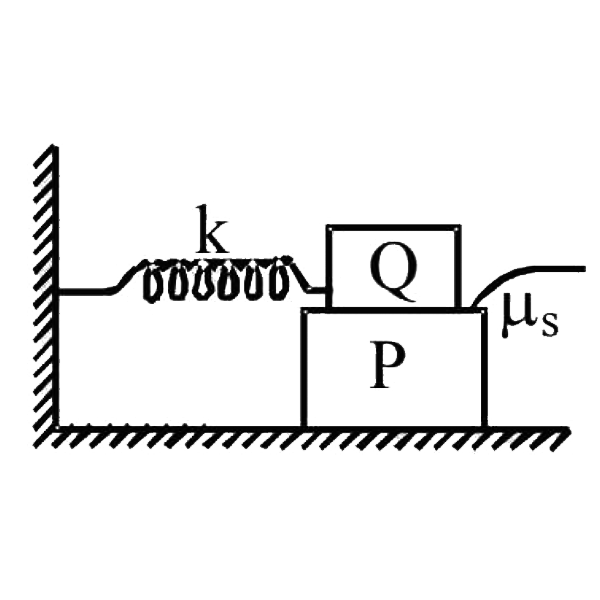
A block P of mass m is placed on horizontal frictionless plane. A second block of same mass m is placed on it and is connected to a spring of spring constant k, the two blocks are pulled by distance A. Block Q oscillates without slipping. What is the maximum value of frictional force between the two blocks.

A

`kA`

B

`(kA)/(2)`

C

zero

D

`mu_(s)mg`

Text Solution

Verified by Experts

The correct Answer is:

B

Block Q oscillates but does not slipe on P. It mean that acceleration is same for Q and P both. There is a force of friction between the two blocks while the horizontal plane is frictinless. The spring is connected to upper block. The (P-Q) system oscilaltes with angular frequency `omega`. The spring is streactched by A.
`:. omega = sqrt((k)/(m + m)) = sqrt((k)/(2m))`
`:. ` Maximum acceleration in SHM `= omega^(2)A`
`a_(m) = (kA)/(2m)"......."(i)`
Now consider the lower block.
Let the maximum force of friction `=f_(m)`
`:. f_(m) = ma_(m) rArr f_(m) = m xx (kA)/(2m) rArr f_(m) = (kA)/(2)`
Promotional Banner

Topper's Solved these Questions

  • SIMPLE HARMONIC MOTION

    ALLEN|Exercise MCQ s one or more than one correct answers|5 Videos
  • SIMPLE HARMONIC MOTION

    ALLEN|Exercise Paragraph|3 Videos
  • SIMPLE HARMONIC MOTION

    ALLEN|Exercise Exercise-05 [A]|39 Videos
  • RACE

    ALLEN|Exercise Basic Maths (Wave Motion & Dopplers Effect) (Stationary waves & doppler effect, beats)|24 Videos
  • TEST PAPER

    ALLEN|Exercise PHYSICS|4 Videos

Similar Questions

Explore conceptually related problems

A block Q of mass 2m is placed on a horizontal frictionless plane. A second block of mass m is placed on it and is connected to a spring of spring constant K, the two block are pulled by distance A. Block Q oscillates without slipping. The work done by the friction force on block Q when the spring regains its natural length is:

A block P of mass m is placed on a smooth horizontal surface. A block Q of the same mass is placed over the block P and the coefficient of static friction between them is mu . A spring of spring constant K is attached to block Q. The blocks are displaced together to a distance A and released. The upper block oscillates without slipping over the lower block. The maximum frictional force between the block is:

Two spring are connected toa block of mass M placed a frictionless surface as shown if both the spring have a spring constant k the frequency of oscillation block is

A block of mass m_1 resting on a frictionless horizontal surface is connected to a spring of spring constant k that is anchored in a near by wall. A block of mass m_2 is placed on the top of the first block. The coefficient of static friction between the two blocks is mu Assuming that the two blocks move together as a unit, find the period of oscillation of the system and also find maximum oscillation amplitude that permits the two bodies to move as a unit.

A block of mass m is placed on a rough horizontal floor and it is pulled by a ideal string by a constant force F as shown. As the block moves towards right the friction force on block

A block of mass m is placed on a smooth inclined plane of inclination theta with the horizontal. The force exerted by the plane on the block has a magnitude

A block of mass m is placed on a smooth inclined plane of inclination theta with the horizontal. The force exerted by the plane on the block has a magnitude

A block of mass m is placed at rest on a horizontal rough surface with angle of friction phi . The block is pulled with a force F at an angle theta with the horizontal. The minimum value of F required to move the block is

A block of mass m is placed at rest on a horizontal rough surface with angle of friction phi . The block is pulled with a force F at an angle theta with the horizontal. The minimum value of F required to move the block is

Two blocks A and B of mass 16kg and 64kg are placed on a smooth horizontal surface. Blocks are connected by a spring of spring constant 100 N//m . Find the ratio of maximum speed of block A to maximum speed of block B .
