Home
Class 12
PHYSICS
Two independent harmonic oscillators of ...

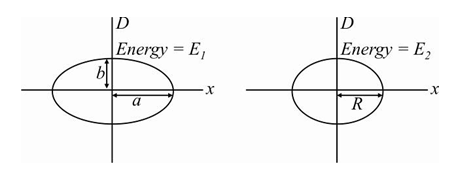
Two independent harmonic oscillators of equal mass are oscillating about the origin with angular frequencies `omega_(1)` and `omega_(2)` and have total energies `E_(1)` and `E_(2)` respectively. The variations of their momenta p with positions x are shown in figures. If `(a)/(b)=n^(2)` and `(a)/(R)=n` then the correct equation(s) is (are):

A

`E_(1)omega_(1) = E_(2)omega_(2)`

B

`(omega_(2))/(omega_(1)) = n^(2)`

C

`omega_(1)omega_(2) = n^(2)`

D

`(E_(1))/(omega_(1)) = (E_(2))/(omega_(2))`

Text Solution

Verified by Experts

The correct Answer is:

B, D

`P_(1max) = maomega_(1) = b`
`P_(2max) = mRomega_(2) = R`
`(omega_(1))/(omega_(2)) = (1)/(n^(2))`
`(omega_(2))/(omega_(1)) = n^(2)`
`E_(1) = 1/(2)momega_(1)^(2)a^(2)`
`E_(2) = (1)/(2)momega_(2)^(2)R^(2)`
`(E_(1))/(E_(2)) = (omega_(1)^(2))/(omega_(2)^(2)) (a^(2))/(R^(2)) = (omega_(1)^(2))/(omega_(2)^(2)) n^(2) = (omega_(1)^(2))/(omega_(2)^(2)) (omega_(2))/(omega_(1))`
`(E_(1))/(E_(2)) = (omega_(1))/(omega_(2))`
`(E_(1))/(E_(2)) = (E_(2))/(omega_(2))`
Promotional Banner

Topper's Solved these Questions

  • SIMPLE HARMONIC MOTION

    ALLEN|Exercise Paragraph|3 Videos
  • SIMPLE HARMONIC MOTION

    ALLEN|Exercise Subjective|30 Videos
  • SIMPLE HARMONIC MOTION

    ALLEN|Exercise Exercise-05 [B]|12 Videos
  • RACE

    ALLEN|Exercise Basic Maths (Wave Motion & Dopplers Effect) (Stationary waves & doppler effect, beats)|24 Videos
  • TEST PAPER

    ALLEN|Exercise PHYSICS|4 Videos

Similar Questions

Explore conceptually related problems

Two independent harmonic oscillators of equal mass are oscillating about the origin with angular frequencies omega_(1) and omega_(2) and have total energies E_(1) and E_(2) repsectively. The variations of their momenta p with positions x are shown in figures. If (a)/(b) = n^(2) and (a)/(R) = n , then the correc t equation(s) is (are) :

Two bodies of different masses m_(1) and m_(2) have equal momenta. Their kinetic energies E_(1) and E_(2) are in the ratio

Two bodies of different masses m_(1) and m_(2) have equal momenta. Their kinetic energies E_(1) and E_(2) are in the ratio

Two bodies of different masses m_(1) and m_(2) have equal momenta. Their kinetic energies E_(1) and E_(2) are in the ratio

Two discs A and B are in contact and rotating with angular velocity with angular velocities omega_(1) and omega_(2) respectively as shown. If there is no slipping between the discs, then

In forced oscillation of a particle the amplitude is maximum for a frequency omega_(1) of the force while the energy is maximum for a frequency omega_(2) of the force, then .

Two batteries of emf E_(1) and E_(2)(E_(2) gt E_(1)) and internal resistance r_(1) and r_(2) respectively are connected in parallel as shown in the figure. Then, which of the followings statements is correct ?

Two bodies with masses m1 kg and m2 kg have equal kinetic energies. If p_(1) and P_(2) are their respective momenta, then p_(1)//P_(2) is equal to :

A particle performing SHM with angular frequency omega=5000 radian/second and amplitude A=2 cm and mass of 1 kg. Find the total energy of oscillation.
