Home
Class 12
PHYSICS
Binding energy per nucleon versus mass n...

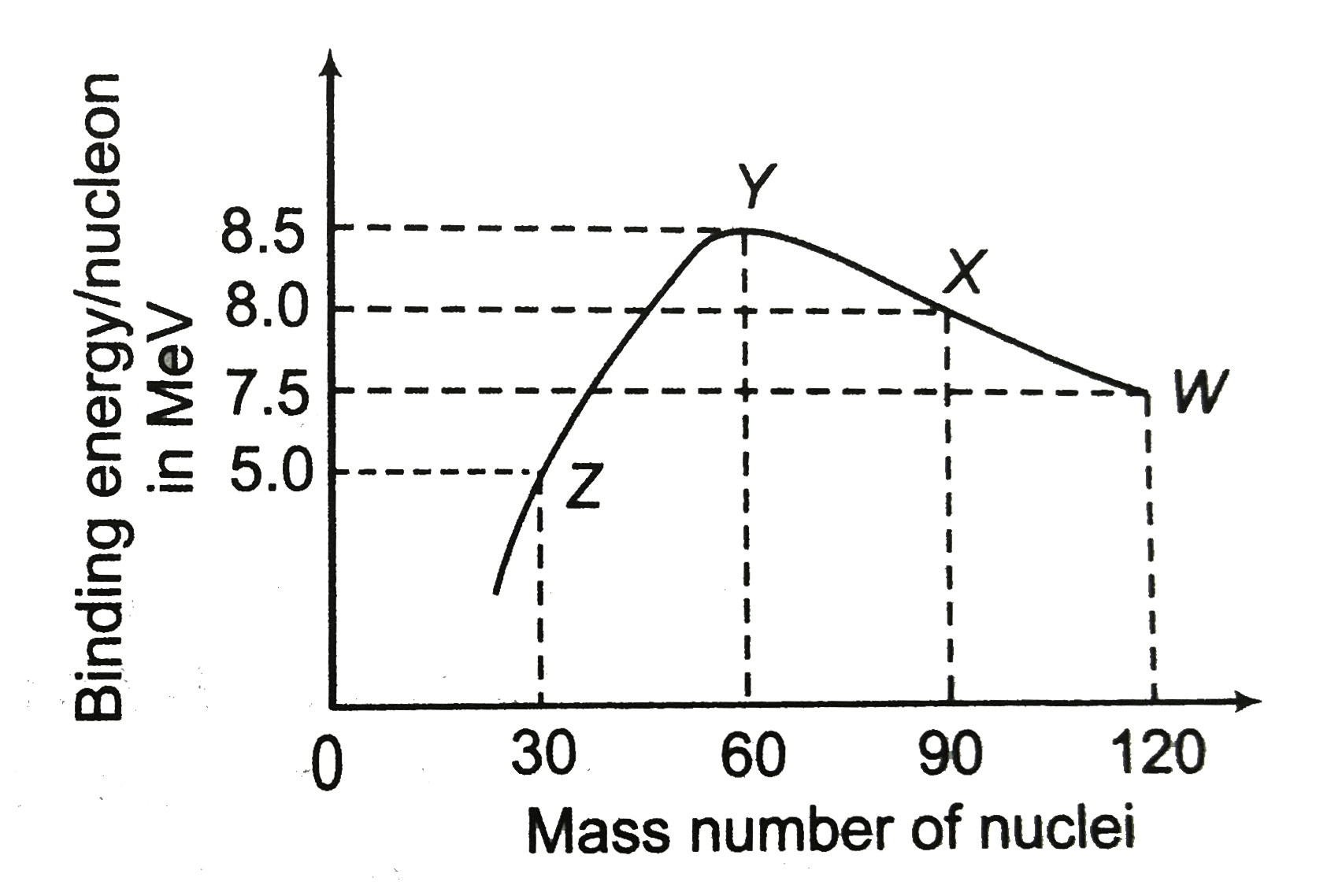
Binding energy per nucleon versus mass number curve for nuclei is shown in figure. W, X, Y, and Z are four nuclei indicated on the curve. The process that would release energy is
(a) `Yrarr2Z`
(b) `WrarrX+Z`
(c) `Wrarr2Y`
(d) `XrarrY+Z`

A

`Y rarr 2Z`

B

`W rarr X + Z`

C

`W rarr 2Y`

D

`X rarr Y + Z`

Text Solution

Verified by Experts

The correct Answer is:

C

Energy is released in process when total binding energy of the nucleus (=binding energy per nucleon `xx` number of nucleons) is increased or we can say, when total binding energy of products is more than the reactants. By calculation we can see that only in case of option (c), this happens.
Given : `W rarr 2Y`
Binding energy of reactants `=120xx7.5`
`=900 MeV` and binding energy of products
`=2(60xx8.5)=1020 MeV gt 900 MeV`.
Promotional Banner

Topper's Solved these Questions

  • SIMPLE HARMONIC MOTION

    ALLEN|Exercise MCQ s|8 Videos
  • SIMPLE HARMONIC MOTION

    ALLEN|Exercise Comprehension #1|3 Videos
  • SIMPLE HARMONIC MOTION

    ALLEN|Exercise Exercise - 04[A]|25 Videos
  • RACE

    ALLEN|Exercise Basic Maths (Wave Motion & Dopplers Effect) (Stationary waves & doppler effect, beats)|24 Videos
  • TEST PAPER

    ALLEN|Exercise PHYSICS|4 Videos

Similar Questions

Explore conceptually related problems

Binding energy per nucleons vs mass curve for nucleus is shown in the figure W,X,Y and Z are four nuclei indicated on the curve . The process that would release energy is

Assume that the nuclear binding energy per nucleon (B//A) versus mass number (A) is as shown in figure. Use this plot to choose the correct choice(s) given below. (a) Fusion of two nuclei with mass numbers, lying in the range of 1ltAlt50 will release energy. Fusion of two nuclei with mass numbers lying in the range of 51ltAlt100 will release energy. (c) Fission of a nucleus lying in the mass range of 100ltAlt200 will release energy when broken into two equal fragements. (d) Fission of a nucleus lying in the mass range of 200ltAlt260 will release energy when broken into two equal fragments.

Using the curve for the binding energy per nucleon as a function of mass number A, state clearly how the release in energy in the processes of nuclear fission and nuclear fusion can be explained.

In the figure, P is the centre of the circle. Prove that: /_X P Z=2\ (/_X Z Y+\ /_Y X Z)

In a nuclear reaction of alpha - decay, the daughter nuclei ._(Z)^(A)X is moving with kinetic energy E. The total energy released if parent nuclei was at rest will be

The binding anergy per nucleon is 8.5 MeV for A=120 and is 7.6 MeV for A=240 (see in figure). Suppose a nucleus with A=240 breaks into two nuclei of nearly equal mass numbers. Calculate the energy released in the process.

The above is a plate of binding energy per nucleon E_(0) against the nuclear mass M, A, B,C,D,E,F correspond to different nuclei Consider four reactions:

Four nuclei of an elements undergo fusion to form a heavier nucles, with release of energy. Which of the two - the parent or the daughter nucleus - would have higher binding energy per nucleon ?

A heavy nucleus X of mass number 240 and binding energy per nucleon 7.6 MeV is split into two fragments Y and Z of mass numbers 110 and 130 . The binding energy of nucleons in Y and Z is 8.5MeV per nucleon. Calculate the energy Q released per fission in MeV.

Arrange with explanation the following elements in the order of increasing ionisation energy. X(Z = 4) , Y(Z = 5), D(Z= 6), E(Z= 11)

ALLEN-SIMPLE HARMONIC MOTION-Exercise-05(B)
  1. The half-life period of a radioactive element X is same as the mean li...

    Text Solution

    |

  2. Order of magnitude of density of uranium nucleus is (mp=1.67xx10^-27kg...

    Text Solution

    |

  3. Binding energy per nucleon versus mass number curve for nuclei is show...

    Text Solution

    |

  4. Imagine an atom made up of a proton and a hypothetical particle of dou...

    Text Solution

    |

  5. The electron in a hydrogen atom makes a transition from an excited sta...

    Text Solution

    |

  6. Electrons with energy 80 ke V are incident on the tungsten target of...

    Text Solution

    |

  7. Two radioactive materials X(1) and X(2) have decay constant 11 lambda ...

    Text Solution

    |

  8. The transition from the state n = 4 " to " n = 3 in a hydrogen like at...

    Text Solution

    |

  9. The intensity of X-rays from a coolidge tube is plotted against wavele...

    Text Solution

    |

  10. The electron emitted in beta radiation originates from

    Text Solution

    |

  11. A radioactive sample consists of two distinct species having equal num...

    Text Solution

    |

  12. A hydrogen atom and a Li^(2+) ion are both in the second excited stat...

    Text Solution

    |

  13. The potential difference applied to an X - ray tube is 5 KV and th...

    Text Solution

    |

  14. The half-life of .^215At is 100mus. The time taken for the activity of...

    Text Solution

    |

  15. Which of the following processes does not represent a gamma decay ?

    Text Solution

    |

  16. The electirc potential between a proton and an electron is given by ...

    Text Solution

    |

  17. If Bohr's theory is applicable to .(100)Fm^(257), then radius of this ...

    Text Solution

    |

  18. For uranium nucleus how does its mass vary with volume?

    Text Solution

    |

  19. A nucleus with mass number 220 initially at rest emits an alpha partic...

    Text Solution

    |

  20. The figure shows the variation of pholo current with for a photo-sensi...

    Text Solution

    |
