Home
Class 12
PHYSICS
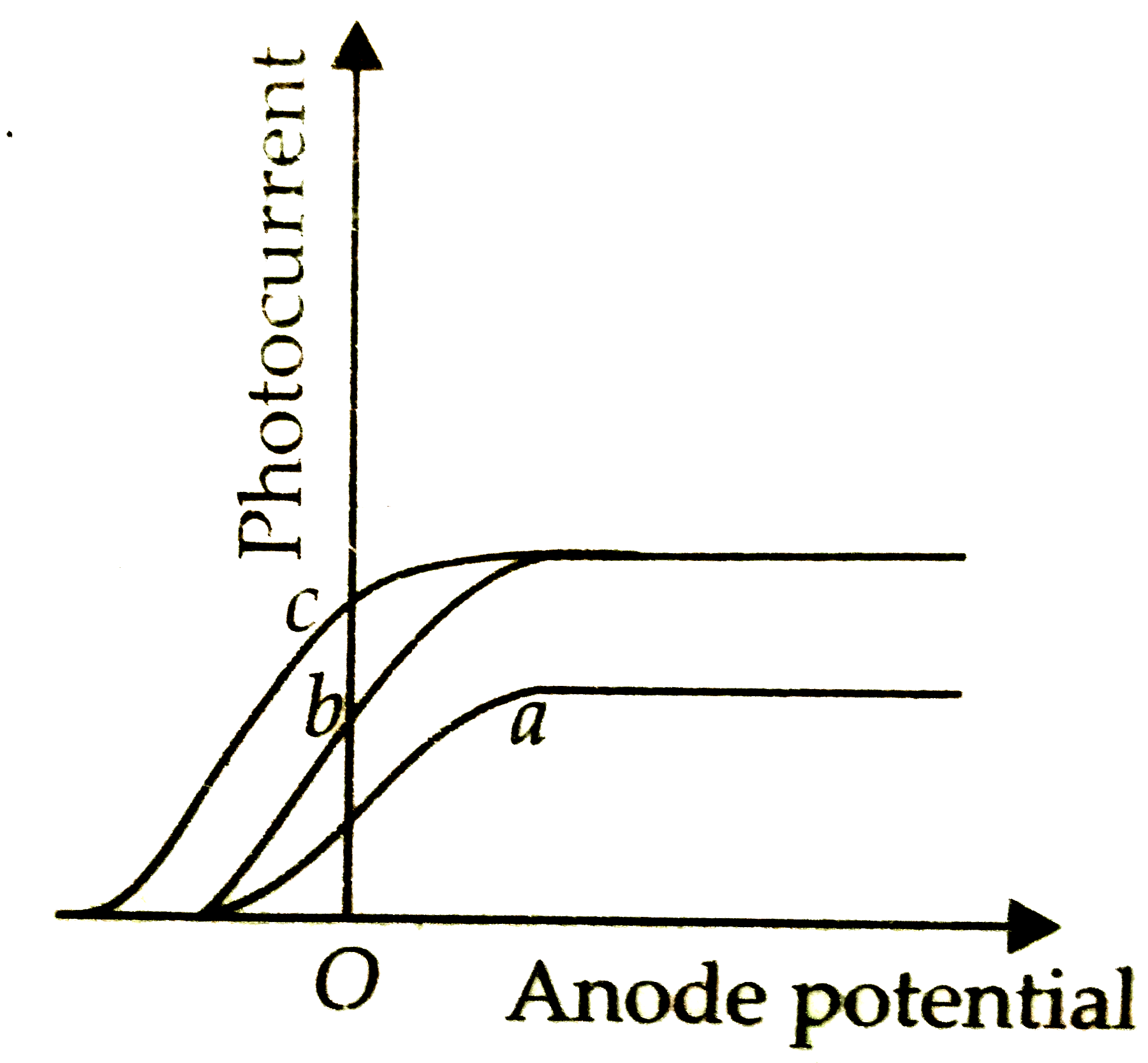
The figure shows the variation of pholo ...

The figure shows the variation of pholo current with for a photo-sensitive surface three different radiations. Let `I_(a)," "I_(b) and I_(c)` the intensities and `v_(a)," "v_(b) and v_(c)` be the freqencies for the curves a,b and c respectively. Then

A

`f_(a) = f_(b)` and `I_(a) ne I_(b)`

B

`f_(a) = f_(c)` and `I_(a) = I_(c)`

C

`f_(a) = f_(b)` and `I_(a) = I_(b)`

D

`f_(b) = f_(c)` and `I_(b) = I_(c)`

Text Solution

Verified by Experts

The correct Answer is:

A

Saturation current proportional to intensity while stopping potential increases with increase in frequency. Hence, `f_(e)=f_(b)` while `l_(1) lt l_(b)`
Promotional Banner

Topper's Solved these Questions

  • SIMPLE HARMONIC MOTION

    ALLEN|Exercise MCQ s|8 Videos
  • SIMPLE HARMONIC MOTION

    ALLEN|Exercise Comprehension #1|3 Videos
  • SIMPLE HARMONIC MOTION

    ALLEN|Exercise Exercise - 04[A]|25 Videos
  • RACE

    ALLEN|Exercise Basic Maths (Wave Motion & Dopplers Effect) (Stationary waves & doppler effect, beats)|24 Videos
  • TEST PAPER

    ALLEN|Exercise PHYSICS|4 Videos

Similar Questions

Explore conceptually related problems

The fig. shows the variation of photon current with anode potential for a photo-sensitive surface for three different radiation. Let I_(a), I_(b) and I_(c) be the intensities and f_(a), f_(b) and f_(c) be the frequency for the curves a,b and c respectively.

The figure shows the variation of photocurrent with anode potential for a photosensitve surface for three different radiations. Let l_a, l_b and l_c be the curves a, b and c, respectively (a) f_a = f_b and l_a != l_b (b) f_a = f_c and l_a = l_c (c ) f_a = f_b and l_a = l_b (d) f_b = f_c and l_b = l_c

The figure shows a plot of three curves a, b, c, showing variation of photocurrent vs collector plate potential for three different intensities I_(1), I_(2) and I_(3) having frequencies v_(1), v_(2) and v_(3) respectively incident on a photosensitive surface. Point out the two curves for which the incident radioations have same frequency but different intensities.

The graph of Fig. shows the variation of photoelectric current (I) versus applied voltage (V) for the two different photosensitive materials for two different intensities of the incident radiation. Identify the pairs of curves that correspond to different materials but same intensity of incident radiation.

Given figure is the part of some circuit. Charge on the capacitor in the circuit is given by q=3(3-e^(-t)) , (coulomb) where t is time in seconds. Let V_(A) , V_(B) and V_(C) be the potentials of points A , B and C , respectively. At t=0 if V_(A)=5 V and a constant current i_(0)=1 Amp flows through R=1Omega , then find the V_(P) (in volt)

The following figure shows a part of a circuit,the potential difference between C and B(V_C - V_B) is

Figure shows graph between I and V for two conductors A and B. Their respective resistances are in the ratio.

The figure shows a arrangement of capacitors and a battery. The potential of the points B and D are (if V_(C) = 0 )

Which one of the following graphs in figure shows the variation of photoelectric current (I) with voltage (V) between the electrodes in a photoelectric cell?

Show that the radiation pressure exerted by an EM wave of intensity I on a surface kept in vacuum is I//c .

ALLEN-SIMPLE HARMONIC MOTION-Exercise-05(B)
  1. For uranium nucleus how does its mass vary with volume?

    Text Solution

    |

  2. A nucleus with mass number 220 initially at rest emits an alpha partic...

    Text Solution

    |

  3. The figure shows the variation of pholo current with for a photo-sensi...

    Text Solution

    |

  4. A photon and an electron have equal energy E, the ratio (lamda"photon"...

    Text Solution

    |

  5. After 280 days, the activity of a radioactive sample is 6000 dps. The ...

    Text Solution

    |

  6. A photon collides with a stationary hydrogen atom in ground state inel...

    Text Solution

    |

  7. Kalpha wavelength emitted by an atom of atomic number Z=11 is lambda. ...

    Text Solution

    |

  8. If a star converts all helium in its core to oxygen then energy releas...

    Text Solution

    |

  9. Half-life of a radioactive substance A is 4 days. The probability that...

    Text Solution

    |

  10. The largest wavelength in the ultraviolet region of the hydrogen spec...

    Text Solution

    |

  11. Electrons of mass m with de-Broglie wavelength lambda fall on the targ...

    Text Solution

    |

  12. In the options given below, let E denote the rest mass energy of a nuc...

    Text Solution

    |

  13. Which one the following statement is wrong , in the context of X - ray...

    Text Solution

    |

  14. A radioactive sample S1 having an activity of 5muCi has twice the numb...

    Text Solution

    |

  15. Photoelectric effect experiments are performed using three different m...

    Text Solution

    |

  16. A pulse of light of duration 100 ps is absorbed completely by a small ...

    Text Solution

    |

  17. if lambda(Cu) is the wavelength of Kalpha, X-ray line fo copper (atomi...

    Text Solution

    |

  18. A metal surface is illuminated by light of two different wavelengths 2...

    Text Solution

    |

  19. In a historical experiment to determine Planck's constant, a metal sur...

    Text Solution

    |

  20. The electrostatic energy of Z protons uniformly distributed throughout...

    Text Solution

    |
